USA Today debunks the false claim that the United Nations’ call for enabling 15-minute cities is a coded plan to institute ‘climate change lockdowns.’


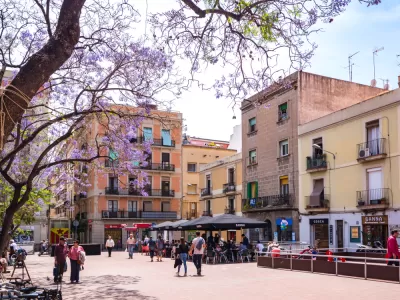
Writing in USA Today, Isabella Fertel fact-checks the conspiracy-minded claim that the concept of the 15-minute city is a global plot to create “climate change lockdowns.”
To be clear, the United Nations 2030 Agenda for Sustainable Development makes zero mentions of lockdowns or keeping people in their own neighborhoods. Rather, the 15-minute city is shorthand for the goal of making transit, jobs, healthcare, parks, and all the other amenities we come to expect from city life accessible to all residents within a 15-minute walk or bike ride.
Carlos Moreno, who coined the concept, says “The core of the ‘15-minute city’ is an open city, a human city, an interconnected city.” Moreno adds, “Of course, all citizens are free to go where they want. There are no constraints.” Dan Luscher, founder of the 15-Minute City Project, says the concept is about promoting, not limiting, mobility.
Read the full story: Fact check: False claim ‘15-minute cities’ are actually ‘climate lockdowns’


Planetizen’s Top Urban Planning Books of 2024
Top of mind in 2024 were the far-reaching impacts of climate displacement, zoning as a solution to the housing crisis, and the potential for safer roads and better public transit in American cities.
When Planning Issues Become ‘Culture Wars’
‘Commonsense’ urbanism projects are being painted by opponents as sinister plots to limit movement and erode property rights.

Ten Urban Success Stories From 2021
Still battling a global pandemic and its widespread economic and social effects, cities nevertheless made progress in some unexpected ways.

Planetizen Federal Action Tracker
A weekly monitor of how Trump’s orders and actions are impacting planners and planning in America.

‘Going backwards:’ Baltimore mayor, students rally against state's transit funding plan
Maryland's proposed six-year plan provides no funding for Baltimore’s BMORE bus program and reduces its road maintenance funding.

Detroit to transform waterfront with $2.2 billion investment
Developers will convert about 18 acres of unused parking lot space into civic spaces.

$2 trillion in economic growth may hide in ‘micropolitan communities’
Small cities hold 39% of America’s population, but receive only 10% of U.S. venture capital investment.

'I can't live in this:' Mississippi town besieged by power plant noise
A plant powering Elon Musk’s xAI data centers is subjecting Southaven, Mississippi residents to ceaseless noise.

Battered from federal attacks, Louisiana's offshore wind industry refuses to give up
State Representative Joe Orgeron expressed hope that the state could revitalize its wind industry once President Trump leaves office.

FREE Course: Walkable City 1: Why Walkability?
After describing his path towards focusing on walkability as the essence of good planning, Jeff Speck marches through his five principal reasons for making more walkable places.
Reinventing Malls: Planning Alchemy—Turning Gray Fields Into Gold
The course focuses on the opportunities and imperatives that shape reinvention of mall sites.

One Hundred Miles
County of Mendocino
planning NEXT
The Architects Foundation
University of Cincinnati Online
Montrose County
Northern Illinois Transit Authority (NITA)
The Pocatello Development Authority