Some state legislators are proposing action at the state level as counties block development using zoning and development requirements even as housing prices rise sharply in the region.


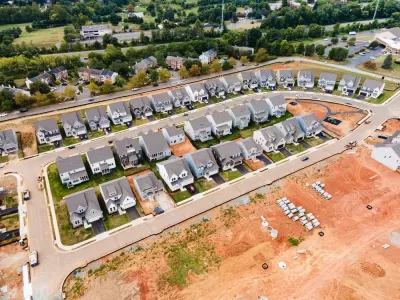
Writing in the Virginia Mercury, Wyatt Gordon explains how some Virginia counties are making it more difficult to build new housing, despite the recent spike in home prices and low supply.
While single-family zoning gets the most press for keeping housing costs high, Gordon points out that “Setback requirements, lot coverage guidelines, minimum lot sizes and even inclusionary zoning standards can all be manipulated to make new development nigh but impossible.”
Gordon explains a state rule that requires growing counties to allow ‘cluster subdivisions,’ a type of development that allows for denser housing types and requires the conservation of green space. To limit the impact of the rule, some counties are raising the conservation requirement, making development economically infeasible in many cases and preventing the growth of higher-density housing that could make homeownership accessible for more households. “With land a limited resource, each anti-density policy localities institute increases the amount of land needed to produce a single housing unit and thus raises the price on Virginians seeking long-term shelter.”
One state delegate with experience in land use law suggested that a statewide set of rules and toolkit could help promote more housing development and prevent communities from blocking new housing. No proposals currently in the state legislature address or limit local control over zoning, but HJ 507 “directs the Virginia Housing Commission to study how revisions to the state code could ‘streamline and enhance predictability in local development review processes and alleviate the effects of local policies or ordinances that contribute to increased housing costs and constrain the supply of affordable and workforce housing.’”
Read the full story: Why are Virginia counties regulating starter homes out of existence?


Poll: 2/3 of Virginians Don’t Trust Local Governments to Address Housing Crisis
Three-quarters of residents say the state needs to do more to address housing supply and affordability.

Judge Rules in Favor of Massachusetts TOD Law
The court rejected an argument that the MBTA Communities law, which requires zoning for multifamily housing, is an “unfunded mandate.”

California Gives 15 Cities ‘Final Warning’ to Submit Mandatory Housing Plans
Communities are required to produce housing elements that accommodate sufficient housing for all income levels.

Planetizen Federal Action Tracker
A weekly monitor of how Trump’s orders and actions are impacting planners and planning in America.

The state-sanctioned urbicide of Austin
People don’t kill cities. Freeways do.

Colorado’s Largest Data Center Could Rise Next to Homes — Without a Public Hearing
The proposed campus would consume 11 times the power of Denver International Airport; as it has across the country, opposition mounts.

Judges permit Denver to divert 77,000 acre feet from the Colorado River for reservoir expansion
Overuse and climate change have caused the Colorado River’s water levels to plummet.

Amtrak, CN end decades-long dispute with eight-year agreement
The new operating agreement establishes an updated framework for the companies to work together, including processes to resolve disputes.

Raised interest rates may kill financially vulnerable construction projects
The chief economist at ConstructConnect warns that if construction project owners are negatively impacted by the raised rates, it could result in delayed payments to contractors.

FREE Course: Walkable City 1: Why Walkability?
After describing his path towards focusing on walkability as the essence of good planning, Jeff Speck marches through his five principal reasons for making more walkable places.
Reinventing Malls: Planning Alchemy—Turning Gray Fields Into Gold
The course focuses on the opportunities and imperatives that shape reinvention of mall sites.

KFH Group Inc.
Greater Baltimore Committee
Eagle County Government
The Architects Foundation
University of Cincinnati Online
The Pocatello Development Authority
The Urban Renewal Agency of the City of Pocatello