Governor Kathy Hochul wants to build 800,000 new homes in New York in the next decade.


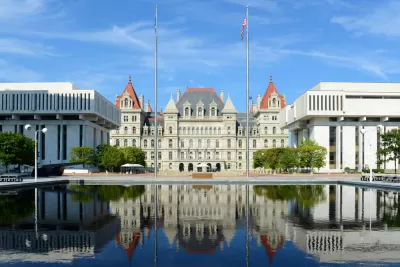
New York Governor Kathy Hochul took the occasion of the first State of the State address after narrowly winning election to the office in November to announce a statewide strategy designed to produce 800,000 new homes over the next decade.
A press release from the governor’s office describes the proposal, called the New York Housing Compact, as a “comprehensive, multi-pronged strategy,” which includes “local participation requirements and incentives to achieve housing growth in every community so that every part of the State is a partner in solving this urgent crisis.”
If that sounds like pro-development rhetoric of the YIMBY variety, you aren’t the only one to notice. An article by Henrey Grabar for Slate responded to the address with an article headlined “New York Has a YIMBY Governor.” Ross Barkan, writing for New York Magazine, notes that the proposals included in the State of the State address “would have been untenable for most politicians a decade ago.” Other publications, such as the New York Daily News and the Buffalo News, picked up on the implications of the proposal for the state’s suburban communities.
More specifically, Gov. Hochul’s proposed compact would require every town, city, and village in the state “to set a target number of new homes to create over a three-year period,” explains Denis Slattery for the New York Daily News. Yes, that means the status quo of exclusionary zoning is on notice. “The governor specifically called out suburban communities surrounding New York City for limiting building in recent decades and said in her address that the state is ready to step in,” adds Slattery.
Writing for the Buffalo News, Jonathan D. Epstein does the math to explain what the 1 percent increase in the housing stock of communities in upstate New York would look like.
Based on U.S. Census data, the mandate would mean four out of every five localities just need to permit 50 or fewer new housing units to meet the state-imposed target. And they will have flexibility on how they meet their goals, including redeveloping and repurposing underused office buildings or office parks, strip malls and industrial buildings, or offering incentives to encourage development of new apartment buildings.
And
For all of Erie County – which has 440,000 housing units, according to the U.S. Census Bureau – that means growth of 4,400 homes by 2026. In comparison, Erie County had 4,150 building permits for housing units during the three years from 2019 to 2021, according to federal data.
Writing for Slate, Grabar describes the New York Housing Compact as long overdue state action.
The Empire State is late to this party, though it’s not Hochul’s fault. New York has done virtually nothing to address its housing shortage over the past decade, even as California, Oregon, Washington, and Massachusetts—four other high-cost states—experiment with various ideas to override onerous local rules that restrict the supply of new homes.
Grabar also notes that some of the most notorious examples of housing discrimination from history played out in New York, including the events depicted in the HBO series Show Me a Hero and a book by the same name written by Lisa Belkin.


Lack of Multi-Family Zones Contributes to Nashville’s High Housing Costs, Study Says
Nashville and surrounding communities allow for a relatively small amount of multi-family housing, according to a new zoning atlas of Middle Tennessee. A regionally focused nonprofit is using the atlas to push for zoning reforms.

Montana Passes Sweeping Legislative Package to Rescind ‘California-Style-Zoning’
The Montana State Legislature recently approved a package of zoning reform bills modeled closely on bills approved in West Coast states, including the state of California, in recent years.

Planning in 2022: Year in Review
A review of the major themes, debates, and events of the year in planning that was 2022 (part one of two).

Planetizen Federal Action Tracker
A weekly monitor of how Trump’s orders and actions are impacting planners and planning in America.

The state-sanctioned urbicide of Austin
People don’t kill cities. Freeways do.

US to reduce Colorado River water deliveries to Mexico
A new Colorado Treaty amendment reduces Mexico’s Colorado River water allocation by 250,000 acre feet.

5 New England states march closer to 800 megawatt wind energy project
Securing federal approval for the project may be complicated under the Trump administration, which has historically been hostile towards domestic wind power.

Baltimore to break ground on $50 million Transit Priority Project
The project will bring faster bus trips, safer streets and better bike connections to Baltimore.

Airbnb launches $250 million 'last-dollar financing' housing accelerator, makes first investment in Austin
The company will put $6.4 million towards affordable housing development in Texas’ capital.

FREE Course: Walkable City 1: Why Walkability?
After describing his path towards focusing on walkability as the essence of good planning, Jeff Speck marches through his five principal reasons for making more walkable places.
Reinventing Malls: Planning Alchemy—Turning Gray Fields Into Gold
The course focuses on the opportunities and imperatives that shape reinvention of mall sites.

Eagle County Government
Harvard University Graduate School of Design
Nashville Planning Department
The Architects Foundation
University of Cincinnati Online
The Pocatello Development Authority
The Urban Renewal Agency of the City of Pocatello
Journal of the American Planning Association