The agency has selected three potential plans for building a light rail or bus rapid transit line that would serve Emory University and other major employment and commercial hubs.


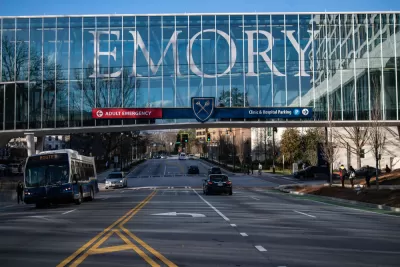
Atlanta-area residents will soon get a look at three proposed options for the Clifton Corridor transit line, a route originally proposed as light rail but which could be scaled back to a bus rapid transit (BRT) line.
According to John Ruch, writing in the Saporta Report, the line would run between Buckhead and either Avondale or Decatur, with stops such as Emory University along the way. After holding public meetings earlier this year, the Metropolitan Atlanta Rapid Transit Authority (MARTA) selected three of ten proposed alternatives for routes and modes. These will be presented to the public at meetings on November 15 and 17.
Planetizen first covered the Clifton Corridor in 2018, when details about MARTA’s plans for spending revenue from a new voter-approved tax were revealed. The area, a major job center, is not connected to the rest of the region by a major interstate or rail transit.
FULL STORY: MARTA to reveal three Clifton Corridor transit alternatives

MARTA To Add BRT Connection to Airport
A new rapid bus line in Atlanta will link residents to one of the nation’s busiest airports.
Atlanta Proposed Rail Line to Become Bus Rapid Transit
MARTA officials argue that bus rapid transit will be faster and more cost-effective than the originally proposed light rail option.
Atlanta One Step Closer to Bus Rapid Transit
The city’s transit agency says bus rapid transit will be cheaper and faster to build than light rail.

Planetizen Federal Action Tracker
A weekly monitor of how Trump’s orders and actions are impacting planners and planning in America.

The state-sanctioned urbicide of Austin
People don’t kill cities. Freeways do.

US to reduce Colorado River water deliveries to Mexico
A new Colorado Treaty amendment reduces Mexico’s Colorado River water allocation by 250,000 acre feet.

Airbnb launches $250 million 'last-dollar financing' housing accelerator, makes first investment in Austin
The company will put $6.4 million towards affordable housing development in Texas’ capital.

Guerilla urbanists are building DIY bus stop benches in Chicago
A before-and-after of one of the bus stops with a new bench. The new benches are not officially sanctioned or permitted, but the residents who placed them hope they will be the start of a network of DIY benches across the city.

Mamdani overhauls NYC's Vision Zero plan with 100 new policy goals
The overhaul aims to reduce traffic deaths and make streets safer for pedestrians, cyclists and drivers through lower speed limits, new safety infrastructure and more.

FREE Course: Walkable City 1: Why Walkability?
After describing his path towards focusing on walkability as the essence of good planning, Jeff Speck marches through his five principal reasons for making more walkable places.
Reinventing Malls: Planning Alchemy—Turning Gray Fields Into Gold
The course focuses on the opportunities and imperatives that shape reinvention of mall sites.

Eagle County Government
Harvard University Graduate School of Design
Nashville Planning Department
The Architects Foundation
University of Cincinnati Online
The Pocatello Development Authority
The Urban Renewal Agency of the City of Pocatello
Journal of the American Planning Association