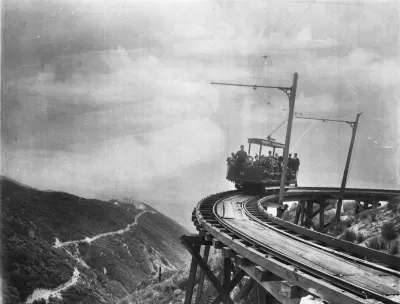
Close to one hundred years after the last funicular trains took tourists up to dizzying heights in the Angeles National Forest, a new shuttle service could bring the wilderness closer to more Los Angeles residents.


A new shuttle service could make the Angeles National Forest, a vast swath of wilderness that looms above hyper-urbanized Los Angeles County, accessible to more visitors. As Steve Scauzillo of the Los Angeles Daily News reports in an article republished in Mass Transit, the proposed Mount Wilson Express Shuttle, funded in part through efforts by U.S. Representative Judy Chu (D-Pasadena), will likely run on weekends and take passengers to the Mount Wilson Observatory, the Haramokngna American Indian Cultural Center at Red Box, Clear Creek Information Center, and trailheads at Eaton Saddle, Colby Canyon and Gould Mesa.
More than a century ago, the vertigo-inducing Mount Lowe Railway operated in the same area, using funicular trains to transport people from the valley floor to Echo Mountain. The new project faces a long planning, permitting, and public input process, as well as the question of how to fund the system’s future operations. Nature For All, the nonprofit working on the shuttle plan, is modeling their proposal on the shuttles currently running in Zion and Yosemite National Parks.
“Nature For All would like to add a shuttle service line that connects with the Azusa L Line station and travels up Highway 39, the main forest entrance route.” This would put the forest within reach of millions of transit-dependent Angelenos who see the mountains every day but, in many cases, never have the opportunity to visit.
Read the full story: CA: Group gets $1 million to build public shuttle from Pasadena into Angeles National Forest

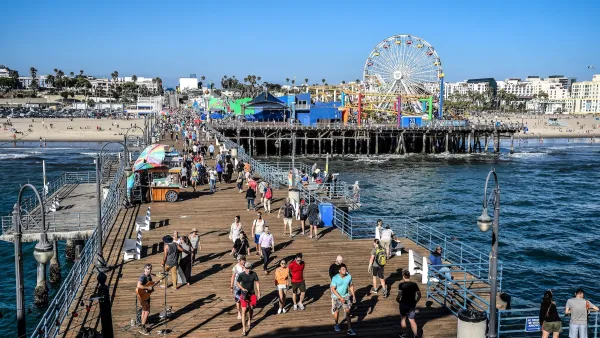
LA County's 'Beach Bus' offers $6 round-trip rides from inland LA to the beach
The annual summer service shuttles residents from eastside communities to Santa Monica.

California TOD Law Gives NIMBYs a new Weapon Against Bus Lanes
A new law that allows rezoning for higher density near transit lines is fueling opposition to a Burbank bus rapid transit line.
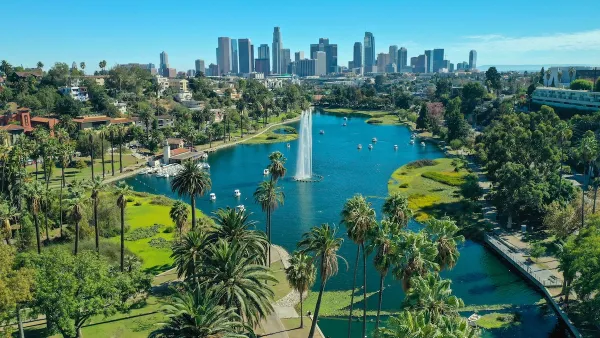
A Historic Investment in LA County’s Parks and Open Spaces
Los Angeles County has launched its largest-ever competitive grant program, investing $58 million to expand park access, enhance climate resilience, and support community-driven projects in the areas that need them most.

Planetizen Federal Action Tracker
A weekly monitor of how Trump’s orders and actions are impacting planners and planning in America.

The state-sanctioned urbicide of Austin
People don’t kill cities. Freeways do.

US to reduce Colorado River water deliveries to Mexico
A new Colorado Treaty amendment reduces Mexico’s Colorado River water allocation by 250,000 acre feet.

Nation's most wind-powered state turns to coal as data centers increase energy demand
For the first time in decades, Iowa has increased its generation of coal power.

NYC cools commuters with city's first rain garden above a bus stop
New York City officials say the plants in the rain garden can absorb 16 gallons of rainwater during heavy storms.

Brightline West’s future may rely on $6 billion federal loan
The company has until Nov. 2 to make a $400 million equity investment into its proposed high-speed rail line.

FREE Course: Walkable City 1: Why Walkability?
After describing his path towards focusing on walkability as the essence of good planning, Jeff Speck marches through his five principal reasons for making more walkable places.
Reinventing Malls: Planning Alchemy—Turning Gray Fields Into Gold
The course focuses on the opportunities and imperatives that shape reinvention of mall sites.

Greater Baltimore Committee
Eagle County Government
Harvard University Graduate School of Design
The Architects Foundation
University of Cincinnati Online
The Pocatello Development Authority
The Urban Renewal Agency of the City of Pocatello
Journal of the American Planning Association