Arizona state law requires Maricopa County to request approval from the state before it can send a transportation tax to the voters for approval.



“Gov. Doug Ducey shocked local leaders — many of them Republicans — when he vetoed a bill Wednesday that would have allowed Maricopa County to ask voters to extend a half-cent sales tax to fund major transportation projects for the next 25 years,” reports Jessica Boehm for Axios.
The Proposition 400 sales tax has been in place in Maricopa County since 1985, and was extended once in 2004. The transportation sales tax is set to expire in 2025. “Proposition 400 has provided funding for almost every major transportation project in metro Phoenix, including Loops 101, 202 and 303,” according to the article.
The Momentum Investment Plan, a long-term transportation plan approved in June 2021 with the Proposition 400 extension in mind, targeted more than 350 miles of new freeway and highway lanes, including 186 miles of new HOV lanes, 1,300 miles of new or improved of arterial roads, and about 12 miles of new light rail, 37 miles of bus rapid transit, and 7 miles of new streetcar, according to the article.
The plan, and Proposition 400, has the support of every mayor and tribal leader in Maricopa County, according to Boehm. Gov. Doug Ducey, however, vetoed the plan. In a letter explaining the decision, Ducey said: “now, with inflation higher than it has been in 40 years, is not the time to ask Arizona voters to tax themselves.”
FULL STORY: Why Arizona's governor vetoed Maricopa County's Prop 400 election

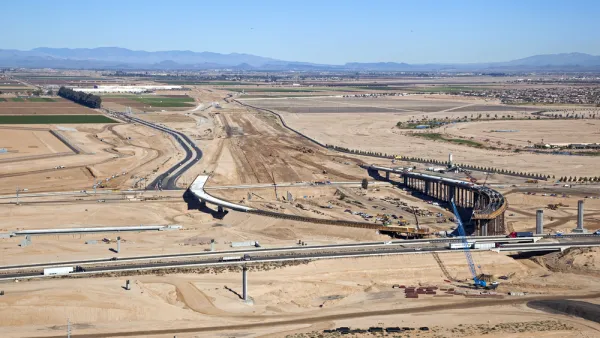
Massive Widening Planned for Interstate 10 in Maricopa County
The Arizona Department of Transportation has selected a developer for the Broadway Curve Improvement Project, which would widen Interstate 10, spanning multiple jurisdictions adjacent to Phoenix.
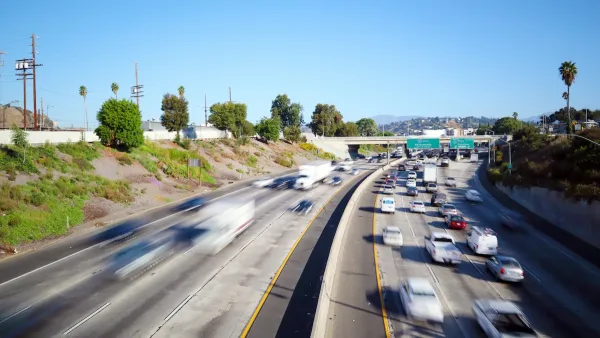
Opinion: LA Should Reject ‘Misguided’ Car-Centric Policies
Even as the city highlights clean energy and transportation for the 2028 Olympics, Metro and Caltrans move forward with plans to expand highways.
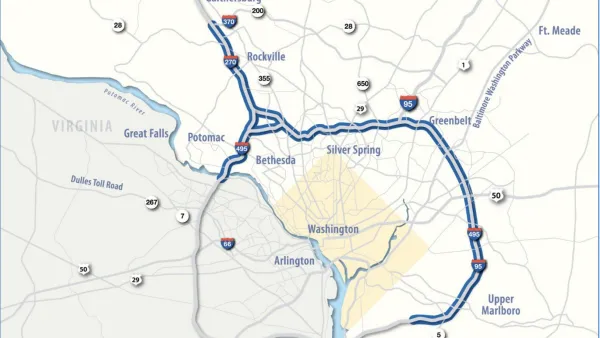
Maryland Highway Widening Plans Moving Forward Under New Governor
Maryland Governor Wes Moore is differentiating his new administration from his predecessor’s, but some projects, like the widening of federal highways in the Capital Beltway, stay the same.

Planetizen Federal Action Tracker
A weekly monitor of how Trump’s orders and actions are impacting planners and planning in America.

The state-sanctioned urbicide of Austin
People don’t kill cities. Freeways do.

US to reduce Colorado River water deliveries to Mexico
A new Colorado Treaty amendment reduces Mexico’s Colorado River water allocation by 250,000 acre feet.

Baltimore to break ground on $50 million Transit Priority Project
The project will bring faster bus trips, safer streets and better bike connections to Baltimore.

Airbnb launches $250 million 'last-dollar financing' housing accelerator, makes first investment in Austin
The company will put $6.4 million towards affordable housing development in Texas’ capital.

Guerilla urbanists are building DIY bus stop benches in Chicago
A before-and-after of one of the bus stops with a new bench. The new benches are not officially sanctioned or permitted, but the residents who placed them hope they will be the start of a network of DIY benches across the city.

FREE Course: Walkable City 1: Why Walkability?
After describing his path towards focusing on walkability as the essence of good planning, Jeff Speck marches through his five principal reasons for making more walkable places.
Reinventing Malls: Planning Alchemy—Turning Gray Fields Into Gold
The course focuses on the opportunities and imperatives that shape reinvention of mall sites.

Eagle County Government
Harvard University Graduate School of Design
Nashville Planning Department
The Architects Foundation
University of Cincinnati Online
The Pocatello Development Authority
The Urban Renewal Agency of the City of Pocatello
Journal of the American Planning Association