After a driver killed a cyclist on Griffith Park Drive in April, the city of Los Angeles is studying safety upgrades on streets in its famous park. The L.A. Times says the changes are part of a growing movement.


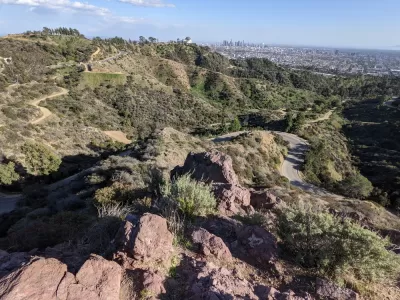
Los Angeles recently closed a road in Griffith Park to automobiles, according to an article by Jonah Valdez in the Los Angeles Times.
“The pilot program marks a major effort by Los Angeles — a place known as the capital of car culture — to reclaim some public roadways for bikes and pedestrians. The experiment comes amid a time of growing traffic deaths caused by cars on city streets,” writes Valdez.
Valdez also notes that the decision to close the section of Griffith Park Drive where it cuts through the heart of the park is the latest in a growing movement around the country: San Francisco and New York City recently closed roads through parks to automobile traffic. Looking a little further back, D.C. also made a similar change in Rock Creek Park in 2016.
There are few examples of streets being closed to automobile traffic in Los Angeles, as noted in the article, and drivers will notice the change. Commuters often use Griffith Park Drive through the park as a way to avoid traffic on State Highway 134 and Interstate 5.
The pilot closure is only one recommendation of several produced by a May 2022 safety study of Griffith Park roads.
“In addition to eliminating cut-through traffic, the study addresses recommendations to lower driving speeds and to improve bike and pedestrian infrastructure with upgrades such as protected bike lanes and raised crosswalks. Many of Griffith Park’s roads lack bike lanes, and some of those that do exist are obstructed by parked cars or have faded over time, consultants noted in a presentation of the study’s early findings,” writes Valdez.
While the article presents the change as part of potential “revolution” of street design, many cities have been rolling back traffic safety and outdoor recreation measures implemented during the pandemic.
FULL STORY: L.A. just banned cars from a major Griffith Park road. Is it beginning of road revolution?


'Transformative' pedestrian bridge planned for LA River in Glendale Narrows
A new bridge will link Griffith Park and the Glendale Narrows Riverwalk.
Los Angeles Approves Road Safety Measure
Voters expressed strong support for road safety improvements.
LA Metro Could Slash Open Streets Funding
Despite the program’s success across the region and rising production costs, Los Angeles-area events could receive less funding in the coming year.

The state-sanctioned urbicide of Austin
People don’t kill cities. Freeways do.

US to reduce Colorado River water deliveries to Mexico
A new Colorado Treaty amendment reduces Mexico’s Colorado River water allocation by 250,000 acre feet.

New Jersey’s second-largest city bans standalone data centers
Jersey City will continue to allow co-location facilities, such as those meant for research institutions that store their own data.

Amtrak not solely to blame for New Jersey commuter rail's unreliability, report finds
A new study from the Garden State Initiative found that NJ Transit’s budget grew 20% across a 4 year period, but reliability declined significantly over the same period.

EPA erases limits on planet-warming pollution from power plants
Under Monday’s plan, power plants would still have some limits on how much mercury, arsenic and other contaminants they can emit.

Phoenix announces new on-demand transit service, more frequent RAPID buses
Both new services will launch in October, and are part of Phoenix's Project Effective Access Solutions for Easing Congestion.

FREE Course: Walkable City 1: Why Walkability?
After describing his path towards focusing on walkability as the essence of good planning, Jeff Speck marches through his five principal reasons for making more walkable places.
Reinventing Malls: Planning Alchemy—Turning Gray Fields Into Gold
The course focuses on the opportunities and imperatives that shape reinvention of mall sites.

Eagle County Government
Harvard University Graduate School of Design
Nashville Planning Department
The Architects Foundation
University of Cincinnati Online
The Pocatello Development Authority
The Urban Renewal Agency of the City of Pocatello
Journal of the American Planning Association