The renaming of Los Angeles's Staples Center to Crypto.com Arena may seem like an innocuous promotional gambit. But it means that cities are now in competition with a seductive virtual world.



"However weird cryptocurrency may seem, what lies ahead promises to be even weirder. The Staples Center deal comes only a few weeks after another California institution, Facebook, announced its intention to create the 'metaverse.” Just as cryptocurrency is money that takes place in cyberspace, the metaverse (Capital M? Lowercase m? Who knows …) is, basically, life that takes place in cyberspace. In Mark Zuckerberg’s imagination, every human will be able to work, socialize, and play in the offices, conference rooms, concert halls, and amusement parks of the metaverse."
"The trouble is, the more we entertain those fantasies, and the more time, energy, ingenuity, and capital (crypto and otherwise) go into creating them, the less time, energy, ingenuity, and capital we will have to invest in the real world. The spectacle of human suffering that the privileged world only barely notices today will become just another reason not to take off the VR headset. The promise of building a new world—especially of the type that thoughtful planners, architects, and engineers might envision—will give way to simulacra constrained only by screen resolutions and processing power."
Read the full story: The Metaverse Lands in Downtown Los Angeles
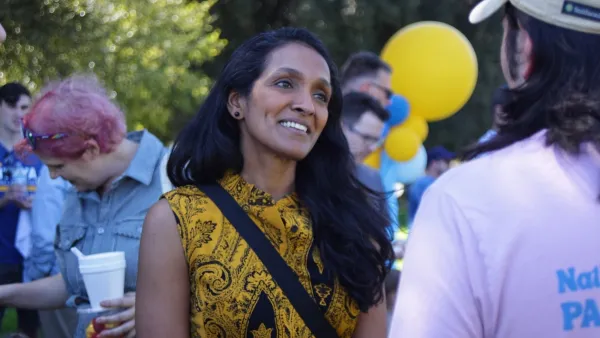
What could the future of LA transit look like under Raman?
The mayor-elect views broken sidewalks and potholes as crises that can be fixed with better governance.

Los Angeles just elected an urban planner as its mayor
Transportation analysts are optimistic that Raman will be more aggressive in addressing transit issues than Bass.
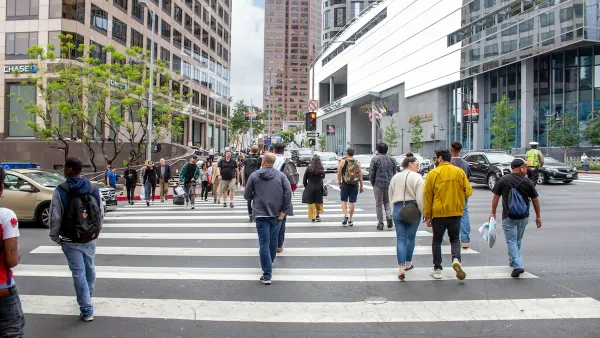
LA residents may be allowed to paint their own crosswalks
Councilwoman Katy Yaroslavsky put out a motion instructing the Los Angeles Department of Public Transportation to study the feasibility of allowing volunteers to paint crosswalks.

Planetizen Federal Action Tracker
A weekly monitor of how Trump’s orders and actions are impacting planners and planning in America.

Eastern Nebraska is running out of electricity
Data centers and electrification are straining eastern Nebraska’s grid, throttling economic development.

Study reveals best places in the U.S. for cycling, walking
New research from Streetlight Data examines bicycle and pedestrian miles per capita in the 100 largest U.S. cities by population.

Next-generation nuclear reactors are coming to Texas
The reactors will not require towering containment structures thanks to new safety features.

California distributes $1.3 billion to prevent transit service cuts, bolster projects
Twenty-eight projects across California received a portion of the funding.

Pennsylvania Democrats have 15 affordability, clean energy bills for flipped state Senate
Bills in consideration include a bill supporting geothermal energy and a bill supporting solar on warehouses.

FREE Course: Walkable City 1: Why Walkability?
After describing his path towards focusing on walkability as the essence of good planning, Jeff Speck marches through his five principal reasons for making more walkable places.
Reinventing Malls: Planning Alchemy—Turning Gray Fields Into Gold
The course focuses on the opportunities and imperatives that shape reinvention of mall sites.

City of Charlotte
City of Rosemead
Rutgers University, Edward J. Bloustein School of Planning and Public Policy
University of Michigan School for Environment and Sustainability (SEAS)
Hunter College, City University of New York (CUNY)
The Architects Foundation
City of Cambridge
The Pocatello Development Authority
The Urban Renewal Agency of the City of Pocatello