A potentially watershed vote in the German capital.


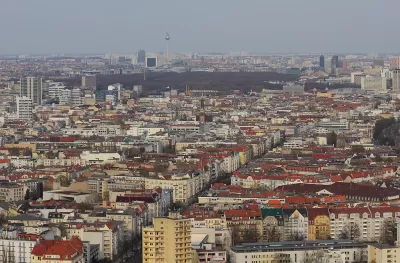
Berlin voters last weekend approved a nonbinding referendum that urges the city to buy hundreds of thousands of apartments from large real estate companies—a massive response to the financialization of the housing market that could inspire similar responses around the continent and perhaps in the United States.
"On Sunday, voters in the German capital backed a nonbinding referendum that called on the local government to buy hundreds of thousands of housing units from large property companies in the latest bid to control Berlin’s spiraling rent," reports Adam Taylor.
"An estimated 240,000 apartments, about 10 percent of the city’s housing stock, would end up in public hands if the radical proposal is carried out," adds Taylor.
The referendum received 56 percent of the vote, sending a strong message about how the city's residents think about the state of the housing market. Still, the potential of the vote to achieve change is still largely speculative. "The referendum has no legal power," for example, and a previous attempt to counter rising rent in Berlin—by capping housing prices—was overturned by Germany’s top court in April.
If the referendum produces the results sought by voters, "this unorthodox approach to municipal housing could reverberate far outside the German capital," according to sources cited by Taylor.
Alexander Vasudevan, an associate professor in human geography at the University of Oxford, wrote for The Guardian earlier this week that the vote could be a catalyst for municipal housing movements all over Europe. As noted by Taylor, rent is lower in Berlin than many other major cities around the world. "Renting a two-bedroom apartment in Berlin cost less than a third of what a similar apartment in Hong Kong or San Francisco would cost, Deutsche Bank has estimated, and half of a similar apartment in Paris or London."
Still, rents are rising in Berlin, threatening the quality of life benefits of accessible housing in Berlin, and some of the primary appeal of the city to many residents.
"In a city where roughly 85 percent of residents rent rather than own, the rental market has been squeezed the hardest, with rents increasing by 42 percent over the past five years — the most of any German city, Berliner Zeitung reported this year."
The news follows less than a month after several large cities in The Netherlands expressed the desire to take advantage of recent legal changes to crackdown on large private real estate investors.
FULL STORY: Berlin voters asked the city to tackle rising rents. The plan is a long-shot, but the message is powerful.

Fast-Rising Rents: Cause or Effect of Institutional Real Estate Investors?
More media attention for the growing influence of large, institutional investors on the housing market.

U.S. Housing Prices Continue Record-Breaking Pace
July marked four straight months of record-breaking increases for housing prices nationwide, according to the latest housing market data.

Tight For-Sale Market Leads to Record Price Spikes in the Rental Market
A supply-demand imbalance in the for-sale housing market will eventually spill into the rental market.

The state-sanctioned urbicide of Austin
People don’t kill cities. Freeways do.

US to reduce Colorado River water deliveries to Mexico
A new Colorado Treaty amendment reduces Mexico’s Colorado River water allocation by 250,000 acre feet.

New Jersey’s second-largest city bans standalone data centers
Jersey City will continue to allow co-location facilities, such as those meant for research institutions that store their own data.

Amtrak not solely to blame for New Jersey commuter rail's unreliability, report finds
A new study from the Garden State Initiative found that NJ Transit’s budget grew 20% across a 4 year period, but reliability declined significantly over the same period.

EPA erases limits on planet-warming pollution from power plants
Under Monday’s plan, power plants would still have some limits on how much mercury, arsenic and other contaminants they can emit.

Phoenix announces new on-demand transit service, more frequent RAPID buses
Both new services will launch in October, and are part of Phoenix's Project Effective Access Solutions for Easing Congestion.

FREE Course: Walkable City 1: Why Walkability?
After describing his path towards focusing on walkability as the essence of good planning, Jeff Speck marches through his five principal reasons for making more walkable places.
Reinventing Malls: Planning Alchemy—Turning Gray Fields Into Gold
The course focuses on the opportunities and imperatives that shape reinvention of mall sites.


Eagle County Government
Harvard University Graduate School of Design
Nashville Planning Department
The Architects Foundation
University of Cincinnati Online
The Pocatello Development Authority
The Urban Renewal Agency of the City of Pocatello
Journal of the American Planning Association