The spike in Covid-19 caused by the highly contagious Delta Variant is slowing the economic recovery in numerous sectors of the economy—case in point the construction industry.


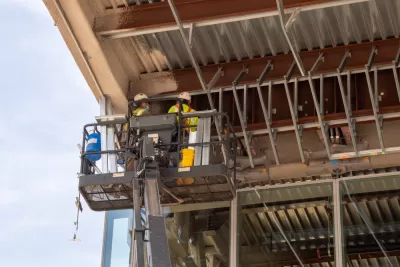
"National nonresidential construction spending expanded 0.1% in July, a decrease of 4.2% from last year at this time, according to an Associated Builders and Contractors analysis of data published Sept. 1 by the U.S. Census Bureau," reports Jennifer Goodman.
A press release from the Associated Builders and Contractors (ABC) elaborated on the bad news with a soundbite from ABC Chief Economist Anirban Basu, who says that the numbers are "meaningfully worse than they appear."
"When adjusting for inflation, the volume of construction services delivered by the U.S. commercial contractors actually declined in July," explains Goodman.
ABC blames the construction slowdown on higher materials prices and worsening skills shortages.
Gooodman provides additional details from the analysis, such as the trend having a bigger impact on public construction spending compared to private. The sectors with the largest declines were 1) public safety (-38.5%), lodging (-30%), and conservation and development (-21.5%).
Read the full story: Delta variant 'significantly' slowing construction recovery, economist says
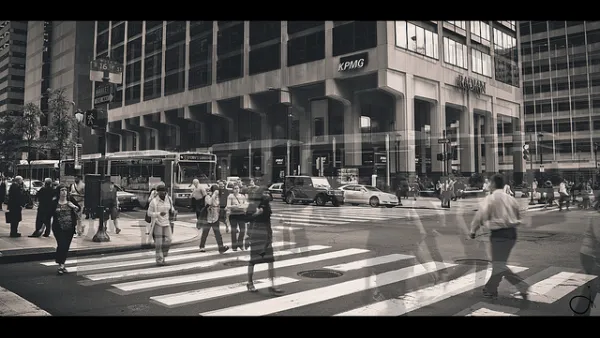
The Future of Downtowns Still Hangs in the Balance
Center City in Philadelphia offers a case study for one of the largest and potentially most consequential contingencies of the pandemic: What happens to downtowns is most workers never come back to the office?
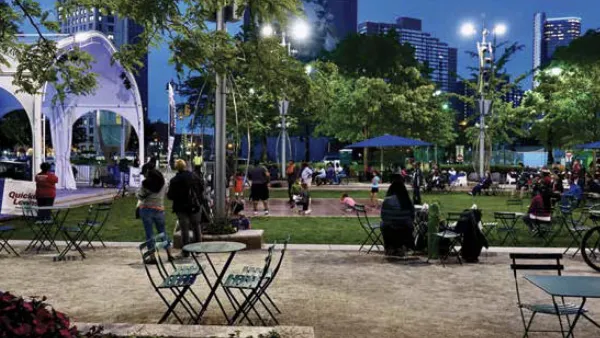
Detroit as a Model for 'Building Back Better'
Cities have more experience, and examples, than they might realize when it comes to reinventing systems of investment and governance to recover from the economic ravages of the COVID-19 pandemic.
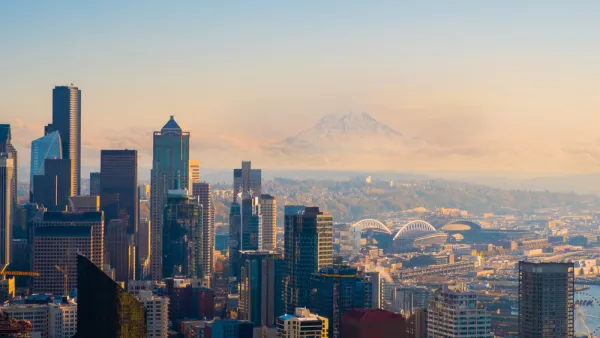
Office Demand in Seattle Suddenly Back and Bigger Than Ever
The fortunes of commercial real estate in Seattle have completely reversed since February, according to a new analysis.

Planetizen Federal Action Tracker
A weekly monitor of how Trump’s orders and actions are impacting planners and planning in America.

California plans to bury El Niño’s downpour
If the state plays its cards right, it may be able to store a billion acre-feet of El Niño’s water in aquifers.

Desperate measures: Advocates weigh draining Lake Powell to fill Colorado River
Draining the reservoir could reduce evaporation losses by a couple hundred thousand acre-feet.

Mamdani’s pied-à-terre tax survives legal challenge
A panel of judges found that the plaintiffs failed to demonstrate injury as a result of New York City's implementation of the tax.

Eastern Nebraska is running out of electricity
Data centers and electrification are straining eastern Nebraska’s grid, throttling economic development.

Seattle passes record-breaking transit services expansion
Proposition 1 will double the city’s transit tax to add 95,000 more bus trips and preserve 180,000 bus trips annually.

FREE Course: Walkable City 1: Why Walkability?
After describing his path towards focusing on walkability as the essence of good planning, Jeff Speck marches through his five principal reasons for making more walkable places.
Reinventing Malls: Planning Alchemy—Turning Gray Fields Into Gold
The course focuses on the opportunities and imperatives that shape reinvention of mall sites.

City of Rosemead
Rutgers University, Edward J. Bloustein School of Planning and Public Policy
One Hundred Miles
University of Michigan School for Environment and Sustainability (SEAS)
Hunter College, City University of New York (CUNY)
The Architects Foundation
City of Cambridge
Montrose County
The Pocatello Development Authority