Analysts from Goldman Sachs predict a wave of evictions as eviction moratoriums end with millions of households still behind on rent.


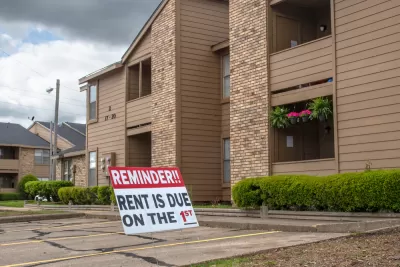
An analysis from Goldman Sachs Group Inc. predicts roughly 750,000 evictions as eviction bans around the country come to an end, reports Patrick Clark. "Currently, as many as 3.5 million households are behind on rent, with landlords owed as much as $17 billion, the analysts estimated in an Aug. 29 note."
While Congress has authorized close to $47 billion in rental assistance, funds have been slow to reach tenants or landlords. "Meanwhile, shortages of for-sale and rental housing are freeing landlords to rapidly increase rents as properties become vacant."
While "[a] surge in evictions would create new inventory of available rental housing, partially offsetting rapidly rising housing costs," it could "also slow job growth and household consumption." Meanwhile, "the implications for public health and Covid-19 infections are probably more severe, the analysts wrote."
Read the full story: Goldman Sees 750,000 Evictions in U.S. as Bans Come to an End
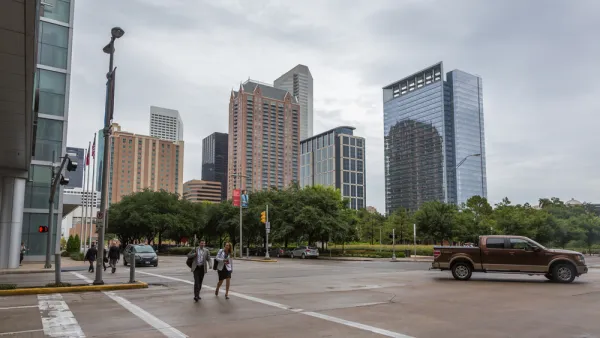
As Rental Assistance Ends, Houston Sees Eviction Filings Rise
More Houston households face evictions as landlords seek to recover back rent accrued during the last two years of the pandemic.
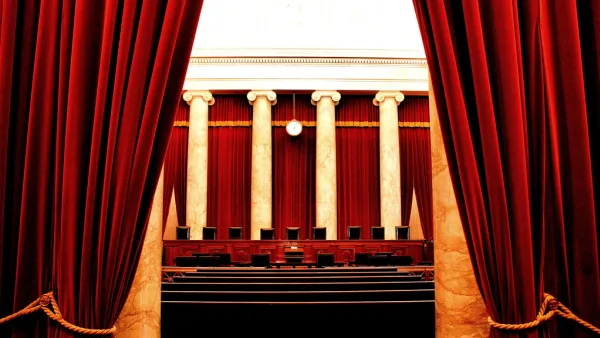
Supreme Court Strikes Down Federal Eviction Moratorium
The majority opinion claims the CDC overstepped its authority and calls for congressional approval of any further eviction moratoriums.
Biden Administration Extends Eviction Moratorium, Implements Stronger Eviction Protections
The Biden administration is promising a "whole-of-government" approach to prevent an impending wave of displacement and effectively distribute rental assistance.

Planetizen Federal Action Tracker
A weekly monitor of how Trump’s orders and actions are impacting planners and planning in America.

California plans to bury El Niño’s downpour
If the state plays its cards right, it may be able to store a billion acre-feet of El Niño’s water in aquifers.

Desperate measures: Advocates weigh draining Lake Powell to fill Colorado River
Draining the reservoir could reduce evaporation losses by a couple hundred thousand acre-feet.

Mamdani’s pied-à-terre tax survives legal challenge
A panel of judges found that the plaintiffs failed to demonstrate injury as a result of New York City's implementation of the tax.

Eastern Nebraska is running out of electricity
Data centers and electrification are straining eastern Nebraska’s grid, throttling economic development.

Seattle passes record-breaking transit services expansion
Proposition 1 will double the city’s transit tax to add 95,000 more bus trips and preserve 180,000 bus trips annually.

FREE Course: Walkable City 1: Why Walkability?
After describing his path towards focusing on walkability as the essence of good planning, Jeff Speck marches through his five principal reasons for making more walkable places.
Reinventing Malls: Planning Alchemy—Turning Gray Fields Into Gold
The course focuses on the opportunities and imperatives that shape reinvention of mall sites.

City of Rosemead
Rutgers University, Edward J. Bloustein School of Planning and Public Policy
One Hundred Miles
University of Michigan School for Environment and Sustainability (SEAS)
Hunter College, City University of New York (CUNY)
The Architects Foundation
City of Cambridge
Montrose County
The Pocatello Development Authority