Using joint power authorities, local governments can purchase luxury buildings, avoid property taxes, and offer lower rents for qualifying tenants.



In response to the ongoing housing affordability crisis, "some California government agencies are purchasing buildings, usually luxury ones, and doing the opposite of most real estate buyers. They’re lowering the rent," reports Andrew Khouri. "The programs are geared toward middle-income workers — including police officers, teachers and nurses — who make too much to qualify for most traditional subsidized housing but still struggle to afford a place near their work, according to government authorities and the private partners involved."
The programs work through "a unique financial model that involves local property tax subsidies" using government agencies known as joint powers authorities. "The most active authorities purchasing buildings are the California Statewide Communities Development Authority, or CSCDA, and the California Community Housing Agency, or CalCHA, which launched the first program in 2019." As government entities, the agencies don't pay property taxes, allowing them to charge lower rent to tenants. In places with such programs in place, "building-wide rent declines have averaged about 10% from what the previous owner charged, with greater decreases seen for the lowest income units."
"Joint powers authorities, which issue and manage bonds on behalf of local governments that join as members, help fund the middle-income programs. They issue bonds and use the proceeds to purchase a property, as well as pay the private companies that arrange the financing and manage the buildings."
But some cities are reluctant to start similar programs. "The Los Angeles City Council is awaiting a staff report on the possibility of joining. In Northern California, the San Jose City Council declined to participate after city staff concluded 'the risks and costs of joining ... outweigh the potential benefits.'"
Meanwhile, "cheaper rent can be found in many of the cities where the programs operate, raising scrutiny of the affordability the program administrators are marketing." An analysis by the California Housing Partnership "found that the new rent, even when reduced, was higher than the citywide average for an apartment with the same number of bedrooms." While the concept is creative, says Jacky Morales-Ferrand, director of San Jose's housing department, "we want to make sure there is significant public benefit when we forgo property tax."
Read the full story: Buy a luxury building, then lower the rent: A housing fix for California’s middle class?

New Washington State Law Lets Cities Give Social Housing Developers City-owned Land
In its current form, HB 1687, which authorizes local governments to assist social housing agencies with land or other resources, only applies to Seattle.
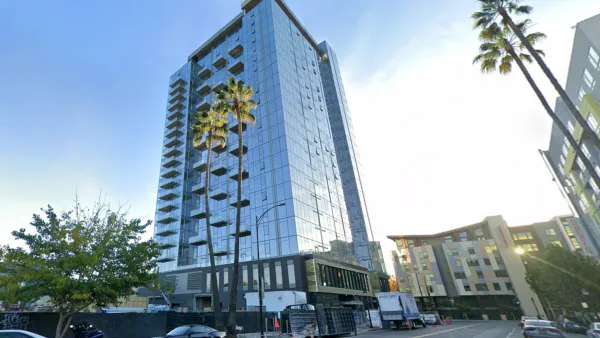
San Jose to Lease Units in Downtown High-rise for Affordable Housing
An innovative pilot program subsidizes rent in a market-rate building for middle-income residents.
Maine Approves Rent Relief Program
Legislators hope the assistance program will help struggling low-income households avoid eviction.

Planetizen Federal Action Tracker
A weekly monitor of how Trump’s orders and actions are impacting planners and planning in America.

Amtrak, CN end decades-long dispute with eight-year agreement
The new operating agreement establishes an updated framework for the companies to work together, including processes to resolve disputes.

Judges permit Denver to divert 77,000 acre feet from the Colorado River for reservoir expansion
Overuse and climate change have caused the Colorado River’s water levels to plummet.

Boston has spent millions making the Green Line more accessible — and there’s no end in sight
While the city has invested millions into expanding and adding platforms to the Green Line to make it more accessible, new train cars set to arrive next year will be too tall for disabled passengers to board without raising the current platforms.

Idaho may see an 18% drop in federal surface transit funding — the largest estimated cut in the US
Transit systems in rural communities are much more reliant on federal funding to provide their services.

How ‘post-disaster gentrification’ alters neighborhoods after natural calamities
After hurricanes, fires or other calamities, the original residents of a community are often replaced by younger, wealthier residents.

FREE Course: Walkable City 1: Why Walkability?
After describing his path towards focusing on walkability as the essence of good planning, Jeff Speck marches through his five principal reasons for making more walkable places.
Reinventing Malls: Planning Alchemy—Turning Gray Fields Into Gold
The course focuses on the opportunities and imperatives that shape reinvention of mall sites.

City of Wisconsin Rapids
Harvard University Graduate School of Design
KFH Group Inc.
The Architects Foundation
University of Cincinnati Online
The Pocatello Development Authority
The Urban Renewal Agency of the City of Pocatello