While the Golden State has awarded $800 million in funds for 'Project Roomkey,' a bill passed by the New York State Senate languishes in the governor's office.



Martin Z. Braun reports on what some critics call New York's failure to seize the "once-in-a-generation opportunity to quickly expand affordable housing" afforded by the drop in hotel occupancy during the pandemic. "New York is proposing to spend too little, and at too slow a pace" to make a significant impact.
A bill approved by state lawmakers in June, known as the "Housing Our Neighbors with Dignity Act" has yet to be signed by Governor Cuomo. Meanwhile, the bill's language "doesn’t override local zoning rules that constrain conversions in hotel-rich neighborhoods like the Garment District and Long Island City" and only allocates $100 million to the program, "a compromise sum which advocates say is not enough to capitalize on the scale of opportunity." "California, by contrast, has already awarded $800 million for local governments to purchase hotels and motels and convert them into permanent housing for people at risk of or experiencing homelessness."
At the same time, "the window for taking any action may be closing" as hotel guests return and hotel owners are less motivated to sell their assets at affordable prices for non-profit housing developers. "Besides the higher hotel acquisition prices, there’s a provision in the New York bill that would require converted hotel units to have kitchenettes and private bathrooms, which would raise costs further. And it doesn’t ease zoning rules on hotel conversions in manufacturing districts, where about 160 of the city’s 720 hotels are located." Developers, says Meghan Altidor, a partner in the law firm Nixon Peabody LLP’s affordable housing and real estate practice, are "feeling as if there needs to be a funding source for acquiring the hotels and converting them into affordable housing. That seems to be the biggest missing piece."
Read the full story: New York May Miss the Window to Convert Hotels to Affordable Housing

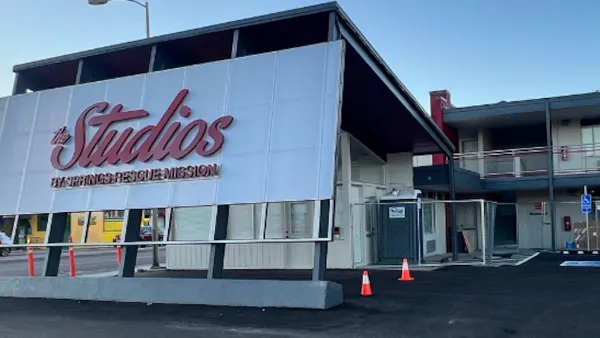
Colorado Springs Motel Converted to Supportive Housing
A vacant motel now offers 12 supportive housing units for formerly homeless women.

Orange County Motel Converted to Supportive Housing
The renovated building offers 57 housing units and supportive services to people formerly experiencing homelessness.

The ‘Meanest Cities’ in America
A list dubbed the ‘Dirty Dozen’ shames the cities where unhoused people face the most harassment and least support from authorities.

Planetizen Federal Action Tracker
A weekly monitor of how Trump’s orders and actions are impacting planners and planning in America.

The state-sanctioned urbicide of Austin
People don’t kill cities. Freeways do.

US to reduce Colorado River water deliveries to Mexico
A new Colorado Treaty amendment reduces Mexico’s Colorado River water allocation by 250,000 acre feet.

Nation's most wind-powered state turns to coal as data centers increase energy demand
For the first time in decades, Iowa has increased its generation of coal power.

NYC cools commuters with city's first rain garden above a bus stop
New York City officials say the plants in the rain garden can absorb 16 gallons of rainwater during heavy storms.

Brightline West’s future may rely on $6 billion federal loan
The company has until Nov. 2 to make a $400 million equity investment into its proposed high-speed rail line.

FREE Course: Walkable City 1: Why Walkability?
After describing his path towards focusing on walkability as the essence of good planning, Jeff Speck marches through his five principal reasons for making more walkable places.
Reinventing Malls: Planning Alchemy—Turning Gray Fields Into Gold
The course focuses on the opportunities and imperatives that shape reinvention of mall sites.

Greater Baltimore Committee
Eagle County Government
Harvard University Graduate School of Design
The Architects Foundation
University of Cincinnati Online
The Pocatello Development Authority
The Urban Renewal Agency of the City of Pocatello
Journal of the American Planning Association