New York's busy airspace can be an inescapable nightmare for residents who experience noise pollution on a daily basis.


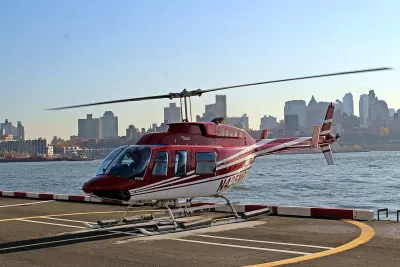
Concerned about the negative impacts of the noise and pollution caused by helicopter travel in and around New York City, a Brooklyn council member is demanding an investigation into the pros and cons of allowing so much helicopter traffic in the city's airspace. "Council Member Brad Lander put in a preliminary legislative request for such a "'cost-benefit' study after the legislature’s Economic Development Committee took up a bill this week to consider limiting helicopter companies’ use of city-owned heliports to slightly lower-noise vehicles." Gersh Kuntzman reports that according to Landers, the city is putting the interests of "tourists and well-heeled travelers" ahead of residents who deal with the noise on a daily basis.
At a recent hearing, the Economic Development Committee stated that the helicopter industry offers meager revenue for the city, providing only "a few dozen jobs and $2- to $3 million per year in revenue." Council Member Lander contends that "the quite significant human harm of helicopter noise and pollution has not been calculated." Lander suggests a "misery index" to gauge the amount of disruption and distress faced by New Yorkers due to noise and pollution. According to the city's 311 logs, "the number of complaints about tourist and commuter helicopters rose nearly 270 percent, from 840 complaints in 2017 to 3,094 complaints in 2019."
Read the full story: Lander: City Must Study Whether the ‘Benefit’ of Helicopters Covers Their Egregious Health Costs

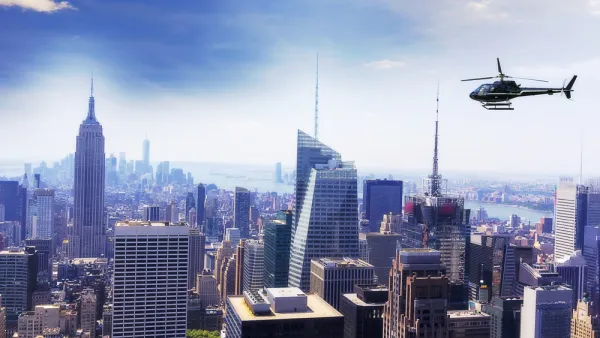
Helicopter Noise Complaints Surge in New York
Residents argue the city and state must do more to regulate the hundreds of flights that criss-cross the area on a daily basis.
Using Tech to Control Noise Pollution
Several cities are piloting programs that use machine learning to identify and understand urban noise patterns and enforce noise ordinances.
Learning About the City by Running for Office
When you are trying to get people's attention, a city feels very different.

Planetizen Federal Action Tracker
A weekly monitor of how Trump’s orders and actions are impacting planners and planning in America.

The state-sanctioned urbicide of Austin
People don’t kill cities. Freeways do.

Colorado’s Largest Data Center Could Rise Next to Homes — Without a Public Hearing
The proposed campus would consume 11 times the power of Denver International Airport; as it has across the country, opposition mounts.

Judges permit Denver to divert 77,000 acre feet from the Colorado River for reservoir expansion
Overuse and climate change have caused the Colorado River’s water levels to plummet.

Amtrak, CN end decades-long dispute with eight-year agreement
The new operating agreement establishes an updated framework for the companies to work together, including processes to resolve disputes.
Raised interest rates may kill financially vulnerable construction projects
The chief economist at ConstructConnect warns that if construction project owners are negatively impacted by the raised rates, it could result in delayed payments to contractors.

FREE Course: Walkable City 1: Why Walkability?
After describing his path towards focusing on walkability as the essence of good planning, Jeff Speck marches through his five principal reasons for making more walkable places.
Reinventing Malls: Planning Alchemy—Turning Gray Fields Into Gold
The course focuses on the opportunities and imperatives that shape reinvention of mall sites.

KFH Group Inc.
Greater Baltimore Committee
Eagle County Government
The Architects Foundation
University of Cincinnati Online
The Pocatello Development Authority
The Urban Renewal Agency of the City of Pocatello