Amtrak officials say they need $4.9 billion in funding to prevent service and job losses.


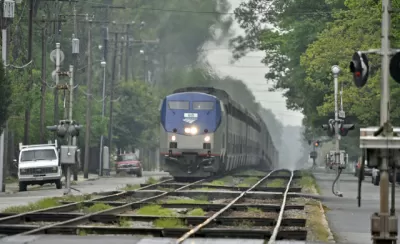
David Shepardson reports for Reuters on the financial state of Amtrak, where officials are asking Congress for $4.9 billion in additional funding to make ends meet during the pandemic.
Amtrak Chief Executive William Flynn went before Congress earlier this month to to request the additional funding, warning that the intercity rail system could face service and job cuts without the funding. Amtrak typically receives $2 billion in funding support from the U.S. government, according to Shepardson.
An earlier article by Pranshu Verma, written for The New York Times, also digs deeper into the pandemic context for Amtrak, comparing it to the U.S. Postal Service as a service provided by the government.
"For Amtrak, the coronavirus pandemic has not only slashed ridership and any chances of breaking even, it has also forced its leaders to face an existential choice: act like a for-profit airline or a government-subsidized entity," writes Verma.
Verma also provides more details on the specifics of the financial challenges facing Amtrak since the outbreak of the novel coronavirus earlier this year: "Since March, ridership on the national rail agency has fallen by 95 percent and projected revenue for 2021 has declined by 50 percent."
As noted in booth articles, Congress has already sent $1 billion in emergency funds to Amtrak, but Amtrak has been asking for more assistance since May.
FULL STORY: Amtrak CEO says passenger railroad needs up to $4.9 billion in U.S. funding

Amtrak Planning Extensive Service Cuts
The disappointment of 2020 has hit Amtrak particularly hard.
How $30 Billion in Stimulus Funding Would Change the Equation for Transit Agencies
The funding in the draft stimulus funding package making its way through Congress falls short of the total requested by the American Public Transportation Association, but would go a long way to helping transit agencies weather the pandemic.
Falling Transit Ridership 'Disastrous' for Greenhouse Gas Reductions
With ridership at record lows and agencies struggling to stay afloat, public transit around the world will need robust investment to recover after the pandemic.

The state-sanctioned urbicide of Austin
People don’t kill cities. Freeways do.

US to reduce Colorado River water deliveries to Mexico
A new Colorado Treaty amendment reduces Mexico’s Colorado River water allocation by 250,000 acre feet.

New Jersey’s second-largest city bans standalone data centers
Jersey City will continue to allow co-location facilities, such as those meant for research institutions that store their own data.

Amtrak not solely to blame for New Jersey commuter rail's unreliability, report finds
A new study from the Garden State Initiative found that NJ Transit’s budget grew 20% across a 4 year period, but reliability declined significantly over the same period.

EPA erases limits on planet-warming pollution from power plants
Under Monday’s plan, power plants would still have some limits on how much mercury, arsenic and other contaminants they can emit.

Phoenix announces new on-demand transit service, more frequent RAPID buses
Both new services will launch in October, and are part of Phoenix's Project Effective Access Solutions for Easing Congestion.

FREE Course: Walkable City 1: Why Walkability?
After describing his path towards focusing on walkability as the essence of good planning, Jeff Speck marches through his five principal reasons for making more walkable places.
Reinventing Malls: Planning Alchemy—Turning Gray Fields Into Gold
The course focuses on the opportunities and imperatives that shape reinvention of mall sites.

Eagle County Government
Harvard University Graduate School of Design
Nashville Planning Department
The Architects Foundation
University of Cincinnati Online
The Pocatello Development Authority
The Urban Renewal Agency of the City of Pocatello
Journal of the American Planning Association