Plans to expand and upgrade Union Station in D.C. might have gone overboard with parking, according to the public comments on the project's draft Environmental Impact Statement.


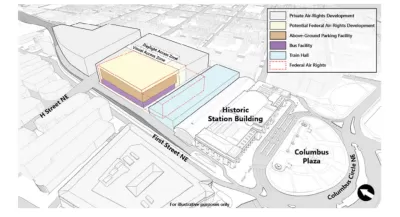
Plans to give Union Station in Washington, D.C. a multi-billion dollar upgrade are caught up in a controversy over parking, according to an article by Alex Holt.
"A growing number of organizations, neighborhood groups, and public officials have expressed concerns over just how many parking spaces the station needs," reports Holt. "Many leaders see a reduction in parking as leaning into a transportation future that is less car-dependent."
The parking criticisms have emerged during extended public comment for the project's draft Environmental Impact Statement, completed by the Federal Railroad Administration (FRA), which is leading planning of the project.
In a year, 37 million people use Union Station to access Amtrak, Metrorail, Maryland Area Regional Commuter (MARC), and Virginia Railway Express (VRE) rail systems, as well as intercity and local bus services, the DC Streetcar, and for-hire vehicles. The proposed upgrades would target platforms, passenger bottlenecks, and make other expansions to accommodate expected ridership growth, according to Holt.
FULL STORY: Planners and business groups blast Union Station plans for having too much parking

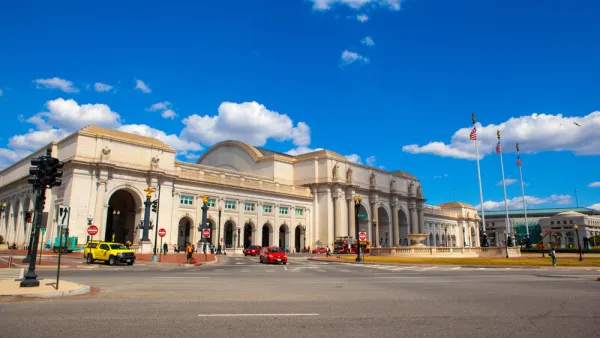
Union Station Redesign Gets a Placemaking Do Over
Criticisms of a draft plan to revamp D.C.'s Union Station have described the proposal as far too concerned with car storage.
Six-Story Parking Lot Nixed From D.C. Union Station Renovation Plans
The Federal Railroad Administration has removed a six-story parking facility included in a 2020 draft Environmental Impact Statement for a $10 billion renovation of Union Station in Washington, D.C.
Key Virginia Rail Bridge Project Completes Environmental Review
A $1.9 billion project to add a second set of rail tracks to the Long Bridge that connects Virginia to D.C. is ready to move forward with a recently completed Environmental Impact Statement.

Planetizen Federal Action Tracker
A weekly monitor of how Trump’s orders and actions are impacting planners and planning in America.

The state-sanctioned urbicide of Austin
People don’t kill cities. Freeways do.

US to reduce Colorado River water deliveries to Mexico
A new Colorado Treaty amendment reduces Mexico’s Colorado River water allocation by 250,000 acre feet.

5 New England states march closer to 800 megawatt wind energy project
Securing federal approval for the project may be complicated under the Trump administration, which has historically been hostile towards domestic wind power.

Baltimore to break ground on $50 million Transit Priority Project
The project will bring faster bus trips, safer streets and better bike connections to Baltimore.

Airbnb launches $250 million 'last-dollar financing' housing accelerator, makes first investment in Austin
The company will put $6.4 million towards affordable housing development in Texas’ capital.

FREE Course: Walkable City 1: Why Walkability?
After describing his path towards focusing on walkability as the essence of good planning, Jeff Speck marches through his five principal reasons for making more walkable places.
Reinventing Malls: Planning Alchemy—Turning Gray Fields Into Gold
The course focuses on the opportunities and imperatives that shape reinvention of mall sites.

Eagle County Government
Harvard University Graduate School of Design
Nashville Planning Department
The Architects Foundation
University of Cincinnati Online
The Pocatello Development Authority
The Urban Renewal Agency of the City of Pocatello
Journal of the American Planning Association