The newest issue the Journal of Planning and Education Research responds to a clear need of the time: the need to address social justice in the public realm while reforming planning practices in the United States.


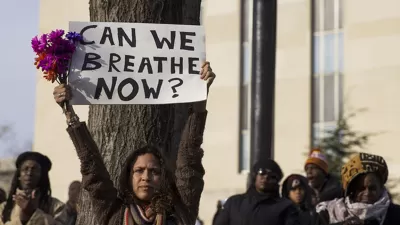
The most recent issue of the Journal of Planning and Education Research responds to one of the very clear demands from urbanists and planners of color during the recent wave of protests and debates: to account for the safety of people of color in the public realm, particularity as a result of disparities in the use of police force and incarceration, before implementing ostensibly progressive planning innovations (see more on the discrepancies between intentions and results in an article published earlier this week on Planetizen).
The Journal of Planning and Education Research published the "Planning beyond Mass Incarceration" recently, while offering the entire contents of the issue temporarily for free online.
Edited by Sheryl -Ann Simpson, Justin Steil, and Aditi Mehta, the issue includes the following essays and research:
- From Revanchism to Inclusion: Institutional Forms of Planning and Police in Hyde Park, Chicago by Steven Averill Sherman (@stephenasherman)
- Latinxs in the Kansas City Metro Area: Policing and Criminalization in Ethnic Enclaves by Dr. Janet Garcia-Hallett @JGarciaHallett ; Dr. Toya Like ; Dr. Theresa Torres ; Dr. Clara Irazabal
- Local Planning in the Age of Mass Decarceration by Dr. Courtney Knapp (@courtneyknapp81)
- When Prison Is the Classroom: Collaborative Learning about Urban Inequality by Dr. Justin Steil and Dr. Aditi Mehta @AditiMehta12
- From Jails to Sanctuary Planning: Spatial Justice in Santa Ana, California by Dr. Carolina S. Sarimiento
- Beyond Safety: Refusing Colonial Violence Through Indigenous Feminist Planning by Dr. Heather Dorries and Dr. Laura Harjo (@lauraharjo)
A blog post by Lisa Schweitzer, to which we owe a hat tip for sharing the news about the open access of this issue, also provides some additional resources for informing anti-racist action into the planning practice and study.
FULL STORY: Planning beyond Mass Incarceration

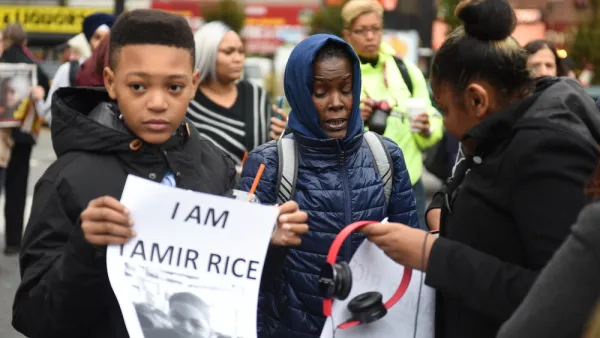
Planning Beyond Mass Incarceration
Sheryl-Ann Simpson from Carleton University, Justin Steil from MIT, and Aditi Mehta from the University of Toronto write about a recent article they co-authored in the Journal of Planning Education and Research.
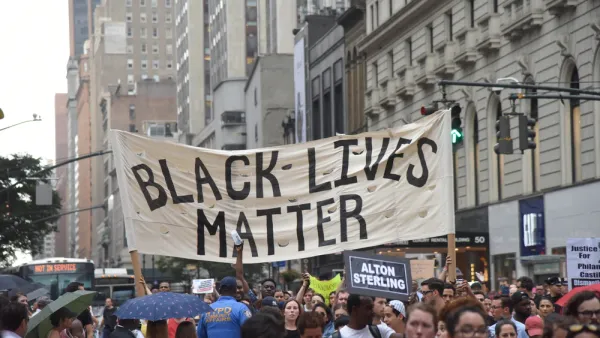
Watch: Responding to Anti-Black Racism in Planning and Urbanism
A must-watch conversation between BIPOC researchers and advocates working in the realm of planning and urbanism is available to watch on YouTube.

Debating the Future of Cities After the Coronavirus, Volume 3
The third installment of an ongoing, curated list of a particularly contemporary genre of urbanism punditry.

Planetizen Federal Action Tracker
A weekly monitor of how Trump’s orders and actions are impacting planners and planning in America.

The state-sanctioned urbicide of Austin
People don’t kill cities. Freeways do.

US to reduce Colorado River water deliveries to Mexico
A new Colorado Treaty amendment reduces Mexico’s Colorado River water allocation by 250,000 acre feet.

Brightline West’s future may rely on $6 billion federal loan
The company has until Nov. 2 to make a $400 million equity investment into its proposed high-speed rail line.

LA Metro’s ultimatum: no extra buses for LA28 if federal funding isn’t imminently secured
If Metro does not provide additional buses, LA28 organizers will have to find a new way to manage Olympic traffic. LA28’s budget does not include a line item for transit.

Colorado’s Largest Data Center Could Rise Next to Homes — Without a Public Hearing
The proposed campus would consume 11 times the power of Denver International Airport; as it has across the country, opposition mounts.

FREE Course: Walkable City 1: Why Walkability?
After describing his path towards focusing on walkability as the essence of good planning, Jeff Speck marches through his five principal reasons for making more walkable places.
Reinventing Malls: Planning Alchemy—Turning Gray Fields Into Gold
The course focuses on the opportunities and imperatives that shape reinvention of mall sites.

Eagle County Government
Harvard University Graduate School of Design
Nashville Planning Department
The Architects Foundation
University of Cincinnati Online
The Pocatello Development Authority
The Urban Renewal Agency of the City of Pocatello
Journal of the American Planning Association