The most recent of funding for Citizens’ Institute on Rural Design (CIRD) design workshops includes an example of an arts center in Maine.


Maureen Milliken reports on the recent designation of the Snow Pond Center for the Arts in Sidney, Maine to the Citizens’ Institute on Rural Design (CIRD).
The CIRD is an initiative of the National Endowment for the Arts in partnership with the Housing Assistance Council and buildingcommunityWORKSHOP, and local leaders hope to parlay the recognition for the Snow Pond Center for the Arts into a larger, collaborative economic development foundation for Kennebec County.
The article quotes John Wiggin, executive director of Snow Pond, in explaining the significance of the recognition and the potential of the arts center in the local economy: "Education, the arts and culture are the primary drivers of economic development, and when looked at historically across the U.S., rural communities that are vibrant, growing, dynamic have that common theme."
Snow Pond Center was one of 23 designees nationwide, as announced in September.
Read the full story: Snow Pond Center gets backup to spark regional development effort
Competition Addresses the Design Challenges of Placemaking in Rural Communities
In its annual competitive funding effort, the Citizens' Institute on Rural Design (CIRD) has selected four small towns and rural communities to host a two-and-a-half day rural design technical workshop.
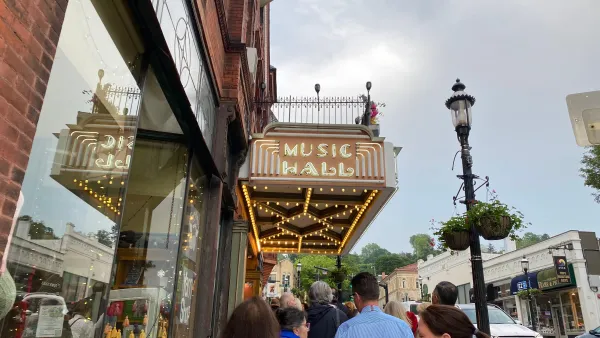
Why city hall doesn't know your music venue is a music venue (and why that matters)
Data shows that cultural venues have long lacked proper classification — which is why so many fall through the cracks.

Misinformation and 'AI slop' are hamstringing rural solar development
False claims about the potential drawbacks of solar farms are prompting some communities to reject potentially lucrative energy projects.

Planetizen Federal Action Tracker
A weekly monitor of how Trump’s orders and actions are impacting planners and planning in America.

Eastern Nebraska is running out of electricity
Data centers and electrification are straining eastern Nebraska’s grid, throttling economic development.

Washington state to charge fee to drivers with fuel-efficient cars
Revenue from the fee will go towards supporting the state’s highways.

Instead of building new housing, LA developers are turning mansions into mega-mansions
In the richest areas, the number of houses valued at $30 million with demolition permits has skyrocketed since 2018.

Illinois considers spending $1 billion in taxpayer money on data center
A quantum computing campus and data center are currently under construction in Chicago.

As development costs rise, Boston moves to lessen affordable housing requirements
The Boston Zoning Commission and the City Council still need to approve Boston Mayor Michelle Wu’s proposed changes

FREE Course: Walkable City 1: Why Walkability?
After describing his path towards focusing on walkability as the essence of good planning, Jeff Speck marches through his five principal reasons for making more walkable places.
Reinventing Malls: Planning Alchemy—Turning Gray Fields Into Gold
The course focuses on the opportunities and imperatives that shape reinvention of mall sites.

City of Charlotte
City of Rosemead
Rutgers University, Edward J. Bloustein School of Planning and Public Policy
University of Michigan School for Environment and Sustainability (SEAS)
Hunter College, City University of New York (CUNY)
The Architects Foundation
University District Partnership
City of Cambridge
The Pocatello Development Authority