Parklets in San Francisco are available for public use, but often they serve as extensions of the dining rooms of eateries.


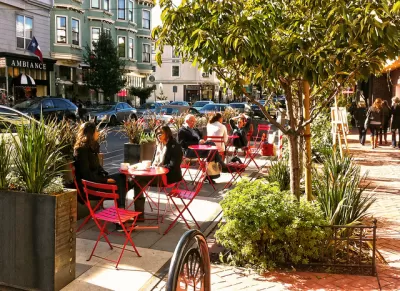
Parklets have sprung up throughout San Francisco in recent years, with many providing additional space for customers of restaurants and cafes. However, they are not extensions of these establishments, reports Justin Phillips:
San Francisco requires parklets to make clear that they are public spaces and part of the city’s program. The design is also supposed to stand alone from the business, at least aesthetically. An example of this can be found at Ritual Coffee Roasters on Valencia Street, where the structure is made to look as though a wooden ship has washed up along the curb.
Phillips says that parklets go through an extensive review process, including public hearings, and they have to conform to a set of design standards. The price tag for parklets varies, but the cost can be substantial for smaller businesses. Still, business owners report that the parklets are an amenity that helps attract customers.
"Yet questions are growing about the use of public space for the benefit of private businesses such as restaurants and cafes that can afford to build one to essentially expand their seating areas," notes Phillips.
FULL STORY: SF parklet proliferation raises concerns about restaurants’ use of public space

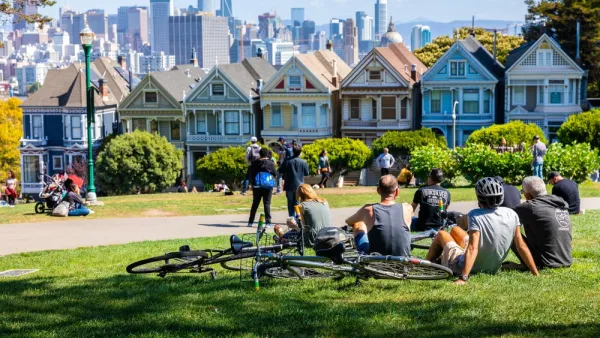
Predictions for San Francisco’s Public Spaces
In 2023, will the city’s public spaces be reclaimed by cars, or will pandemic-era interventions lead to permanent change?
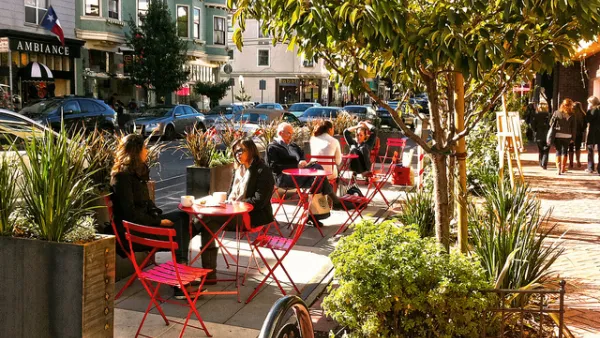
San Francisco Supervisors Vote to Keep Parklets, Close Them at Night
The pandemic-era outdoor seating arrangements can stay, but a last-minute amendment lets business owners close them overnight.
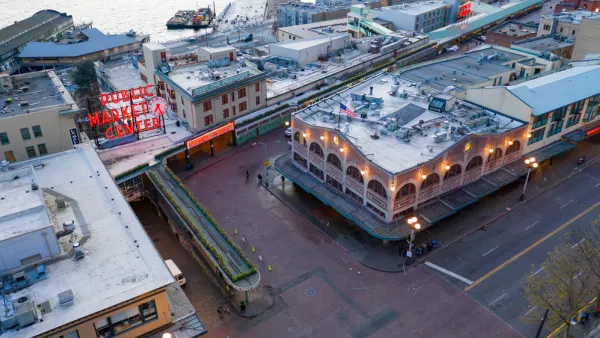
Seattle Extends Outdoor Dining for a Year, Eases Rules on Heaters for the Winter
Outdoor dining is going to hang out for a bit.

The state-sanctioned urbicide of Austin
People don’t kill cities. Freeways do.

US to reduce Colorado River water deliveries to Mexico
A new Colorado Treaty amendment reduces Mexico’s Colorado River water allocation by 250,000 acre feet.

New Jersey’s second-largest city bans standalone data centers
Jersey City will continue to allow co-location facilities, such as those meant for research institutions that store their own data.

Amtrak not solely to blame for New Jersey commuter rail's unreliability, report finds
A new study from the Garden State Initiative found that NJ Transit’s budget grew 20% across a 4 year period, but reliability declined significantly over the same period.

EPA erases limits on planet-warming pollution from power plants
Under Monday’s plan, power plants would still have some limits on how much mercury, arsenic and other contaminants they can emit.

Phoenix announces new on-demand transit service, more frequent RAPID buses
Both new services will launch in October, and are part of Phoenix's Project Effective Access Solutions for Easing Congestion.

FREE Course: Walkable City 1: Why Walkability?
After describing his path towards focusing on walkability as the essence of good planning, Jeff Speck marches through his five principal reasons for making more walkable places.
Reinventing Malls: Planning Alchemy—Turning Gray Fields Into Gold
The course focuses on the opportunities and imperatives that shape reinvention of mall sites.

Eagle County Government
Harvard University Graduate School of Design
Nashville Planning Department
The Architects Foundation
University of Cincinnati Online
The Pocatello Development Authority
The Urban Renewal Agency of the City of Pocatello
Journal of the American Planning Association