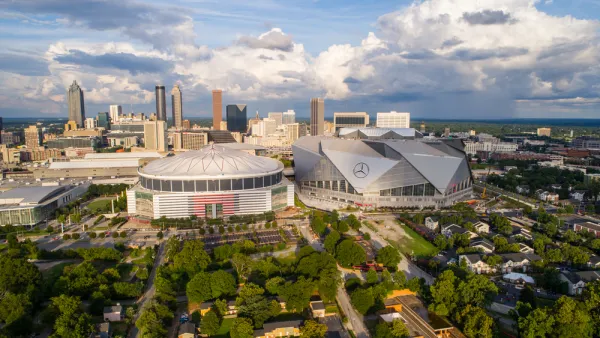
The pedestrian bridge connecting Mercedes-Benz Stadium to a nearby transit stop won't be open in time for the Super Bowl, despite the city allocating an additional $12 million in funding for exactly that goal.



The pedestrian bridge connecting Mercedes Benz Stadium to the Vine City MARTA Station won't be open in time for the Super Bowl, reports Sean Keenan, despite extra expenses above its original $13 million price tag designed to deliver the project in time for the game.
"What was initially supposed to be a $13 million project resulting in a neon-lit bridge linking the western border of Northside Drive—namely the Vine City MARTA station—with Atlanta’s new sports arena had spiked in total costs, due in part to a sense of urgency to complete it for the biggest event in American football," according to Keenan.
Early last year, the Atlanta City Council elected to green light more than $12 million in additional funding for the pedestrian bridge—“because of next year’s Super Bowl,” the Atlanta Journal-Constitution reported in March—and urbanist blog ThreadATL clocks the current price tag at upwards of $27 million.
The the Atlanta Business Chronicle originally reported the news about the bridge's closure for the Super Bowl, in an article that could be behind a paywall for some readers.


Inside the $2 Billion Stadium Hosting the Super Bowl
The hot dogs cost $1,999,999,998 less than the stadium, and either $199,999,998 or $699,999,998 less than taxpayers invested in the stadium.

Sunday Fun: The Super Bowl in Atlanta on Social Media
Traffic and cars play a central role in the social media chatter surrounding the Super Bowl in Atlanta.
Atlanta Pedestrian Bridge—Not a Good Example of Public Dollars Well Spent
The bridge was touted as a connection between downtown and the Mercedes-Benz Stadium, but it is more a reflection of the city’s misplaced fiscal and planning priorities.

Planetizen Federal Action Tracker
A weekly monitor of how Trump’s orders and actions are impacting planners and planning in America.

California plans to bury El Niño’s downpour
If the state plays its cards right, it may be able to store a billion acre-feet of El Niño’s water in aquifers.

Chicago breaks ground on $3 billion megadevelopment
The new neighborhood, titled Foundry Park, will one day host 3,700 residences.

California High-Speed Rail Authority CEO resigns after $600,000 scandal
Under Ian Choudri, the authority used taxpayer dollars to fund first class flights and trips to nightclubs.

Want to study the Missouri River? Soon, you may need unanimous approval from 10 states
Legislation would require 10 governors’ permission to study or build projects moving water outside the basin.

Desperate measures: Advocates weigh draining Lake Powell to fill Colorado River
Draining the reservoir could reduce evaporation losses by a couple hundred thousand acre-feet.

FREE Course: Walkable City 1: Why Walkability?
After describing his path towards focusing on walkability as the essence of good planning, Jeff Speck marches through his five principal reasons for making more walkable places.
Reinventing Malls: Planning Alchemy—Turning Gray Fields Into Gold
The course focuses on the opportunities and imperatives that shape reinvention of mall sites.

City of Rosemead
Rutgers University, Edward J. Bloustein School of Planning and Public Policy
One Hundred Miles
Hunter College, City University of New York (CUNY)
The Architects Foundation
University of Cincinnati Online
City of Cambridge
Montrose County
The Pocatello Development Authority