California's new governor has sent a strong signal to local governments: build housing to comply with state law or else.


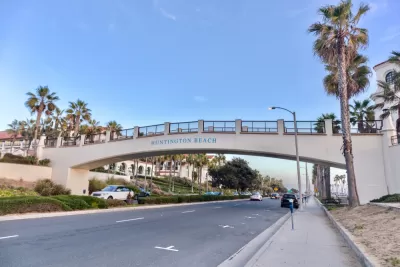
"Gov. Gavin Newsom announced Friday that California was suing an Orange County city over what he said was its failure to allow enough new homebuilding to accommodate a growing population," reports Liam Dillon.
"The lawsuit accuses Huntington Beach of defying a state law that requires cities and counties to set aside sufficient land for housing development," according to Dillon. Dillon has written extensively in the past on the California's Regional Housing Need Allocation (RHNA) law, and its ineffectiveness at compelling cities to build enough housing to meet state mandates.
In 2015, Huntington Beach downzoned two major corridors in the city, leaving the city without "enough land zoned to accommodate low-income residents under state requirements," according to Dillon.
This is the latest sign that Governor Newsom plans to use the power of the state to force more local governments to build new housing. Earlier this month, in his inauguration speech, Newsom promised to withhold funding from cities that don't build housing.
A lot more detail on the political context and the history of housing planning in Huntington Beach are included in the article.
FULL STORY: At Gov. Newsom’s urging, California will sue Huntington Beach over blocked homebuilding


California Gives 15 Cities ‘Final Warning’ to Submit Mandatory Housing Plans
Communities are required to produce housing elements that accommodate sufficient housing for all income levels.

LA Opposes California Bill to add Housing Next to Transit Hubs
In a narrow vote, the city council voted to oppose SB79, a bill that would bypass local zoning laws to allow denser development near transit stops.

California’s New Housing Laws: What You Need to Know
The state legislature passed dozens of new laws aimed at improving housing affordability and streamlining the development process to meet rising demand.

The state-sanctioned urbicide of Austin
People don’t kill cities. Freeways do.

US to reduce Colorado River water deliveries to Mexico
A new Colorado Treaty amendment reduces Mexico’s Colorado River water allocation by 250,000 acre feet.

New Jersey’s second-largest city bans standalone data centers
Jersey City will continue to allow co-location facilities, such as those meant for research institutions that store their own data.

Amtrak not solely to blame for New Jersey commuter rail's unreliability, report finds
A new study from the Garden State Initiative found that NJ Transit’s budget grew 20% across a 4 year period, but reliability declined significantly over the same period.

EPA erases limits on planet-warming pollution from power plants
Under Monday’s plan, power plants would still have some limits on how much mercury, arsenic and other contaminants they can emit.

Phoenix announces new on-demand transit service, more frequent RAPID buses
Both new services will launch in October, and are part of Phoenix's Project Effective Access Solutions for Easing Congestion.

FREE Course: Walkable City 1: Why Walkability?
After describing his path towards focusing on walkability as the essence of good planning, Jeff Speck marches through his five principal reasons for making more walkable places.
Reinventing Malls: Planning Alchemy—Turning Gray Fields Into Gold
The course focuses on the opportunities and imperatives that shape reinvention of mall sites.

Eagle County Government
Harvard University Graduate School of Design
Nashville Planning Department
The Architects Foundation
University of Cincinnati Online
The Pocatello Development Authority
The Urban Renewal Agency of the City of Pocatello
Journal of the American Planning Association