Project documents acquired by The Washington Post reveal numerous unresolved problems with construction on the Purple Line.


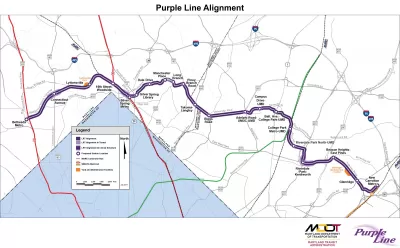
"The opening of Maryland’s Purple Line is at least a year behind schedule, and delays have added at least $215 million to the light-rail line’s cost," reports Katherine Shaver.
Now the Purple Line is expected to open in February 2023, "almost a year behind the March 2022 opening date in the project’s contract and four months behind the October 2022 date that Maryland transit officials insist is still possible," according to Shaver.
Apparently there is still dispute over the potential opening data. State transportation officials are pushing Purple Line Transit Partners (PLTP), "a team of companies building the 16-mile line and helping to finance its construction," to accelerate work to stick closer to the original schedule. Meanwhile, contractors have also proposed a much later opening date of June 2024.
There are $5.6 billion reasons for PLTP and the state to figure out a way to get on the same page. "PLTP and the state signed a $5.6 billion contract — one of the largest ever in Maryland — for the private consortium to design and build the line and then operate and maintain it for 30 years. PLTP also is helping to finance the line’s $2.4 billion construction," according to Shaver.
FULL STORY: Purple Line will open a year late and delays will cost at least $215 million, contractor says

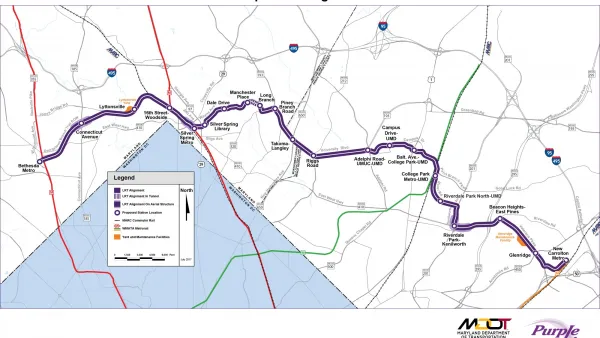
Another Lawsuit Complicates Purple Line Plans in Maryland
The 16-mile Purple Line light rail project, which connects Maryland suburbs in Montgomery and Prince George's counties to the D.C. Metro Gold, Red, and Orange lines, is facing a new lawsuit.
Maryland's Purple Line Gets the Green Light Again
The public-private partnership behind the Purple Line light rail project in Maryland fell apart in September, and has this past week been revived.
Purple Line Construction Halts in Maryland as Contractor Woes Deepen
Purple Line Transit Partners, the contractors managing construction of the beleaguered Purple Line in Maryland, have begun to walk off the job as a dispute about cost overruns brings the project to a screeching halt.

Planetizen Federal Action Tracker
A weekly monitor of how Trump’s orders and actions are impacting planners and planning in America.

The state-sanctioned urbicide of Austin
People don’t kill cities. Freeways do.

US to reduce Colorado River water deliveries to Mexico
A new Colorado Treaty amendment reduces Mexico’s Colorado River water allocation by 250,000 acre feet.

5 New England states march closer to 800 megawatt wind energy project
Securing federal approval for the project may be complicated under the Trump administration, which has historically been hostile towards domestic wind power.

Baltimore to break ground on $50 million Transit Priority Project
The project will bring faster bus trips, safer streets and better bike connections to Baltimore.

Airbnb launches $250 million 'last-dollar financing' housing accelerator, makes first investment in Austin
The company will put $6.4 million towards affordable housing development in Texas’ capital.

FREE Course: Walkable City 1: Why Walkability?
After describing his path towards focusing on walkability as the essence of good planning, Jeff Speck marches through his five principal reasons for making more walkable places.
Reinventing Malls: Planning Alchemy—Turning Gray Fields Into Gold
The course focuses on the opportunities and imperatives that shape reinvention of mall sites.

Eagle County Government
Harvard University Graduate School of Design
Nashville Planning Department
The Architects Foundation
University of Cincinnati Online
The Pocatello Development Authority
The Urban Renewal Agency of the City of Pocatello
Journal of the American Planning Association