Washington, D.C. is seeking public comment on the "Sustainable DC 2.0" plan.


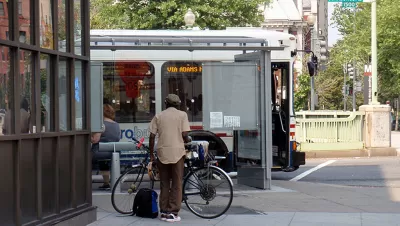
"The DC government has released its 'Sustainable DC 2.0' draft, an update to the 2012 sustainability plan and a further developed version of an outline released in June," reports David Alpert.
Comments are open on the plan until September 30, and Alpert certainly has some feedback already. His evaluation of the plan is separated into sections on "what's great" and "what should be stronger." Headlining the former are goals to increase use of public transit, increase walking and biking, and decrease car trips. For the latter, Alpert focuses on the details that will be necessary to achieve some of the goals laid out by the plan. "For instance, on bus service, the action is to 'Complete a high capacity transit study on high capacity corridors.' The draft plan neither defines what high-capacity transit is nor insists we then implement any of these corridors."
Read the full story: Sustainable DC 2.0 keeps big goals, but achieving them takes more ambition on buses, bikes, and scooters

D.C. Updating its Sustainability Plan
The District of Columbia is updating its Sustainable DC plan, originally crafted in 2012, and seeking feedback on draft goals set for 2032.
Reducing Car Trips in L.A.: Transportation Demand Management Ordinance Could Be Expanded
The proposed expansion would affect smaller multi-family developments and include incentives for reducing travel during peak hours and encouraging transit, walking, and biking.
D.C. Comprehensive Plan Amendments Approved
New amendments to the D.C. Comprehensive Plan set goals for new housing development and fewer cars on the road.

Planetizen Federal Action Tracker
A weekly monitor of how Trump’s orders and actions are impacting planners and planning in America.

California plans to bury El Niño’s downpour
If the state plays its cards right, it may be able to store a billion acre-feet of El Niño’s water in aquifers.

Desperate measures: Advocates weigh draining Lake Powell to fill Colorado River
Draining the reservoir could reduce evaporation losses by a couple hundred thousand acre-feet.

Chicago Avenue bridge construction delays enrages city leaders
The bridge has been closed since 2025. The city originally aimed to re-open it in December, and now expects to finish construction in 2027.

NYC bus network redesign speeds up Queens buses
Rush routes have seen a 4.6% speed increase after the redesign.

California High-Speed Rail Authority picks trainset manufacturer
The California High-Speed Rail Authority aims to start servicing passengers by 2033.

FREE Course: Walkable City 1: Why Walkability?
After describing his path towards focusing on walkability as the essence of good planning, Jeff Speck marches through his five principal reasons for making more walkable places.
Reinventing Malls: Planning Alchemy—Turning Gray Fields Into Gold
The course focuses on the opportunities and imperatives that shape reinvention of mall sites.

City of Rosemead
Rutgers University, Edward J. Bloustein School of Planning and Public Policy
One Hundred Miles
Hunter College, City University of New York (CUNY)
The Architects Foundation
University of Cincinnati Online
City of Cambridge
Montrose County
The Pocatello Development Authority