A proposed Urban Parking Overlay District would end requirements for off-street dedicated parking in two of Cincinnati's busiest neighborhoods.



John Young writes on opinion piece offering support and advice for the Cincinnati City Planning Department as it prepares an Urban Parking Overlay District for the downtown and Over-the-Rhine neighborhoods.
"If approved, the district would remove the requirement for uses in downtown to provide off-street dedicated parking," according to Young, and Young is all for ending off-street parking requirements.
According to Young, the city has added thousands of parking spots in the last six years, leaving the downtown neighborhoods with an overabundance of parking. Instead of the status quo, Young encourages a Shoupista-approved approach to parking innovations, and new kinds of infill development that could be attracted to a parking requirement-free development market.
"Even when parking requirements are reduced or eliminated most banks and investors still require parking to be provided or identified for developments to move forward," explains Young to make a key point. "Removing zoning requirements for parking often allows the developer to build the parking that is really needed and not what is arbitrarily demanded by local zoning controls. This reduces the cost of development and in turn, allows more affordable housing to be provided."
Young includes more details about what a post-parking requirement approach to parking might look like in Cincinnati, as well as the kinds of benefits the city could shoot to achieve in implementing parking reform.
FULL STORY: EDITORIAL: Parking Requirement Removal Should Be First Step In Broader Reform


Cities Rethinking the Value of Parking
The effort to reclaim public and private spaces from car storage had some setbacks since the days of al fresco and open streets in the first years of Covid-19. But widespread parking reforms and new evidence shows the public is rethinking parking.

Cincinnati Ends Parking Requirements in the City’s West End
The West End neighborhood of Cincinnati is home to 6,000 residents but only one dine-in restaurant.
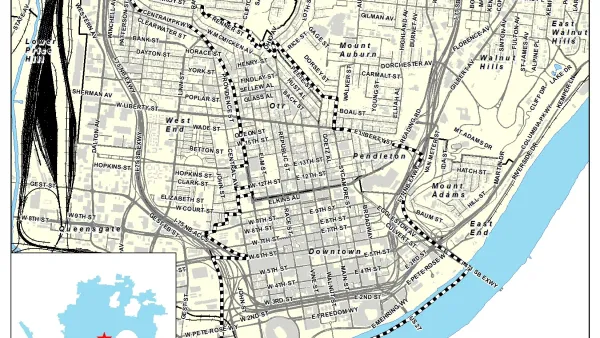
Downtown Cincinnati: Parking Not Required
The Cincinnati City Council voted this week to eliminate parking requirements in vast swaths of the downtown urban core.

Planetizen Federal Action Tracker
A weekly monitor of how Trump’s orders and actions are impacting planners and planning in America.

The state-sanctioned urbicide of Austin
People don’t kill cities. Freeways do.

US to reduce Colorado River water deliveries to Mexico
A new Colorado Treaty amendment reduces Mexico’s Colorado River water allocation by 250,000 acre feet.

Baltimore to break ground on $50 million Transit Priority Project
The project will bring faster bus trips, safer streets and better bike connections to Baltimore.

Airbnb launches $250 million 'last-dollar financing' housing accelerator, makes first investment in Austin
The company will put $6.4 million towards affordable housing development in Texas’ capital.

Guerilla urbanists are building DIY bus stop benches in Chicago
A before-and-after of one of the bus stops with a new bench. The new benches are not officially sanctioned or permitted, but the residents who placed them hope they will be the start of a network of DIY benches across the city.

FREE Course: Walkable City 1: Why Walkability?
After describing his path towards focusing on walkability as the essence of good planning, Jeff Speck marches through his five principal reasons for making more walkable places.
Reinventing Malls: Planning Alchemy—Turning Gray Fields Into Gold
The course focuses on the opportunities and imperatives that shape reinvention of mall sites.

Eagle County Government
Harvard University Graduate School of Design
Nashville Planning Department
The Architects Foundation
University of Cincinnati Online
The Pocatello Development Authority
The Urban Renewal Agency of the City of Pocatello
Journal of the American Planning Association