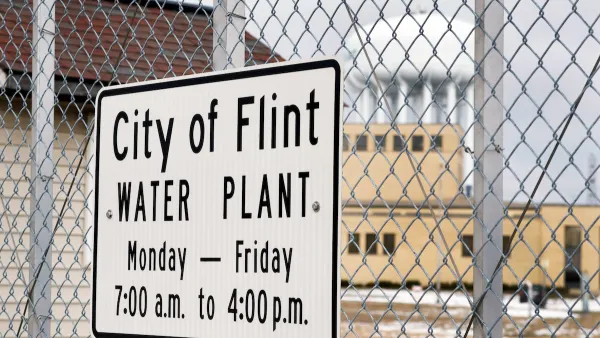
The legal controversy over the Genesee Power Plant in Flint, Michigan has finally ended, with a court forcing the U.S. Environmental Protection Agency to better investigate and resolve complaints of environmental discrimination.


"After 26 years, the oldest pending civil rights complaint against the Environmental Protection Agency is finally over," reports Sophie Yeo. "A district court in California has found [pdf] that the EPA was guilty of environmental racism when it ignored the pollution concerns of a largely African-American community in Flint in the 1990s."
The story of this lawsuit dates back to 1990, when a Catholic priest named Father Phil Schmitter began speaking out against plans for the Genesee Power Station, an incinerator expected to emit lead, mercury, arsenic, and other pollutants into the air, according to Yeo.
The article includes a detailed history of the incinerator's approval and construction, the initial civil rights complaint brought forward by the St. Francis Prayer Center against the Michigan Department of Environmental Quality, and the subsequent failure of the EPA to respond to the complaint. As noted by Yeo, such negligence on the part of the EPA was not uncommon. "A 2015 investigation by the Center for Public Integrity found that, of all complaints submitted to the EPA's civil rights office, 162 were rejected, 38 were not reviewed, and only 64 were accepted."
FULL STORY: ENVIRONMENTAL RACISM IN FLINT IS MUCH OLDER THAN THE WATER CRISIS

EPA Drops More Civil Rights Investigations
A lawsuit that halted an investigation in Louisiana’s ‘Cancer Alley’ is having a chilling impact on other environmental justice cases.

1,700 Flint Residents Sue U.S. EPA for $722 Million in Damages
Flint residents are suing the U.S. Environmental Protection Agency for damages caused by exposure to lead in the city's drinking supply.
How the U.S. Environmental Protection Agency Failed the People of Flint
While blame squarely lays with Michigan state officials, agencies, and possibly Gov. Rick Snyder himself, the EPA also played a role by both detecting the cause of the problem but not acting on the reports of improper treatment of river water.

Planetizen Federal Action Tracker
A weekly monitor of how Trump’s orders and actions are impacting planners and planning in America.

The state-sanctioned urbicide of Austin
People don’t kill cities. Freeways do.

US to reduce Colorado River water deliveries to Mexico
A new Colorado Treaty amendment reduces Mexico’s Colorado River water allocation by 250,000 acre feet.

Guerilla urbanists are building DIY bus stop benches in Chicago
A before-and-after of one of the bus stops with a new bench. The new benches are not officially sanctioned or permitted, but the residents who placed them hope they will be the start of a network of DIY benches across the city.

Mamdani overhauls NYC's Vision Zero plan with 100 new policy goals
The overhaul aims to reduce traffic deaths and make streets safer for pedestrians, cyclists and drivers through lower speed limits, new safety infrastructure and more.

Amtrak not solely to blame for New Jersey commuter rail's unreliability, report finds
A new study from the Garden State Initiative found that NJ Transit’s budget grew 20% across a 4 year period, but reliability declined significantly over the same period.

FREE Course: Walkable City 1: Why Walkability?
After describing his path towards focusing on walkability as the essence of good planning, Jeff Speck marches through his five principal reasons for making more walkable places.
Reinventing Malls: Planning Alchemy—Turning Gray Fields Into Gold
The course focuses on the opportunities and imperatives that shape reinvention of mall sites.

Eagle County Government
Harvard University Graduate School of Design
Nashville Planning Department
The Architects Foundation
University of Cincinnati Online
The Pocatello Development Authority
The Urban Renewal Agency of the City of Pocatello
Journal of the American Planning Association