Holmdel, New Jersey, was home to a huge, beautiful, and empty headquarters of the now defunct Bell Labs. Now the campus is home to tech startups, a library, and a host of other businesses.


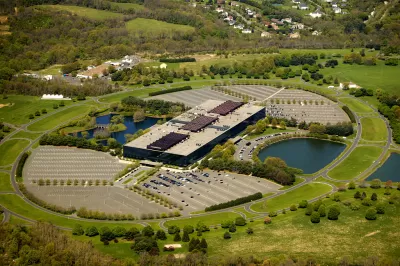
Bell Labs' giant, former headquarters sat empty for years. "The company’s 2 million-square foot complex was zoned for office use by a single tenant. Coming to terms with the impossibility of finding a single tenant for the building, the town’s zoning committee consented to alter the site’s zoning to accommodate multiple uses, "Anthony Paletta writes for CityLab.
A project to revitalize the building included modernizing the utility spaces and getting rid of a lot of cubicles among other things. But the unique building maintains its midcentury charms. "The office floors are now 70 to 80 percent leased by a variety of tenants—mostly tech and coworking companies—and one is headed by a former Bell Labs employee," Paletta writes.
Read the full story: A New Urbanist Developer Gives Saarinen a Reboot

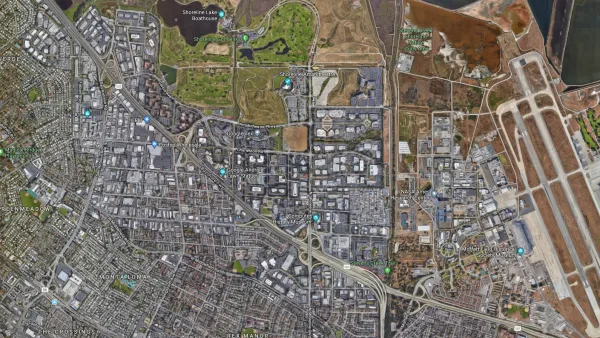
Mountain View Goes Big on Google Expansion, Approves 10,000 Housing Units
Could the approval of a massive redevelopment plan for Google property in the city of Mountain View pave the way for a new development-friendly approach to planning in the Silicon Valley and the greater Bay Area?
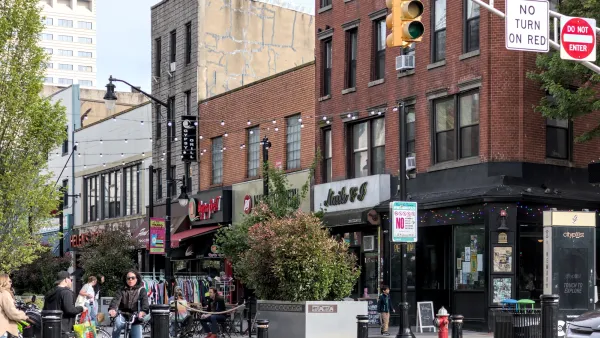
Jersey City could build 700 homes on city-owned parking lots
If approved, a redevelopment proposal would build hundreds of new homes on a pair of city parking lots.
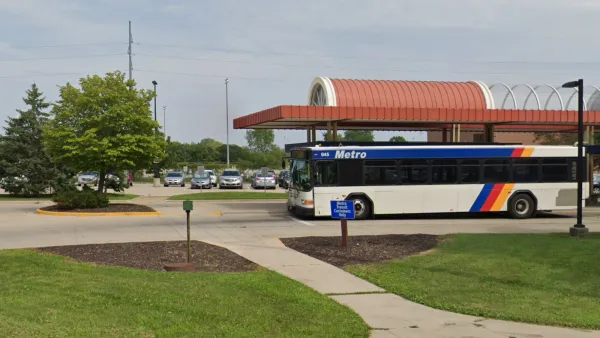
Madison approves hundreds of affordable apartments as deadline for federal funding looms
A recently approved project will bring 163 affordable units to the north side.

Planetizen Federal Action Tracker
A weekly monitor of how Trump’s orders and actions are impacting planners and planning in America.

Amtrak, CN end decades-long dispute with eight-year agreement
The new operating agreement establishes an updated framework for the companies to work together, including processes to resolve disputes.

Judges permit Denver to divert 77,000 acre feet from the Colorado River for reservoir expansion
Overuse and climate change have caused the Colorado River’s water levels to plummet.

NYC DOT wants faster, more permanent street upgrades
The city is examining ways to build more concrete infrastructure without getting entangled in 'decades-long' projects.

'Something we’ve never seen before:' rising utility rates could strain city finances nationwide
Data centers, climate change and other factors have caused utility rates in the United States to increase by 38% since 2020.

Trump to overrule local leaders, lease millions of acres of America’s Pacific Island territories’ seafloors to mining companies
International law says that the Indigenous people of America’s territories have a right to prior and informed consent regarding projects that impact their countries.

FREE Course: Walkable City 1: Why Walkability?
After describing his path towards focusing on walkability as the essence of good planning, Jeff Speck marches through his five principal reasons for making more walkable places.
Reinventing Malls: Planning Alchemy—Turning Gray Fields Into Gold
The course focuses on the opportunities and imperatives that shape reinvention of mall sites.


Harvard University Graduate School of Design
KFH Group Inc.
Greater Baltimore Committee
The Architects Foundation
University of Cincinnati Online
The Pocatello Development Authority
The Urban Renewal Agency of the City of Pocatello