The department's activities, or lack thereof, under the Trump administration have caused housing advocates a lot of consternation. Under Ben Carson, is HUD abandoning its fair housing mission?


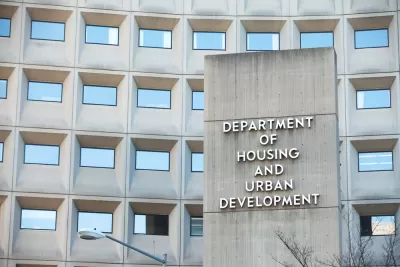
Glenn Thrush gives a us rundown of the many ways Ben Carson's HUD has backed off from fair housing enforcement. Things came to a head, he writes, in March, when the secretary moved "to strike the words 'inclusive' and 'free from discrimination' from HUD's mission statement."
Carson has denied a broader shift away from a fair housing agenda. "Mr. Carson dismissed the idea he was abandoning the agency's fair housing mission as 'nonsense' in a memo to the department's staff earlier this year, and reiterated that point during recent congressional hearings."
But examples of more relaxed enforcement, or none at all, continue to accumulate. Thrush discusses several, including HUD's termination of an investigation into potentially discriminatory advertising practices by Facebook, as well as how the agency backed away from its previous stance on a Houston mixed-race housing development that advocates say the city blocked on discriminatory grounds.
"Advocates for the poor and career HUD officials say that Mr. Carson, a retired neurosurgeon, and his political appointees have begun weakening the department's fair housing division at a critical moment."
FULL STORY: Under Ben Carson, HUD Scales Back Fair Housing Enforcement

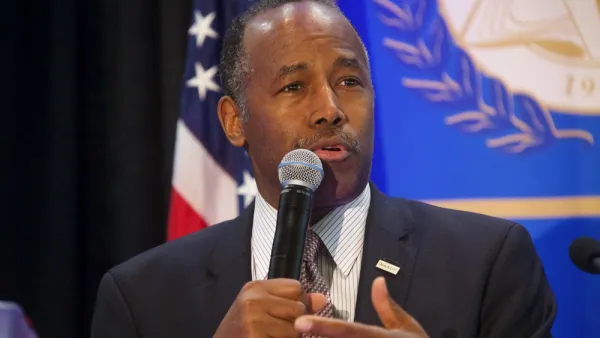
Ben Carson’s Clear Disdain for Fair and Affordable Housing
Carson has spent much of his time as HUD secretary attacking the housing programs, initiatives, and regulations central to the agency’s mission.
HUD Whistleblowers: Agency is ‘Systematically Undermining’ Fair Housing Laws
HUD employees say the agency has decimated the Office of Fair Housing, reducing staff by 70 percent, and forced a gag order that prevents them from effectively enforcing fair housing and civil rights laws.
HUD Plans to Revive Fair Housing Rule
The department is proposing an updated version of the Affirmatively Furthering Fair Housing rule, which requires local governments to take action to end residential segregation.

Planetizen Federal Action Tracker
A weekly monitor of how Trump’s orders and actions are impacting planners and planning in America.

The state-sanctioned urbicide of Austin
People don’t kill cities. Freeways do.

US to reduce Colorado River water deliveries to Mexico
A new Colorado Treaty amendment reduces Mexico’s Colorado River water allocation by 250,000 acre feet.

5 New England states march closer to 800 megawatt wind energy project
Securing federal approval for the project may be complicated under the Trump administration, which has historically been hostile towards domestic wind power.

Baltimore to break ground on $50 million Transit Priority Project
The project will bring faster bus trips, safer streets and better bike connections to Baltimore.

Airbnb launches $250 million 'last-dollar financing' housing accelerator, makes first investment in Austin
The company will put $6.4 million towards affordable housing development in Texas’ capital.

FREE Course: Walkable City 1: Why Walkability?
After describing his path towards focusing on walkability as the essence of good planning, Jeff Speck marches through his five principal reasons for making more walkable places.
Reinventing Malls: Planning Alchemy—Turning Gray Fields Into Gold
The course focuses on the opportunities and imperatives that shape reinvention of mall sites.

Eagle County Government
Harvard University Graduate School of Design
Nashville Planning Department
The Architects Foundation
University of Cincinnati Online
The Pocatello Development Authority
The Urban Renewal Agency of the City of Pocatello
Journal of the American Planning Association