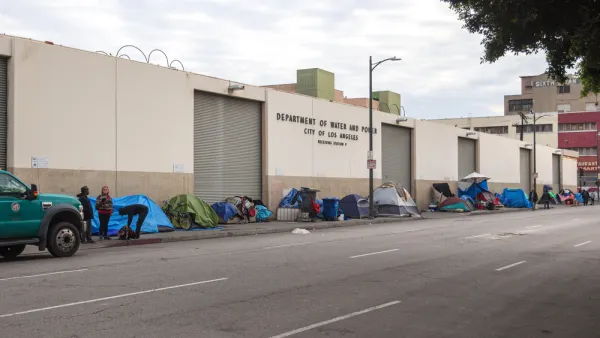
If approved, a City Council motion would mark a shift in how Los Angeles deals with a rising number of homeless residents.


Last week, Los Angeles City Councilman Jose Huizar introduced a motion to create temporary housing for the homeless in five trailers on a downtown lot owned by the city.
From the Los Angeles Times:
If approved by the City Council, the initiative to provide temporary shelter would mark a new strategy for the city, which has focused primarily on encouraging the construction of permanent housing through $1.2 billion in voter-approved bonds.
Mayor Eric Garcetti has recently given "some hints" about the change in policy.
In an interview last week on KNX-AM, Garcetti challenged City Council members to find places in their districts for more temporary housing, saying the city needs sites for 'not just permanent housing, but for shorter-term shelter, pop-up shelters, pop-up housing, with those dollars that we have.'
In the recent past, the city has made a number of other efforts to address housing as its homeless population rose for a number of years, and then leapt a full 23 percent in 2017.
The most recent initiative to address homelessness is a proposed ordinance that would make it easier to convert hotels and motels into transitional housing.
FULL STORY: Temporary trailers for homeless people planned on downtown city lot

Los Angeles Could Streamline Temporary Shelters, Permanent Supportive Housing
Los Angeles is exploring multiple angles for sheltering the 34,000 homeless living in the city. Urbanize LA takes a look at two of the city's most recent legislative efforts to develop more supportive housing.

Did L.A.’s Supportive Housing Bond Fail?
Six years after Prop HHH was passed, the fund appears to be delivering on its housing construction goals in the 10-year timeline. But the measure is being routinely criticized on all sides.
The 'Vanlord' Providing Shelter to L.A.'s Homeless
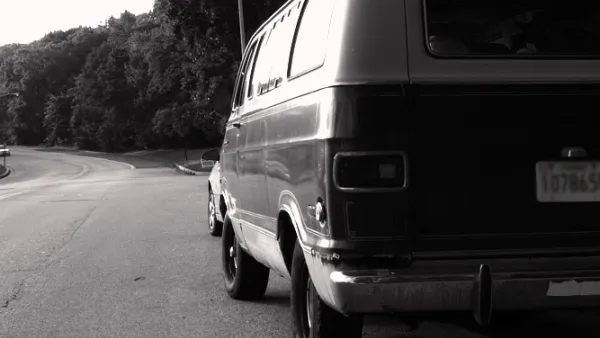
A creative rental industry has emerged in Los Angeles as the affordable housing crisis grows.

The state-sanctioned urbicide of Austin
People don’t kill cities. Freeways do.

US to reduce Colorado River water deliveries to Mexico
A new Colorado Treaty amendment reduces Mexico’s Colorado River water allocation by 250,000 acre feet.

New Jersey’s second-largest city bans standalone data centers
Jersey City will continue to allow co-location facilities, such as those meant for research institutions that store their own data.

Amtrak not solely to blame for New Jersey commuter rail's unreliability, report finds
A new study from the Garden State Initiative found that NJ Transit’s budget grew 20% across a 4 year period, but reliability declined significantly over the same period.

EPA erases limits on planet-warming pollution from power plants
Under Monday’s plan, power plants would still have some limits on how much mercury, arsenic and other contaminants they can emit.

Phoenix announces new on-demand transit service, more frequent RAPID buses
Both new services will launch in October, and are part of Phoenix's Project Effective Access Solutions for Easing Congestion.

FREE Course: Walkable City 1: Why Walkability?
After describing his path towards focusing on walkability as the essence of good planning, Jeff Speck marches through his five principal reasons for making more walkable places.
Reinventing Malls: Planning Alchemy—Turning Gray Fields Into Gold
The course focuses on the opportunities and imperatives that shape reinvention of mall sites.


Eagle County Government
Harvard University Graduate School of Design
Nashville Planning Department
The Architects Foundation
University of Cincinnati Online
The Pocatello Development Authority
The Urban Renewal Agency of the City of Pocatello
Journal of the American Planning Association