The state of Louisiana could be the first state to adopt a massive plan to push residents out of coastal areas threatened by sea level rise and coastal erosion. More states are expected to follow Louisiana's lead.



"Louisiana is finalizing a plan to move thousands of people from areas threatened by the rising Gulf of Mexico, effectively declaring uninhabitable a coastal area larger than Delaware," reports Christopher Flavelle.
Flavelle describes the plan as the most aggressive response to climate change in the United States. A draft of the plan, "calls for prohibitions on building new homes in high-risk areas, buyouts of homeowners who live there now and hikes in taxes on those who won’t leave."
The plan, known as Louisiana Strategic Adaptations for Future Environments (LA SAFE), responds to a combination of environmental factors: sea level rise brought on by climate change and sinking land caused in part by oil and gas extraction. Bloomberg News obtained a copy of the draft plan, the basis for Flavelle's reporting, but the final draft plan is expected to be complete early in 2018.
FULL STORY: Louisiana, Sinking Fast, Prepares to Empty Out Its Coastal Plain


How Cities Can Support Climate Adaptation
In the face of federal cuts to climate resilience funding, a panel at ULI’s Resilience Summit offered suggestions for maintaining managed retreat and other climate adaptation programs.
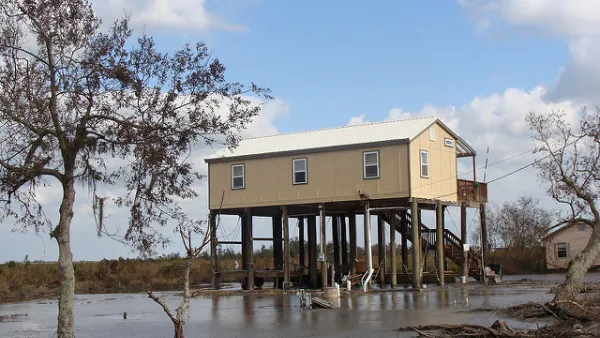
'America’s First Climate Refugees' Are Still on the Island
The 99 residents of Isle de Jean Charles have $48 million to relocate together, but that doesn’t make it easy.

Two Coastal Areas Face Climate Change Threats, but Their Stories Are Vastly Different
In Manila and the San Francisco Bay Area, the severe impacts of rising sea levels are indisputable. But the only similarities are that both places face very uncertain futures.

The state-sanctioned urbicide of Austin
People don’t kill cities. Freeways do.

US to reduce Colorado River water deliveries to Mexico
A new Colorado Treaty amendment reduces Mexico’s Colorado River water allocation by 250,000 acre feet.

New Jersey’s second-largest city bans standalone data centers
Jersey City will continue to allow co-location facilities, such as those meant for research institutions that store their own data.

Amtrak not solely to blame for New Jersey commuter rail's unreliability, report finds
A new study from the Garden State Initiative found that NJ Transit’s budget grew 20% across a 4 year period, but reliability declined significantly over the same period.

EPA erases limits on planet-warming pollution from power plants
Under Monday’s plan, power plants would still have some limits on how much mercury, arsenic and other contaminants they can emit.

Phoenix announces new on-demand transit service, more frequent RAPID buses
Both new services will launch in October, and are part of Phoenix's Project Effective Access Solutions for Easing Congestion.

FREE Course: Walkable City 1: Why Walkability?
After describing his path towards focusing on walkability as the essence of good planning, Jeff Speck marches through his five principal reasons for making more walkable places.
Reinventing Malls: Planning Alchemy—Turning Gray Fields Into Gold
The course focuses on the opportunities and imperatives that shape reinvention of mall sites.

Eagle County Government
Harvard University Graduate School of Design
Nashville Planning Department
The Architects Foundation
University of Cincinnati Online
The Pocatello Development Authority
The Urban Renewal Agency of the City of Pocatello
Journal of the American Planning Association