A trio of local experts offers insight into how Washington, D.C. tripled bike mode share in a decade.


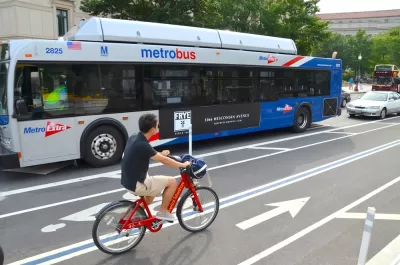
Andrew Small reports on the success of Washington, D.C. as a bike-friendly city, where people actually bike:
Cycling has taken off in the American capital. Nearly 17,000 cyclists regularly rode their bikes to work in Washington, D.C. in 2016, according to Census estimates, which is about 5 percent of the city’s commuters. That’s nearly triple the “mode share” it had in 2006, putting it in second place on the list of top biking cities in the U.S., just behind famously gear-friendly Portland, Oregon.
That explosive growth is the envy of bike advocates in car-oriented cities all over the United States, though D.C. still lags behind New York in total numbers, and it's worthy of a closer examination for lessons. Small traces the history of D.C.'s bike boom, though the adoption of the country's "first modern bikeshare system" to bike planning and project implementation. Insights are offered by Jim Sebastian, planner the District Department of Transportation, Nelle Pierson, a longtime bike advocate, and Sterling Stone, executive director of the non-profit bike shop Gearin’ Up Bicycles.
Read the full story: How Washington, D.C., Built a Bike Boom

Estimated Cost Savings of 10 Percent of People Riding Bikes: $24 Trillion
The mode share for bikes in urban environments around the world currently sits around 6 percent. A new report out of a university located in one of the most bike-friendly cities in the country quantifies the benefits of 10 percent mode share.
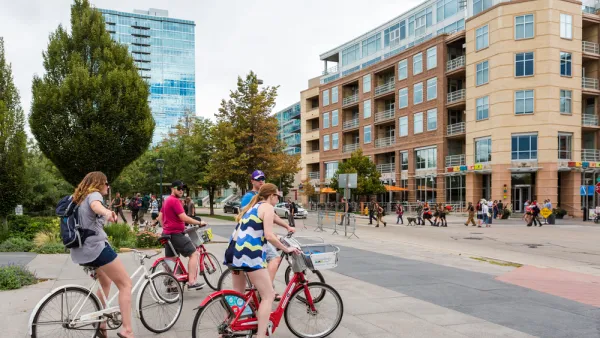
Study: More Bike Infrastructure Could Prevent 15,000 Deaths Annually
In addition to reducing air pollution and congestion, improving bike infrastructure could save thousands of lives each year, according to new research.
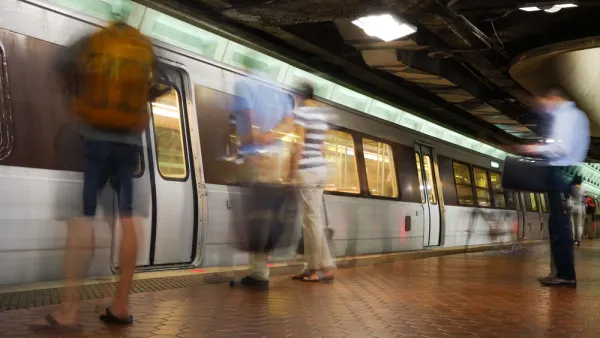
Report: D.C. Area Commuters Driving Alone Less
With all the bad news about plummeting ridership as the D.C. Metro transit system has struggled to deal with maintenance issues, a new report indicates that regional commuters are still driving alone less.

Planetizen Federal Action Tracker
A weekly monitor of how Trump’s orders and actions are impacting planners and planning in America.

Amtrak, CN end decades-long dispute with eight-year agreement
The new operating agreement establishes an updated framework for the companies to work together, including processes to resolve disputes.

Judges permit Denver to divert 77,000 acre feet from the Colorado River for reservoir expansion
Overuse and climate change have caused the Colorado River’s water levels to plummet.

NYC DOT wants faster, more permanent street upgrades
The city is examining ways to build more concrete infrastructure without getting entangled in 'decades-long' projects.

'Something we’ve never seen before:' rising utility rates could strain city finances nationwide
Data centers, climate change and other factors have caused utility rates in the United States to increase by 38% since 2020.

Trump to overrule local leaders, lease millions of acres of America’s Pacific Island territories’ seafloors to mining companies
International law says that the Indigenous people of America’s territories have a right to prior and informed consent regarding projects that impact their countries.

FREE Course: Walkable City 1: Why Walkability?
After describing his path towards focusing on walkability as the essence of good planning, Jeff Speck marches through his five principal reasons for making more walkable places.
Reinventing Malls: Planning Alchemy—Turning Gray Fields Into Gold
The course focuses on the opportunities and imperatives that shape reinvention of mall sites.

Harvard University Graduate School of Design
KFH Group Inc.
Greater Baltimore Committee
The Architects Foundation
University of Cincinnati Online
The Pocatello Development Authority
The Urban Renewal Agency of the City of Pocatello