Local businesses in Beaverton, Oregon hope new walking and biking infrastructure will attract young talent.


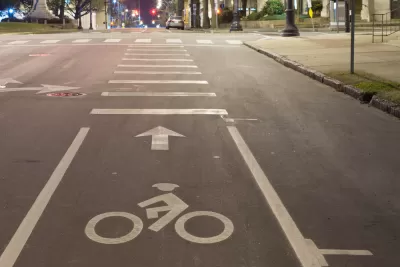
The city of Beaverton plans to reduce auto lanes and add bike lanes on a stretch of road in "Silicon Forest," John Maus reports at Bike Portland. What makes this particular bike project "a big deal," in Maus's words, is that it was requested by local merchants as a strategy to boost business.
In a city survey, owners of businesses on the street "overwhelmingly" supported building up bicycle and pedestrian infrastructure, Maus reports. In fact, it became the "top priority" of the city's plan for the area employment district, West Five. The goal stressed in planning documents is to attract a younger demographic to the area, who will hopefully become the next generation workforce for the tech cluster and other major businesses nearby.
FULL STORY: To boost business, Beaverton will build separated bikeways on Western Ave

Even Quaint Towns Can Be Cutting Edge
Small towns can teach big cities about effective roadway designs.
Transportation Secretary Foxx Announces Bike/Ped Safety Initiative
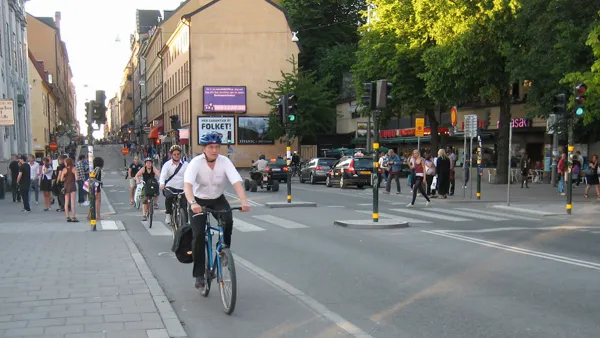
Streetsblog's Tanya Snyder, attending the Pro-Walk Pro-Bike Pro-Place conference in Pittsburgh, Pa., reports that Transportation Secretary Anthony Foxx announced a U.S. DOT pedestrian and bike safety initiative.
New Federal Grant Rules Could Kill Detroit Road Diets
Millions in federal dollars for safe streets could be in jeopardy after federal agencies changed conditions for grant funding.

Planetizen Federal Action Tracker
A weekly monitor of how Trump’s orders and actions are impacting planners and planning in America.

The state-sanctioned urbicide of Austin
People don’t kill cities. Freeways do.

US to reduce Colorado River water deliveries to Mexico
A new Colorado Treaty amendment reduces Mexico’s Colorado River water allocation by 250,000 acre feet.

5 New England states march closer to 800 megawatt wind energy project
Securing federal approval for the project may be complicated under the Trump administration, which has historically been hostile towards domestic wind power.

Baltimore to break ground on $50 million Transit Priority Project
The project will bring faster bus trips, safer streets and better bike connections to Baltimore.

Airbnb launches $250 million 'last-dollar financing' housing accelerator, makes first investment in Austin
The company will put $6.4 million towards affordable housing development in Texas’ capital.

FREE Course: Walkable City 1: Why Walkability?
After describing his path towards focusing on walkability as the essence of good planning, Jeff Speck marches through his five principal reasons for making more walkable places.
Reinventing Malls: Planning Alchemy—Turning Gray Fields Into Gold
The course focuses on the opportunities and imperatives that shape reinvention of mall sites.

Eagle County Government
Harvard University Graduate School of Design
Nashville Planning Department
The Architects Foundation
University of Cincinnati Online
The Pocatello Development Authority
The Urban Renewal Agency of the City of Pocatello
Journal of the American Planning Association