A new map reveals the scale of the food desert challenge in Cleveland and environs.


Ginger Christ reports that as many as 450,000 people in Cuyahoga County, Ohio live in a food desert, lacking convenient access to healthy food and suffering from higher risks of chronic disease.
The recently released Cuyahoga County Supermarket Assessment mapped the county's food deserts to illustrate the scale of the problem, including neighborhoods in the city of Cleveland and its suburbs, and overlays the food desert map with demographic data. According to Christ, the project identifies "about 20 spots in the county, in areas such as Glenville and Bedford Heights, where access to healthy food is the most difficult."
While the article is able to report the recent opening of a supermarket in Euclid, details about the efforts of the Cuyahoga County Board of Health's Creating Healthy Communities program are lacking in the article. The county's program is made possible by funding from the Ohio Department of Health, and more information is available online and in the video found below.
Read the full story: As many as 450,000 people in the county live in food deserts; group wants to increase access to supermarkets


Study: Cuyahoga County Suburbs Ready for TOD
The growth of transit-oriented development in the Cleveland region is being hindered by zoning codes that limit housing density and excessive parking requirements that drive up construction costs, new research suggests.
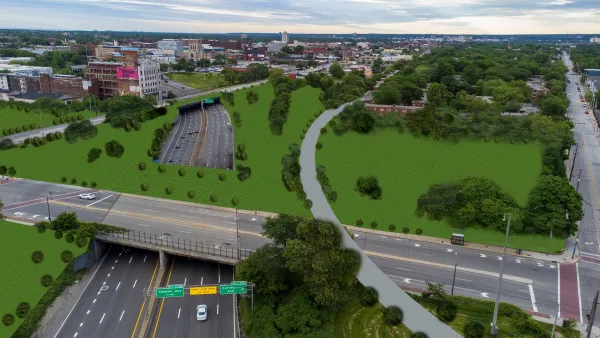
Freeway Cap Park Proposed in the Heart of Cleveland
A proposal to cap part of the Innerbelt Freeway east of Downtown Cleveland would require the demolition of a vacant, historic courthouse near the East 22nd Street Bridge.

Another State (Ohio) Gets It Right
Washington and California have been praised for early efforts to mitigate community spread of the novel coronavirus, resulting in relatively low rates of infection, hospitalization, and ultimately, death. Add Ohio to the bunch.

Planetizen Federal Action Tracker
A weekly monitor of how Trump’s orders and actions are impacting planners and planning in America.

The state-sanctioned urbicide of Austin
People don’t kill cities. Freeways do.

Colorado’s Largest Data Center Could Rise Next to Homes — Without a Public Hearing
The proposed campus would consume 11 times the power of Denver International Airport; as it has across the country, opposition mounts.

Raised interest rates may kill financially vulnerable construction projects
The chief economist at ConstructConnect warns that if construction project owners are negatively impacted by the raised rates, it could result in delayed payments to contractors.

Data centers are consuming nearly 25% of Oregon’s power
The state has 111 data centers, with 32 more either planned or under construction.

A third of Texas cities must update their zoning codes to comply with new housing law
Texas municipalities are now required to allow manufactured housing in at least one residential zoning district.

FREE Course: Walkable City 1: Why Walkability?
After describing his path towards focusing on walkability as the essence of good planning, Jeff Speck marches through his five principal reasons for making more walkable places.
Reinventing Malls: Planning Alchemy—Turning Gray Fields Into Gold
The course focuses on the opportunities and imperatives that shape reinvention of mall sites.

Greater Baltimore Committee
Eagle County Government
Harvard University Graduate School of Design
The Architects Foundation
University of Cincinnati Online
The Pocatello Development Authority
The Urban Renewal Agency of the City of Pocatello
Journal of the American Planning Association