When San Francisco Supervisor Scott Wiener proclaimed last month that his city "should always have a subway under construction," there were many doubters due to the funds required and unlikelihood of federal support. "Aggressive" is good, says Foxx.


Transit officials from throughout the country were gathered this week in the City by the Bay to attend the 2015 Annual Meeting of the American Public Transit Association (APTA). Joe Fitzgerald Rodriguez, transportation beat reporter for the San Francisco Examiner, writes that "while [DOT Secretary Anthony Foxx] only took a handful of questions from local journalists in 10 minutes, perhaps the most controversial concerned San Francisco Supervisor Scott Wiener’s proposed Subway Master Plan."
The plan would task San Francisco with ‘always’ building a subway, until it has a network of tunnels across The City.
The Examiner asked if Foxx approves of such an ambitious plan – especially in light of dwindling federal funds, which are key to capital projects.
Foxx gave all the reasons to be hesitant to pursue such an aggressive plan. Federal transit funding has gone from an 80 percent match to a 50 percent match, and "you're lucky to get that." The future for federal transit funding is uncertain, particularly with Republicans in charge of Congress.
With that in mind, Foxx said, local transit agencies should still aggressively pursue capital projects, like the Subway Master Plan.
Wiener's reaction: “Secretary Foxx’s support sends a powerful signal that we are on the right track in pursuing this plan. We need to work hard to convince other policymakers of the Secretary’s vision.”
San Francisco is currently building the the 1.7-mile, $1.6 billion Central Subway from Caltrain to Chinatown, and is "studying an extension of the subway to Fisherman's Wharf."
Hat tip: MTC-ABAG Library
Read the full story: U.S. Secretary of Transportation approves of ‘aggressive projects’ like SF subway master plan
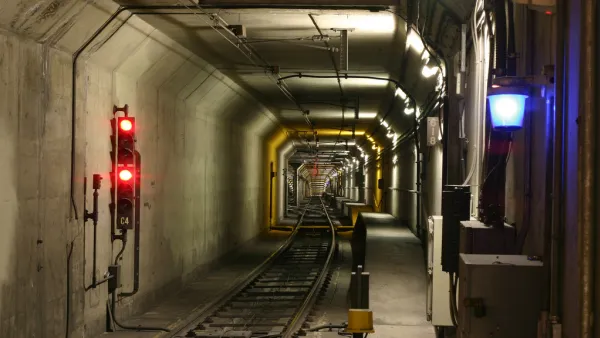
Subways Central to San Francisco Supervisor's Ambitious Transit Agenda
San Francisco County Supervisor announced an ambitious agenda to construct underground rail transit—arguing that the city "should always have a subway under construction."
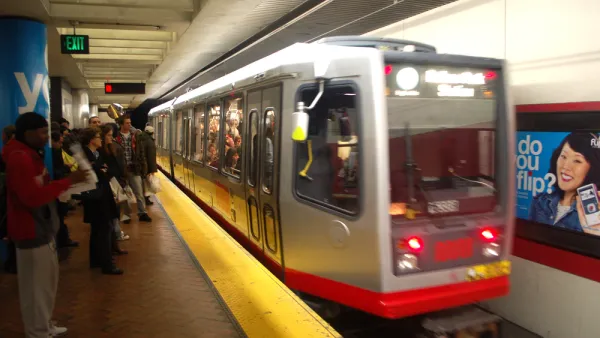
San Francisco Working on a New 'Subway Vision'
Planners in San Francisco have completed a public outreach process called Subway Vision. The goal is to create a framework for subway expansion in the city.
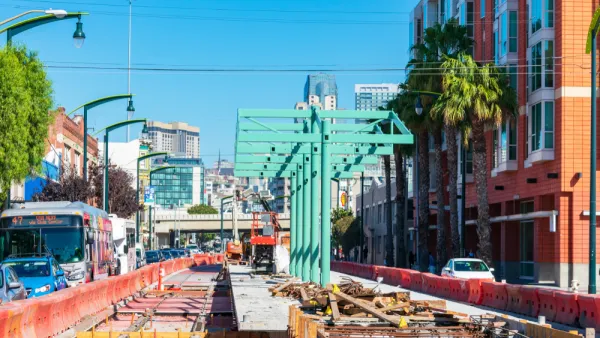
Long Delayed, $1.95 Billion Central Subway Opens in San Francisco
San Francisco’s first north-south subway opened last weekend, extending service on Muni’s T light rail line.

Planetizen Federal Action Tracker
A weekly monitor of how Trump’s orders and actions are impacting planners and planning in America.

California plans to bury El Niño’s downpour
If the state plays its cards right, it may be able to store a billion acre-feet of El Niño’s water in aquifers.

Desperate measures: Advocates weigh draining Lake Powell to fill Colorado River
Draining the reservoir could reduce evaporation losses by a couple hundred thousand acre-feet.

Chicago voters approve permanent festival grounds, penalty for vacant property owners
Currently, major summer and fall festivals take over public parks for weeks at a time, drawing criticism from nearby residents

NYC votes to cut outdoor dining red tape, speed up permitting
New York City also voted to allow the Department of Transportation to begin work on urgent projects before notifying elected officials.

California appears to reject Prop. 45
The proposition would have expanded the projects that qualify for a streamlined environmental review, effectively paring down the California Environmental Quality Act.

FREE Course: Walkable City 1: Why Walkability?
After describing his path towards focusing on walkability as the essence of good planning, Jeff Speck marches through his five principal reasons for making more walkable places.
Reinventing Malls: Planning Alchemy—Turning Gray Fields Into Gold
The course focuses on the opportunities and imperatives that shape reinvention of mall sites.

City of Rosemead
Rutgers University, Edward J. Bloustein School of Planning and Public Policy
One Hundred Miles
Hunter College, City University of New York (CUNY)
The Architects Foundation
University of Cincinnati Online
City of Cambridge
Montrose County
The Pocatello Development Authority