Land Use
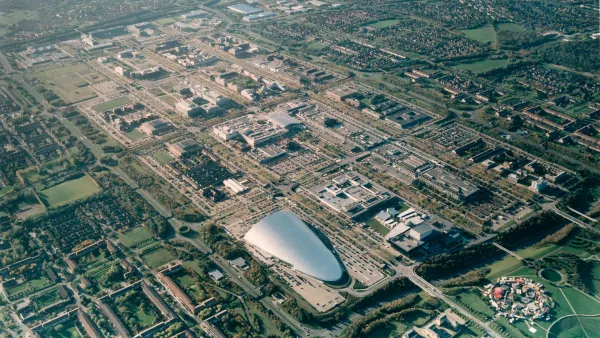
The UK’s Most Infamous ‘New Town’ Pioneers a Food System Revolution
Urban agriculture is a promising solution to a variety of ills afflicting our increasingly urbanizing planet. Milton Keynes, Britain's largest New Town of the 20th Century, is forging a path towards food sovereignty by growing its urban farms.
Modular Street Squares Turn NYC's "Leftover" Spaces into Public Amenities
New York City's 5.3 million square feet of “leftover” street space provides a prime opportunity to create public amenities and a more resilient city. Eric Tan and his colleagues at Gensler have created modular "Street Squares" to fill the void.

America's First Non-Profit Supermarket Provides a Model for Alleviating Food Deserts
Last weekend a new supermarket opened in Chester, Pennsylvania. But this isn't just another Safeway, Chester's groundbreaking non-profit supermarket could provide a model for areas across the country struggling to attract full-service grocers.
El Paso Officials Spread the Gospel of New Urbanism
Looking to move beyond its history of sprawling development, El Paso turned to New Urbanism. But instead of hiring New Urbanist experts, the city decided to indoctrinate its staff and private sector designers in the movement's principles.
Is Atlanta's Shift to Infill Development the Canary in the Sprawl Coal Mine?
A new study indicates that one of America's poster children for auto-centric development has a made a significant u-turn. Since 2009, the majority of Atlanta's new commercial and rental housing has been built in "walkable urban places".
Car-Free Events Improve Cash Flow for L.A. Businesses
A new study by UCLA's Luskin School of Public Affairs has found that the city's popular CicLAvia open streets event has been a boon to local businesses: boosting sales 10% for businesses along the route and 57% for those participating.
Pilot Parklet Program Finds Fans in L.A., May Expand
Before its launch, a skeptic in car-crazy L.A. might have wondered whether a pilot program to transform parking spaces into pocket parks would have much success. But, to the delight of backers, the parklets have been a hit and may expand citywide.
The State of Monopoly's Real Life Inspiration
When the infamous real estate and development board game was created, it took the streets of Atlantic City, NJ as the inspiration for its property names. In a photo tour through the city, Nick Carr notes how these streets appear today.
L.A.'s Bicycle Love Affair: Enduring Relationship or Passing Fancy?
The Los Angeles Times' editorial page declares itself "pro-bike" as it launches "Roadshare", an effort to engage the city's cyclists, drivers, pedestrians, taxpayers and others in a discussion over L.A.'s transportation future.
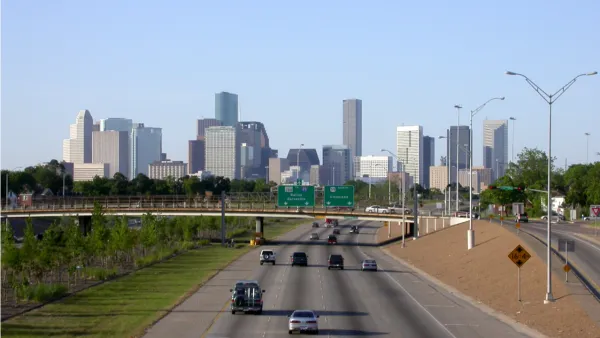
Houston Becomes an Unlikely Model for America's Urban Revival
In a city that has long typified auto-centric sprawl and unplanned growth, a funny thing is happening. An urban revival has taken root as the city competes with its suburbs and other big cities to attract residents and businesses.
Who'll Fix the Suburbs?
Two new books proffer the end of the suburbs and the salvation of dense urbanity. But the suburbs are "not about to shrivel," says Justin Davidson. So who should be responsible for fixing suburban dysfunction?
LEED-ND Projects Reduce Driving, But Is There a Simpler Way to Measure Success?
New research by Ewing et al finds that vehicle miles traveled in LEED-ND projects may be as much as 60% lower than regional averages. However, objective models of transportation outcomes may prove more efficient than LEED’s points-based system.
Poor Design Threatens L.A.'s Quixotic Grand Avenue Quest
With a key deadline looming today for downtown L.A.'s Grand Avenue project, a "little-noticed" decision last week by a public agency to reject the developer's most recent design has thrown the future of the elusive effort in doubt.
How Many Charity Races Is Too Many?
Every weekend, Chicago area public spaces are overrun with charity races, walks, and bike rides. For the charities, and city coffers, the events are largely a boon. But with such events increasing nationwide, is there a risk of 5K overload?
D.C.'s Neighborhood Committees Exert a "Great Weight" on Development: For Better or Worse?
Although they're not decision-making bodies, D.C.'s Advisory Neighborhood Committees (ANC’s) exert a powerful influence on the city's development process. David M. Schwarz Architects examine whether that's for better or for worse.
7 Promising Visions of "The City 2.0"
A conference hosted by TED last week in New York continued the conversation the organization started last year with the awarding of its 2012 prize to The City 2.0. Alissa Walker looks at some of the most promising visions for the future of cities.
$300 Million Aid Package Aimed at Revitalizing Detroit's Neighborhoods
The $300 million in federal and private aid announced Friday for Detroit is just a drop in the bucket compared to the city's $18 billion debt. While the aid is far short of a bailout, it represents a down payment on the city's recovery.
Can Planning Reverse the Rise in Sexual Violence in India's Cities?
The increase in vehicular speeds, removal of street hawkers, and addition of gated neighborhoods are all seen as contributing to a rise in crimes against women in New Delhi and other Indian cities. How can planning and design reverse this trend?
Maryland Light Rail Moved to Avoid Golf Course and Residents Cry Foul
In exchange for a promise from a country club not to oppose the planned Purple Line, the Maryland Transit Administration has agreed to move tracks, build sound walls, and attend regular meetings. Residents aren't happy about the special treatment.
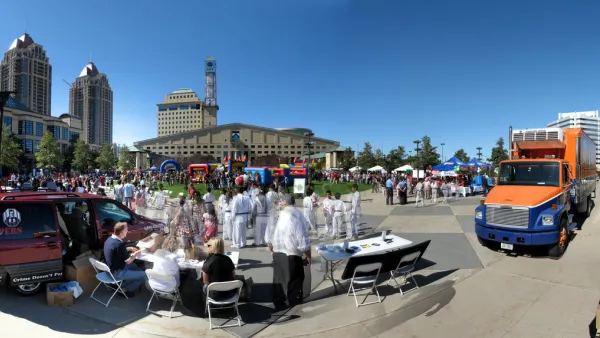
Why Toronto's Suburbs are the 'New City'
In the Toronto area, the region's suburbs have evolved in ways that make them fundamentally different from their outdated postwar image. Yet the ways we think and talk about the suburbs haven't kept up with this new reality.

FREE Course: Walkable City 1: Why Walkability?
After describing his path towards focusing on walkability as the essence of good planning, Jeff Speck marches through his five principal reasons for making more walkable places.
Reinventing Malls: Planning Alchemy—Turning Gray Fields Into Gold
The course focuses on the opportunities and imperatives that shape reinvention of mall sites.

City of Rosemead
Rutgers University, Edward J. Bloustein School of Planning and Public Policy
One Hundred Miles
University of Michigan School for Environment and Sustainability (SEAS)
Hunter College, City University of New York (CUNY)
The Architects Foundation
City of Cambridge
Montrose County
The Pocatello Development Authority









