Joe Nickol pens a paean to the often overlooked sidewalk: "our neighborhood's breadwinner, bringing vitality, safety, and economy."


As the street becomes a central subject of attention in our efforts to rethink urban and suburban development patterns, Nickol aregues that the sidewalk deserves to be reclaimed.
"No longer can sidewalks be value engineered out of the equation, disconnected or relegated to a single use. Layering design functions is critical to achieving the value they provide. They can be broad or intimate; flush to the street or raised; and shaded by galleries, awnings, arcades, or street trees. Sidewalks can be eaten upon, have chairs set up in them, performances performed in them, be an extension of a sales floor, or simply a place to stroll and window shop. They can be the safe route to school or a means to patrol the neighborhood. They can be urban or they can be in less dense areas. They are our most straight-forward and economical health care plan."
"Whatever the case, we must once again own the sidewalk."
Read the full story: Reclaiming the Sidewalk in City Design
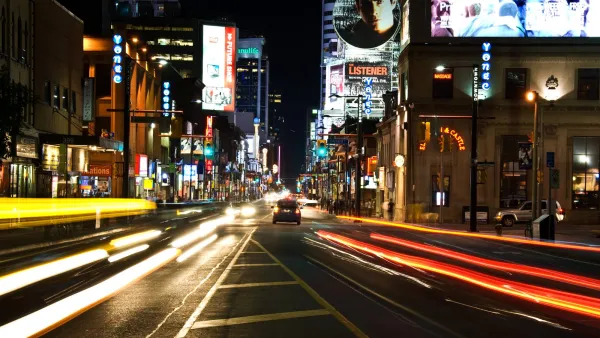
A Pedestrian-Forward Vision for Toronto Roadway
Toronto’s iconic Yonge Street is heavily used by pedestrians, and, according to this article, it's time for a revamp that acknowledges all of the street's users.
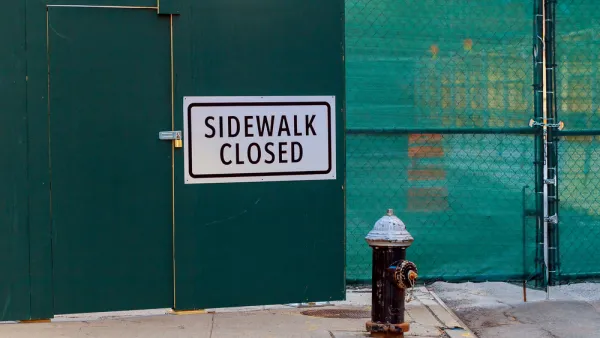
The Universal Need for Better Sidewalks
The "8 Principles of Sidewalks" guide has been translated from Portuguese to English and is available to download.
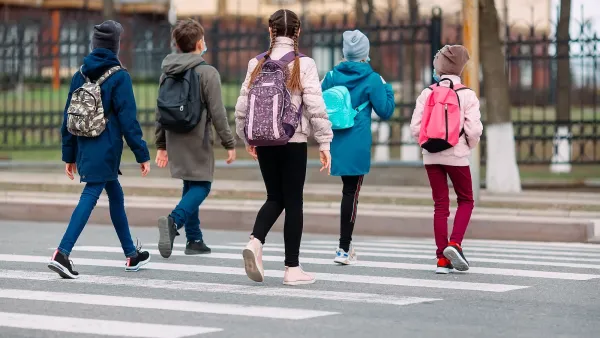
The number of kids walking to school dropped from over 50% to 11% since the 1960s
Unsafe pedestrian infrastructure makes walking to school dangerous or impossible for a growing number of American students.

Planetizen Federal Action Tracker
A weekly monitor of how Trump’s orders and actions are impacting planners and planning in America.

California plans to bury El Niño’s downpour
If the state plays its cards right, it may be able to store a billion acre-feet of El Niño’s water in aquifers.

Desperate measures: Advocates weigh draining Lake Powell to fill Colorado River
Draining the reservoir could reduce evaporation losses by a couple hundred thousand acre-feet.

Los Angeles just elected an urban planner as its mayor
Transportation analysts are optimistic that Raman will be more aggressive in addressing transit issues than Bass.

Mamdani’s pied-à-terre tax survives legal challenge
A panel of judges found that the plaintiffs failed to demonstrate injury as a result of New York City's implementation of the tax.

Eastern Nebraska is running out of electricity
Data centers and electrification are straining eastern Nebraska’s grid, throttling economic development.

FREE Course: Walkable City 1: Why Walkability?
After describing his path towards focusing on walkability as the essence of good planning, Jeff Speck marches through his five principal reasons for making more walkable places.
Reinventing Malls: Planning Alchemy—Turning Gray Fields Into Gold
The course focuses on the opportunities and imperatives that shape reinvention of mall sites.

City of Rosemead
Rutgers University, Edward J. Bloustein School of Planning and Public Policy
One Hundred Miles
University of Michigan School for Environment and Sustainability (SEAS)
Hunter College, City University of New York (CUNY)
The Architects Foundation
City of Cambridge
Montrose County
The Pocatello Development Authority