As the "new tech capital of the world," San Francisco's SoMA district is facing development pressures that challenge the city's often petty planning process, while providing an opportunity to reconsider what the city could become.


With a spate of new tech-driven developments in the pipeline, San Francisco's SoMA neighborhood is "in the midst of one of this city's great urban transformations," writes Randy Howder.
"From new office and mixed-use developments like 222 2nd Street, Foundry Square, 140 New Montgomery, and 5M to the new residential developments rising on Rincon Hill, and, of course, the Transbay Terminal, vacant lots and former freeway off-ramps are being replaced by ever more dense and street-friendly projects that will accommodate the tens of thousands of people expected to move to San Francisco over the next couple of decades."
"This level of development and the fees the projects bring the city offers an unprecedented chance to rethink urban living in SoMA at the scale of the entire neighborhood," he argues. "But this new development alone isn't enough to transform a part of town that's still too car-oriented and downright filthy to become a place most people want to set down roots and build a community. San Francisco has an opportunity to experiment with a new model, one that balances density and development with public space and that encourages engagement, activity, and innovative thinking."
Howder examines the tradtitional obstacles that have confronted transformative thiking in the city, and argues that San Francisco would be remiss in allowing those obstacles to stand in the way of "a chance to do something remarkable."
Read the full story: San Francisco's Chance for a Great Urban Transformation
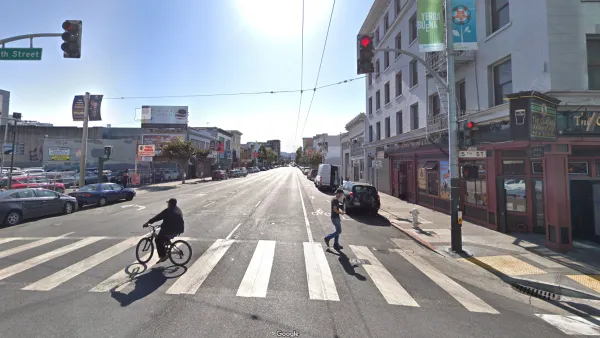
It Takes a Fatality to Remove On-Street Parking
On March 8, 30-year-old Tess Rothstein of Berkeley was riding a rented Ford GoBike in San Francisco's SoMa district when a car door suddenly opened, forcing her outside the narrow white line of the conventional bike lane into the path of a truck.
San Francisco MUNI's New Competition (in the Marina District, at Least)
Live in the Marina District and work downtown or SoMA? You now have more transit choices thanks to two new startups, Chariot and Leap. Think of the two private shuttle services as Google buses for the public, except they are not quite so large.
Third S.F. Cyclist Death Sparks Movement For Protected Bike Lane
The death of 24-year-old cyclist Amelie Le Moullac on August 14 marks the third this year by a truck, and the second by one turning right (known as a right hook) into the bike lane. Her death has set off a movement for safer streets in SoMa, S.F.

Desperate measures: Advocates weigh draining Lake Powell to fill Colorado River
Draining the reservoir could reduce evaporation losses by a couple hundred thousand acre-feet.

Eastern Nebraska is running out of electricity
Data centers and electrification are straining eastern Nebraska’s grid, throttling economic development.

Malls are becoming the midtowns of the future
Mall and office park redevelopments are a generational opportunity to create new nodes of urbanity.

NYC breaks ground on anti-flooding infrastructure project
New York City's new system will reduce stormwater flows to local sewers by 90%.

One Kentucky town’s secret to affordable housing
The Smoketown Community Land Trust has already built seven affordable homes for community members.

Houston gains petal-shaped cooling infrastructure to make streets more ‘delightful’
The city has installed the pavilions along 15 blocks in Houston.

FREE Course: Walkable City 1: Why Walkability?
After describing his path towards focusing on walkability as the essence of good planning, Jeff Speck marches through his five principal reasons for making more walkable places.
Reinventing Malls: Planning Alchemy—Turning Gray Fields Into Gold
The course focuses on the opportunities and imperatives that shape reinvention of mall sites.

City of Rosemead
Rutgers University, Edward J. Bloustein School of Planning and Public Policy
One Hundred Miles
University of Michigan School for Environment and Sustainability (SEAS)
Hunter College, City University of New York (CUNY)
The Architects Foundation
City of Cambridge
Montrose County
The Pocatello Development Authority