The death of 24-year-old cyclist Amelie Le Moullac on August 14 marks the third this year by a truck, and the second by one turning right (known as a right hook) into the bike lane. Her death has set off a movement for safer streets in SoMa, S.F.


Streetsblog's Aaron Bialick has covered the many unfolding aspects of Le Moullac's death and the San Francisco Bicycle Coalition's subsequent work to ensure that these types of deadly truck/car vs. bicycle collisions don't reoccur, particularly in the fast-growing South of Market area (SoMa) district of San Francisco, the location of all three bicyclist deaths this year.
SFBC is asking San Francisco Mayor Ed Lee to "commit to the redesign of Folsom Street" where Le Moullac had been riding that would include converting the existing bike lane into a protected bike lane. As Bialick noted in a blog for SPUR in 2011, it is an example of an "outdated, 20th-century strategy of engineering downtown streets into multi-lane, one-way motorways."
Bialick and KRON’s Stanley Roberts observed that "few drivers seem to understand how to properly make a right-turn in a bike lane — they’re required to merge fully into it, like any other traffic lane, while yielding to people on bikes. Instead, many drivers turn across the bike lane, setting up bicycle riders for a “right hook” crash."
Right hooks were the causes of death for Le Moullac and Dylan Mitchell while they were biking this year. The third victim, Diana Sullivan, was reportedly run over while stopped at a red light at Third and King Streets. None of the truck drivers involved have been cited or charged.
This movement for greater bike safety in the South of Market Area (SOMA) region of San Francisco following the deaths of cyclists has been seen in other cities. We noted attempts to safeguard cyclists from 'right hooks' in Seattle in 2008 and with the installation of 'bike boxes' in Portland in 2008.
September 6th update from S
Read the full story: At Safe Streets Rally, SFPD Blocks Bike Lane to Make Point of Victim-Blaming

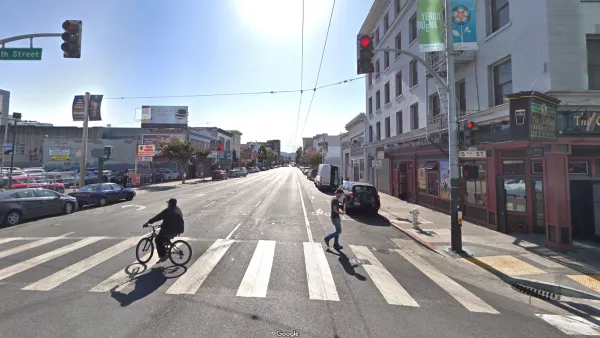
It Takes a Fatality to Remove On-Street Parking
On March 8, 30-year-old Tess Rothstein of Berkeley was riding a rented Ford GoBike in San Francisco's SoMa district when a car door suddenly opened, forcing her outside the narrow white line of the conventional bike lane into the path of a truck.
Construction Begins Raising San Francisco Bike Lane
A small section of the well-used, protected bike lane on San Francisco's busy Market Street will be raised just a few inches to increase bicycle safety. Construction began Monday and should take a month to complete.
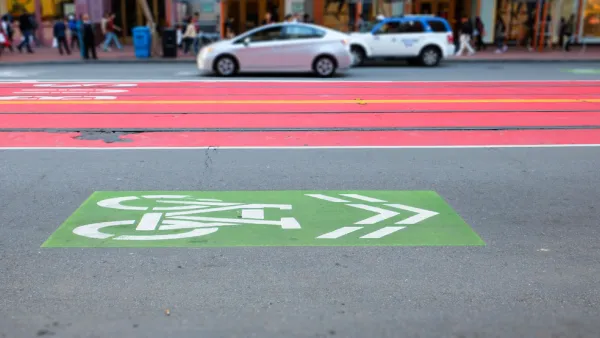
Protected Bike Lane Plan Shelved in San Francisco
Bike advocates say a protected bike lane near the downtown Caltrain station can't wait. The San Francisco Municipal Transportation Agency (SFMTA) says the project will have to wait.

Planetizen Federal Action Tracker
A weekly monitor of how Trump’s orders and actions are impacting planners and planning in America.

Amtrak, CN end decades-long dispute with eight-year agreement
The new operating agreement establishes an updated framework for the companies to work together, including processes to resolve disputes.

Judges permit Denver to divert 77,000 acre feet from the Colorado River for reservoir expansion
Overuse and climate change have caused the Colorado River’s water levels to plummet.

Northwest rail fans eager for Sept. 30 debut of Amtrak’s Airo fleet
Get ready for that new train smell and more seats. But they won’t go faster or run more frequently on the Cascades route in Washington and Oregon.

NYC DOT wants faster, more permanent street upgrades
The city is examining ways to build more concrete infrastructure without getting entangled in 'decades-long' projects.

'Something we’ve never seen before:' rising utility rates could strain city finances nationwide
Data centers, climate change and other factors have caused utility rates in the United States to increase by 38% since 2020.

FREE Course: Walkable City 1: Why Walkability?
After describing his path towards focusing on walkability as the essence of good planning, Jeff Speck marches through his five principal reasons for making more walkable places.
Reinventing Malls: Planning Alchemy—Turning Gray Fields Into Gold
The course focuses on the opportunities and imperatives that shape reinvention of mall sites.

Harvard University Graduate School of Design
KFH Group Inc.
Greater Baltimore Committee
The Architects Foundation
University of Cincinnati Online
The Pocatello Development Authority
The Urban Renewal Agency of the City of Pocatello