How thoughtful deregulation could unlock a housing and infrastructure boom, the social histories that lie behind a globalizing economy, and the growing role of artificial intelligence in planning.



This year, many writers focused in on the housing crisis, bringing various perspectives on why housing development is so difficult and expensive, why U.S. cities continue to rely on outmoded patterns, and how to move past the stagnation to make cities more livable and affordable. Zooming out, several authors take a similar view on city-building and development, arguing that, in an effort to prevent the mistakes of the past and ensure all citizens have a voice, progressive policymakers have swung too far in the other direction, overregulating projects out of existence and stymying progress. Doubtlessly, leaders who pushed through massive infrastructure projects have displaced countless American families, disrupted communities, and reinforced patterns of exclusion and disinvestment. But for many of this year’s authors, this doesn’t mean the U.S. can’t still build big things in large volume — but doing so requires new paradigms and the political will to change long-standing practices.
Some selections, while at first glance histories of specific cities or regions, speak to much broader issues. From the lessons a warming world can learn from the cities of the American Southwest to the globalized trade economy as seen through the social history of Oakland, California, these place-based books offer stories that are often universal via deeply researched chronicles of trailblazing U.S. cities.
Map nerds will find an interesting read in a book about the relationship between maps and mathematics, a well-illustrated outline of how maps serve as the visual representations of mathematical concepts that shape how we view the world. A book about an ephemeral resource, shade, reminds us of how crucial it can be in warming cities. Baseball fans will enjoy an intimate history of small town baseball and its role in American communities. And AI expert offers a detailed, rigorous guide to basic AI concepts, ethical concerns, and urban planning applications of a technology that’s becoming impossible to ignore.
Please note that this list — named in no particular order — only includes books published between roughly November 2024 and October 2025. Books published in the last part of the year will be evaluated for next year’s list. Think we missed any outstanding books from this past year? Let us know!
American Oasis: Finding the Future in the Cities of the Southwest
Kyle Paoletta
Pantheon
January 14, 2025, 352 pages
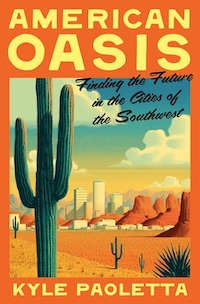 A native of Albuquerque, Kyle Paoletta blends a deep personal passion for the Southwest with clear-eyed scholarship that traces the history and growth of Southwestern cities like Las Vegas, Phoenix, and El Paso. These cities offer both a tantalizing example of the American Dream — metropolises that rose like mirages out of the desert — and a stark warning against unfettered growth in the face of water scarcity and rising heat.
But Paoletta asserts that the Southwest also possesses a resilience that offers useful lessons for other regions. Describing Las Vegas, Paoletta writes, “Only here, in the forlorn Mojave Desert, could a handful of civic pioneers have realized their supersize ambitions in such a short period of time. The city stands as an assertion of selfhood in a place given to abnegation, a monument to willfulness in the face of droughty indifference.”
American Oasis describes how the Native Americans of the Southwest adapted their built environment to the climate, how the region was transformed as its political control changed hands, and how the meteoric growth of modern cities has shaped it. The book includes the stories of formative figures in each city’s history, offering a humanizing view of civic growth.
As Paoletta takes us on a road trip through the desert, it becomes easy to understand the allure of the region, as well as the limits of growth and innovation and the challenges ahead. “As the twenty-first century wears on, it will become impossible to ignore the eternal truth that the earth sets the conditions, and the only sensible path for humanity is to meet those terms with humility and grace.”
The Pacific Circuit: A Globalized Account of the Battle for the Soul of an American City
Alexis Madrigal
MCD
March 18, 2025, 384 pages
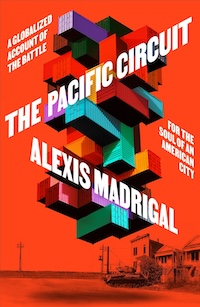 The Pacific Circuit is a story about Oakland, a city uniquely positioned at the crossroads of past and future economies. But it’s also a broader story of globalization and reinvention that offers lessons for other cities.
Madrigal focuses on Oakland’s history as a nexus for progressive activism and labor movements, which have persisted in many ways despite the city’s evolution as part of the titular Pacific Circuit, the “vast, powerful, opaque cultural structure” that is today’s globalized supply economy.
The book centers Oakland and its port as a key entry point for imported goods, a lynchpin of international trade that exploded after containerization revolutionized shipping. But this success comes at a cost to the communities that bear the brunt of the air pollution and displacement brought on by commerce. In The Pacific Circuit, Madrigal addresses these costs, and how activists and community members have fought for justice, through a carefully researched social history brought to life by human stories.
Abundance
Ezra Klein and Derek Thompson
Avid Reader Press / Simon & Schuster
March 18, 2025, 304 pages
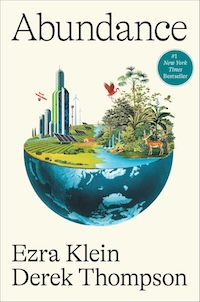 The year’s buzziest planning-related book, Abundance coalesces several of Klein and Thompson’s ideas about the housing crisis into one volume, outlining the trajectory of housing affordability in America and the authors’ proposed solutions. The book aims its critiques and suggestions at the progressives who the authors see as their peers, offering their approach to making housing work for everyone.
The main thrust of the book is a call to reject the scarcity mindset that leads people to favor exclusionary policies. For the authors, an abundance mindset means making it “easier to build and create more so there is enough for everyone.” They aim their message at fellow progressives, arguing that it is often the most ‘progressive’ and left-leaning states that have the most restrictive regulations on new housing, often stifling development and driving up the cost of living in the process.
The ‘Abundist’ philosophy speaks to proponents of effective altruism and other movements that purport to bring a dose of realism to lofty social goals. The approach relies on compromise and trade-offs in regulations and zoning — essentially, “don’t let the perfect be the enemy of the good.” The book offers a way of thinking that the authors believe could help ease regulatory bottlenecks. In a similar vein to other book such as Stuck and Why Nothing Works, Abundance wants to be at the vanguard of a intentional deregulatory movement that they believe will liberate innovation and growth in housing and other areas.
Why Nothing Works: Who Killed Progress — and How to Bring It Back
Marc J. Dunkelman
PublicAffairs
February 18, 2025, 416 pages
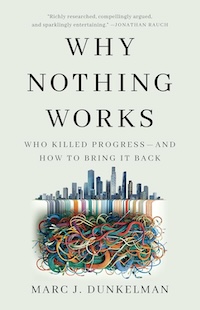 Like other books that were published this year, Why Nothing Works primarily aims its critiques at the left, charging that American cities are no longer “building big things” largely due to an overcorrection of prior sins — namely the displacement and other harms caused by leaders like Robert Moses, who plowed ahead with projects with little regard for the victims left in their wake.
For Dunkelman, “the [progressive] movement’s determination to protect against latter-day Robert Moses types now serves not only to thwart abuse, but also undermine government’s ability to do big things.” In the effort to prevent the destruction that can be wrought by powerful, unaccountable leaders, progressives have kneecapped necessary development, partly contributing to today’s housing crisis and lack of imaginative solutions.
Contrasting ‘Jeffersonian’ and ‘Hamiltonian’ views on government, Dunkelman, like other authors on this year’s list, argues that the perfect can’t be the enemy of the good — not when people’s livelihoods are at stake. Effective government, for Dunkelman, requires a balance of the Hamiltonian impulse to empower government and institutions with the Jeffersonian desire to limit the reach of centralized government and give voice to everyday citizens.
Dunkelman warns of the danger in letting citizens believe government is incompetent, unable to build housing, infrastructure, or anything else. Once people no longer trust institutions, where do they turn? For Dunkelman, it’s imperative for governments to both ensure that voters feel listened to and to actually deliver on promises of more affordable housing, better jobs, and a lower cost of living.
Mapmatics: How We Navigate the World Through Numbers
Paulina Rowińska
Belknap Press
September 17, 2024, 304 pages
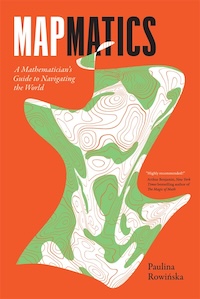 If you’ve never taken a dive into the roots of cartography, this book offers a highly readable history of mapping and its connection to mathematics. By explaining how math and maps intertwine, Rowińska illustrates the power that maps have to shape politics and influence how we see the world.
According to Rowińska, “Maps have been fueled by mathematics and have also inspired numerous mathematical breakthroughs. Once we notice this connection between mathematics and cartography, we won’t be able to unsee it, and it will help us to understand how our world works.” From figuring out how to illustrate a 3-dimensional world on a flat surface to the gerrymandering of political districts, Mapmatics shows how maps can be used — and abused — in everything from navigation to disease prevention.
Rowińska argues that “Maps represent reality, but we can take full advantage of these visual aids only when we understand the underlying math.” Both cartographers and mathematicians, Rowińska writes, are tasked with creating useful models of real-world phenomena within the limitations of written or visual media.
Stuck: How the Privileged and the Propertied Broke the Engine of American Opportunity
Yoni Appelbaum
Random House
February 18, 2025, 308 pages
Many planners probably imagine permanence when they envision the structures, roads, parks, and other trappings of urbanism that they must account for. But, no matter how many years, or centuries, a building might stand, the people who use and live in them are in constant flux. Or, at least, they should be.
Stuck, by historian and journalist Yoni Applebaum of The Atlantic, raises the alarm of stasis in the United States. Due to rising home prices — especially in economically prosperous cities — demographic shifts, restrictive zoning, tax revolts, and various varieties of NIMBYism, Americans are not moving as much as they used to. Applebaum argues that movement has traditionally defined American settlement patterns, with a full third of Americans changing addresses each year in the late 1800s. He cites sweeping examples like (woefully imperialist) Manifest Destiny and Great Migration as well as more localized patterns, such as the relatively brief tenure of most immigrants who lived in New York City’s tenements before moving up(town) to more spacious quarters and more prosperous lives.
Today’s immobility crisis, Applebaum writes, “shows up in lengthening commutes…soaring home prices… . painfully high rents…. homelessness,” and withering economic opportunities (he cites one study suggesting that if New York City and the Bay Area built enough housing to meet demand, GDP would rise by $2 trillion). This trend should concern planners greatly. They should not just build cities that people want to move to, but also cities that people want to move within and out of per their preferences and economic ambitions. Applebaum’s solution: “build.” “We need to turn housing from a scarce asset back into an abundant resource.”
Land Power: Who Has It, Who Doesn’t, and How That Determines the Fate of Societies
Michael Albertus
Basic Books
January 14, 2025, 336 pages
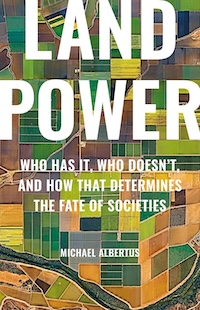
For all the ways that individuals and people wield power within and between societies, one of the oldest is still one of the most powerful: regulation, control, and ownership of land. Michael Albertus, a professor of political science at the University of Chicago, illustrates many of the nuances, across eras and geographies, in Land Power. Up to roughly 200 years ago, the control of land was essentially dictated by versions of feudalism, in which physical might and generational traditions determined who owned what. This system “defined and conditioned virtually every aspect of social life,” typically to the detriment of anyone without land. Albertus describes how land-based inequities have historically disadvantaged women and ethnic minorities, and led to environmental degradation.
In the late Modern Era, societies engaged in what Albertus calls “the Great Reshuffle.” Land has been, on occasion, deliberately redistributed (or conserved), and the monopoly of the wealthy has broken down. These efforts have been a mixed bag. But, he argues that, with enlightened redistribution schemes, land power need not be zero-sum. Albertus’s examples range from Chilean wilderness areas to Bengali farms to the desert city of Palm Springs, where Anglo settlers have clashed with the Agua Caliente tribe for centuries.
Albertus notes that some conflicts over land will take new turns in an era of population decline, and he is optimistic that “governments, communities, and individuals around the globe are…. Turning away from traditional, narrow conceptions of exclusive and individual ownership…. To balance the benefits of ownership and economic growth with environmental management, equality, land and housing access, and a voice for broader communities." Albertus does not focus on cities so much as on broader swaths of land. But, for planners, the power struggles, and solutions, he describes apply on almost any scale.
Shade: The Promise of a Forgotten Natural Resource
Sam Bloch
Random House
July 22, 2025, 315 pages

In the spirit of surprising but engaging single-subject histories like Stiff and Salt, environmental journalist Sam Bloch begins with a history of his titular subject matter. It turns out that the history of shade is arguably richer than the present. In ancient Mesopotamia, the grids of early cities were oriented diagonally, in order to catch shade as the sun moved throughout the day. Ancient Rome featured arcades and canopies under which entire urban subcultures — including strolling, commerce, and prostitution — arose. Conversely, deforestation was so common in the American colonies, shade was "forgotten."
Today, climate exchange is in full swing, exacerbated by climate change, and life out-of-doors is miserable for too many people. Bloch reminds us how vulnerable the human body and mind are to overheating. Societies that are overcooked aren’t just less comfortable; they are also less productive and less civil than more temperate ones are. Referring to examples like Los Angeles and Phoenix, Bloch explores what happens when the heat island effect mixes with the lack of shade, which is especially absent in poorer neighborhoods.
Whether shading is a matter for architects, landscapers, public works people, or planners is debatable. But, it doesn’t matter. Bloch sounds the alarm for anyone who will listen, calling for cities to recognize “the right to shade.” He writes favorably of “shade audits” in Australia and notes that streets made shadier — by trees, fabric “sails,” or architectural features make cities more walkable, productive, and healthy. He notes grimly that this issue will only get worse as climate change intensifies.
Books by Planetizen Contributors
The Unfinished Metropolis: Igniting the City-Building Revolution
Benjamin Schneider
Island Press
October 21, 2025, 320 pages
 Why has the evolution of American cities stagnated since the 1970s — and how can cities do better for the people that live in them?
In The Unfinished Metropolis, Schneider argues that the development patterns entrenched in U.S. citybuilding since the mid-20th century no longer serve us, and that it’s time to radically reimagine how and where we build. The book urges readers to envision cities with “new districts of light-filled apartment buildings that working-class families can afford, automated metro lines that practically teleport riders between neighborhoods, and supersafe bike lanes that make school drop-off a daily joy.”
Schneider offers positive examples of major urban development projects, the most successful of which are parks a la New York City’s High Line, San Francisco’s Salesforce Park, or Chicago’s Millennium Park. And while parks are crucial urban infrastructure, he calls these low-hanging fruit in the scope of city-building, projects that often enjoy political support and philanthropic financing.
When it comes to projects that are complex, expensive, have long time horizons, or encounter political opposition, U.S. cities largely fail. In Schneider’s view, this is in part because other governments take an “active, rather than reactive” role in urban development and empower transit agencies, social housing developers, and other government agencies with adequate funding and resources. By explaining how key parts of the built environment came about and why they often no longer function the way they were intended to, Schneider argues for a new city-building movement that reimagines public and private spaces to create more livable, affordable communities through large-scale, government-backed projects and major regulatory changes that, in Schneider’s view, are the only solution for some of the country’s biggest challenges.
Artificial Intelligence for Urban Planning
Thomas W. Sanchez
Routledge
September 22, 2025, 254 pages
 Whatever your feelings about artificial intelligence, its impact can no longer be ignored. In planning as in many other fields, AI offers the promise of increased efficiency and more informed decision-making, but not without limitations and risks.
Sanchez introduces essential concepts, ethical challenges, and practical considerations for planners. The book offers tools for integrating AI into daily work and understanding its capabilities and implications, a task becoming ever more vital. Sanchez urges planners to learn about AI so that they can have a say over how it’s ultimately utilized. The book demystifies key concepts, empowering planners to adopt AI tools with confidence and build capabilities for better analysis and knowledge sharing in the field.
Honorable Mentions
A few other titles caught our eye this year. Born in Flames: The Business of Arson and the Remaking of the American City by Bench Ansfield is a provocative and thoroughly researched account of a 1970s arson wave that saw tens of thousands of families lose their homes to intentional fires and impacted how the insurance market operates to this day. Homestand: Small Town Baseball and the Fight for the Soul of America by Will Bardenwerper offers a nostalgic and reverent look at small, legacy cities and the role that minor league baseball plays in community-building. Clamor: How Noise Took Over the World - and How We Can Take It Back by Chris Berdik begins a much-needed exploration of how urban sounds impact public health and why noise pollution is more than just a daily annoyance.


Planetizen’s Top Urban Planning Books of 2024
Top of mind in 2024 were the far-reaching impacts of climate displacement, zoning as a solution to the housing crisis, and the potential for safer roads and better public transit in American cities.
The "vicious cycle of real estate mania" — and how we might find our way home
Book review: In "The Lost and the Found: A True Story of Homelessness, Found Family, and Second Chances," Kevin Fagan humanizes the housing crisis like never before.

Oakland opens first affordable housing for teachers
The school district says 70% of its teachers can't afford to live in Oakland.

The state-sanctioned urbicide of Austin
People don’t kill cities. Freeways do.

US to reduce Colorado River water deliveries to Mexico
A new Colorado Treaty amendment reduces Mexico’s Colorado River water allocation by 250,000 acre feet.

New Jersey’s second-largest city bans standalone data centers
Jersey City will continue to allow co-location facilities, such as those meant for research institutions that store their own data.

Amtrak not solely to blame for New Jersey commuter rail's unreliability, report finds
A new study from the Garden State Initiative found that NJ Transit’s budget grew 20% across a 4 year period, but reliability declined significantly over the same period.

EPA erases limits on planet-warming pollution from power plants
Under Monday’s plan, power plants would still have some limits on how much mercury, arsenic and other contaminants they can emit.

Phoenix announces new on-demand transit service, more frequent RAPID buses
Both new services will launch in October, and are part of Phoenix's Project Effective Access Solutions for Easing Congestion.

FREE Course: Walkable City 1: Why Walkability?
After describing his path towards focusing on walkability as the essence of good planning, Jeff Speck marches through his five principal reasons for making more walkable places.
Reinventing Malls: Planning Alchemy—Turning Gray Fields Into Gold
The course focuses on the opportunities and imperatives that shape reinvention of mall sites.

Eagle County Government
Harvard University Graduate School of Design
Nashville Planning Department
The Architects Foundation
University of Cincinnati Online
The Pocatello Development Authority
The Urban Renewal Agency of the City of Pocatello
Journal of the American Planning Association

