Examining models of progress toward restrictions on the use and storage of automobiles from urban areas around the world.



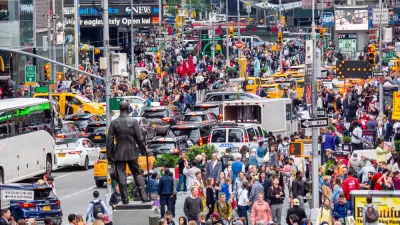
Excited by the number of cities that have closed off streets to cars during the Covid-19 pandemic, urban planners are envisioning a different city. Last week, Farhad Manjoo’s graphic New York Times feature, “The End of Cars,” showed the nation how amazing our streets could be without cars. At least a dozen cities have closed streets to make room for socially distanced walking and biking. Others are extending sidewalks for al fresco dining. Oakland is the leader, with 74 miles of closures, but New York is catching up with plans to close off 100 miles of streets. Seattle is the first city to make its closure of 20 miles of streets permanent.
Now that we have the vision, how do we achieve it once the pandemic is over? Making this transition in U.S. cities, even at a small scale, will be excruciating, as nearly all are built around the car. Seattle illustrates that even in a liberal city committed to climate action, deprioritizing cars is painful and politically charged.
Driving less means using other modes of transportation more—public transit, biking, and walking. But options vary depending on a city’s population, density, degree of sprawl, and the extent of 20th century rail removal. Many people in low-income neighborhoods have neither cars nor adequate access to reliable transit, yet equity objectives related to accessibility and affordability of transit are not often integrated into transportation plans in North American cities
In Greenovation, Urban Leadership on Climate Change, I outline five actions for deprioritizing cars. I elaborate on three of them below.
Create Car-Free Areas
European cities lead. Venice, of course, has always been car free. Copenhagen began creating car-free zones in the 1960s. Freiburg, Germany banned cars in its historic center in 1973 and built extensive bike and trolley infrastructure to replace cars. Brussels has one of Europe’s largest car-free areas, which city officials are continually expanding. Berlin, Hamburg, Madrid, and Oslo are among the European cities that have taken comprehensive action to create car-free zones and add bike “superhighways”—physically separated, uninterrupted bike lanes that traverse a city. Berlin’s famous Unter den Linden began allowing only buses, taxis, and bikes in 2019. And in April 2019, Berlin senator for environment, traffic, and climate protection Regine Günther announced that the entire area inside the S-Bahn train ring to become car free by 2030, a controversial undertaking. Berlin planners are piloting closing off streets and monitoring the effect on different transportation modes on these and surrounding streets. Hamburg’s approach is more comprehensive, but slower: pedestrian-only zones will be added gradually to include 40 percent of the city by 2035.
The strategy has been to create the bans, observe how they play out, and course correct based on observations. Policies at the city and national level support that process. Copenhagen and Oslo are helped in reducing cars by the fact that Denmark imposes a 180 percent tax on new car purchases and Norway 100 percent.
Although car-free zones are politically controversial, Madrid shows that once the public experiences car-free living, people don’t want to go back to car-choked cities. When a right-wing coalition that came to power in May 2019 tried to eliminate that car-free areas, public backlash pressured them to relent. But Germany’s experience probably more closely predicts what will happen in the United States, as both countries have strong car cultures. Günther’s call for a car-free Berlin and eliminating cars with combustion engines even has opposition from the Social Democratic Party (SPD), which is often in coalition with the Green Party, because of its impractical timeline. Another factor at play in Berlin that is similar to many U.S. cities is that its multi-nuclei urban form and grand-scale boulevards and sidewalks makes the need and desire for getting rid of cars less urgent, as Fergus O’Sullivan points out for Bloomberg CityLab.
Provide Less Parking—and Make it Expensive
Too many cities have contradictory policies. Limiting cars requires more public transit. Cities that want to increase transit—the carrot—will not be effective without the stick of reducing the amount of parking and increasing its cost. Closing off streets does reduce parking, but cities also have to experiment with reducing or eliminating parking minimums. These local laws require developers to provide a certain amount of off-street parking, which varies for residential and commercial areas. Among cities pursuing this approach are Buffalo, Columbus, London, Mexico City, Paris, Philadelphia, San Francisco, Seattle, Washington, D.C., and many more. UCLA urban planning professor Donald Shoup, a leading critic of free and too-plentiful parking, has demonstrated that minimums produce far more parking spaces than needed and make housing more expensive.
Other cities are reducing the amount of free parking on offer. Zurich and Hamburg have taken a comprehensive and highly managed approach. In 1996, Zurich capped the number of parking spaces and instituted a cap-and-trade-type system that requires retiring old spaces to match any new spaces. These measures to reduce parking reduce traffic and are less controversial than congestion pricing, which charges vehicles for entering areas of the city.
Implement (Better) Complete Streets Programs
Complete streets are an approach to designing and operating streets that safely accommodates pedestrians, bicyclists, drivers, and transit riders of all ages and abilities. The movement got its start in 2004, and currently about 25 percent of American municipalities report the adoption of complete streets policies. The problem is the policies are often ignored. Cities have to get better at living up to complete streets commitments. A study by University of Toronto planners Kelly Gregg and Paul Hess found that of 125 complete streets policies, most are aspirational and don’t grant clear legal authority for implementation or provide requirements or processes for balancing the trade-offs among the different uses that the streets are supposed to accommodate. They conclude that most policies are weak and “do not create a solid foundation for transforming deeply institutionalized auto-oriented street building practices.” Further, comprehensive complete-streets policies tend to be found in places that are white and wealthy, according to a 2017 report examining policies across the country. Some evidence suggests that complete streets can lead to gentrification, leading to the National Complete Streets Coalition to include equity and diversity into its evaluation rubric and focus more on underserved communities.
The other strategies are building right-sized bus rapid transit and implementing (better) transit-oriented development. None of these are new—planners and other urbanists have been advocating for these approaches for years. As usual, what is missing is political will. Perhaps this Covid-induced vision of cities without cars will create it.

Did the Pandemic End the Car's Domination of New York Streets?
Imagining a post-car (or car-lite) New York City.
Open Streets and Outdoor Dining Are Best for Business, Report Says
Most business owners believe that they'd be out of business without on-street parking near their front door. The experience of New York City during the pandemic proves otherwise.
Cities Rethinking the Value of Parking
The effort to reclaim public and private spaces from car storage had some setbacks since the days of al fresco and open streets in the first years of Covid-19. But widespread parking reforms and new evidence shows the public is rethinking parking.

Planetizen Federal Action Tracker
A weekly monitor of how Trump’s orders and actions are impacting planners and planning in America.

Amtrak, CN end decades-long dispute with eight-year agreement
The new operating agreement establishes an updated framework for the companies to work together, including processes to resolve disputes.

Colorado’s Largest Data Center Could Rise Next to Homes — Without a Public Hearing
The proposed campus would consume 11 times the power of Denver International Airport; as it has across the country, opposition mounts.

Federal judge strikes down DOE orders to keep Michigan power plant open past retirement date
The decision is one of the first successful legal challenges to President Trump’s “national energy emergency” ruling, which instructs federal agencies to use emergency powers to increase fossil fuel production.

'This is going to be painful:’ Virginia stares down $1.7 billion funding gap for highway maintenance
The state may address the deficit by shifting $290 million from its construction budget to maintenance projects.

Judges permit Denver to divert 77,000 acre feet from the Colorado River for reservoir expansion
Overuse and climate change have caused the Colorado River’s water levels to plummet.

FREE Course: Walkable City 1: Why Walkability?
After describing his path towards focusing on walkability as the essence of good planning, Jeff Speck marches through his five principal reasons for making more walkable places.
Reinventing Malls: Planning Alchemy—Turning Gray Fields Into Gold
The course focuses on the opportunities and imperatives that shape reinvention of mall sites.

KFH Group Inc.
Greater Baltimore Committee
Eagle County Government
The Architects Foundation
University of Cincinnati Online
The Pocatello Development Authority
The Urban Renewal Agency of the City of Pocatello

