The demise of local businesses reached a crisis point long ago. To survive, they must resort to desperate measures—by actually asking for help. If they don't, the urban fabric will suffer.


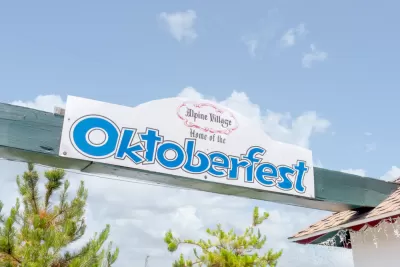
Allow me to make a modest proposal: Oktoberfest in April.
I advance this culturally insensitive but, hopefully, not unwelcome idea because, in Los Angeles, there will be no Oktoberfest this year. To the list of bookstores, hardware stores, clothing stores, single-screen movie theaters, restaurants, and dive bars slaughtered by this decade’s ungodly coincidence of recession, rental rate inflation, and online consumerism that has ravaged coastal California and other expensive metros, we must now bid auf wiedersehen to Alpine Village.
More than just a restaurant, but not quite a village, Alpine Village, in the beach-adjacent city of Torrance, has served its share of schnitzel, spaetzle, and sauerkraut throughout the year for the past 51 years. But Oktoberfest, during which Alpine Village tented its parking lot and transformed it into a beer hall, was where it made serious Deutsche marks.
It seems tacky, for sure. But, as cultural appropriation goes, I think Southern Californians consumed their sausages and downed their beers with sufficient reverence for German culture. There was probably a lot of stumbling around and ironic lederhosen too.
I actually wouldn’t know. Going to Alpine Village’s Oktoberfest was always one of those things I’d always intended to do but never got around to. And I certainly never considered it endangered. Between the century-old American tradition of drinking beers in parking lots and the 210-year tradition of commemorating Prince Ludwig’s marriage to Princess Therese, I figured Alpine Village was pretty safe. Not so much. It’s closing April 15.
Is nothing sacred? These days, no.
The onslaught started years ago with big box stores, continued with the rise of e-commerce, and, in some cities, has reached the level of a true crisis with the rise in retail rental rates. It’s no wonder that some cities—most prominently San Francisco—are proposing measures, such as taxing vacant storefronts, to encourage landlords to keep the businesses they have rather than raise rents in the hopes of landing newer, richer tenants. In many cases, those tenants are deep-pocketed chains. In many other cases, they are nobody. How can anyone pay more when the competition is paying just for megabytes and bandwidth?
This story takes place in Los Angeles, but it could just as easily take place in any other high-cost city short of Munich.
Why should we care? I suppose the folks who buy every necessity and three meals a day at Walmart don’t care. At least, they don’t care enough to pay a premium, however slight, to shop at unique stores run by real neighbors rather than a behemoth concerned only about its stock value. For everyone else, stores are essential elements of the urban fabric. Planners and urbanists can talk about building and rebuilding great cities. But if there’s nothing to put in those buildings—especially in critical street-level spaces—then there’s not much point. An empty storefront is scarcely better than a vacant lot.
What saddens me isn’t just the number of small businesses that have closed—it’s the number that have closed silently.
If a store closes in the city and no one hears, did it really close? Yes. After Adventure 16 announced its closing, it naturally had a clearance sale. The day I went, the line just to get in the front door was 20 people deep when I arrived. A16 had no shortage of fans. It just had a shortage of customers. They showed up (myself included) only after it was too late. We missed the birthday party and came only for the funeral.
It’s not that loyal customers are mercurial—it’s just that, too often, they simply don't know when beloved places are in trouble.
Contrast A16 with Peterfield Bookshop in Hampshire, England. A few weeks ago, Peterfield went an entire day without selling a single book. Its owner sent out a plaintive tweet, "Not a single book sold today…£0.00…We think this (is) maybe the first time ever." The next day they sold 1,000 GPB worth of books. Customers knew the store was in trouble. They tapped into their empathy for the earnest merchant and, presumably, their self-interest—who doesn’t want a thriving bookstore nearby?
Surely that single day won’t save the store. But that tweet put customers on notice. They now have all the more reason to think about Peterfield before they buy another book on Amazon.
Imagine if Adventure 16 had done the same—if they hadn’t "toughed it out," like a good outdoorsperson ascending a 14’er, but rather sent up a flare and asked for help. Imagine the number of people who’d have dropped their parkas, ground pads, and dehydrated meals right there in the checkout line at REI to come to its rescue. Just as people with illnesses should not suffer silently, neither should under-performing stores. For businesses, revenue is the best medicine.
Which brings me back to Alpine Village. Oktoberfest probably makes their year financially. And Oktoberfest probably makes some of their customers’ years socially. So, if you can’t get by on one Oktoberfest, why not have two? Why not raise the alarm and entreat loyal fans to drink a few extra steins? Why not give fans (Alpine Village has "zuperfans") the chance to save an institution?
We in Southern California have never needed our holidays and our weather to match up. A Bavarian might tell you that cheering "O'zapft is!" in April is sacrilege. I don’t think anyone else is going to mind. Los Angeles needs all the communal events it can get.
It’s too late for Alpine Village. But it’s not too late for other places. Any store, restaurant, or beer garden that has hung on this long surely has its fans. If things start to get bad, those fans deserve to know. They deserve the chance to show their loyalty. Future generations deserve the pleasure of drinking beer and carrying on under a tent. And if businesses themselves don’t fight back against the "retail apocalypse," who will?
For me, if I’m ever going to go to Oktoberfest, it’s going to cost me a ticket on Lufthansa. I love Munich as much as the next guy, but I’d still rather spend my money at home. Even if it’s in a parking lot.

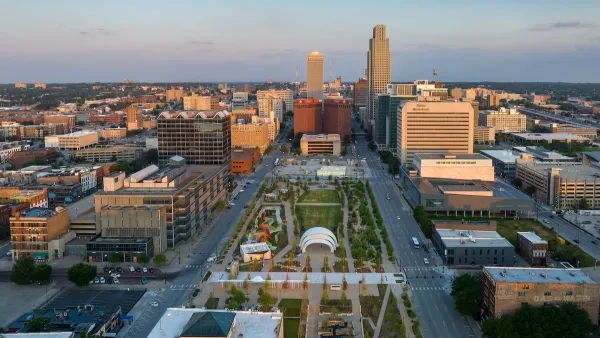
Downtown Omaha Planning for its Post-One-Way-Streets Era
The Omaha City Council has decided to reverse the transportation model adopted in the city in the 1950s, for the benefit of traffic safety and local retail activity.
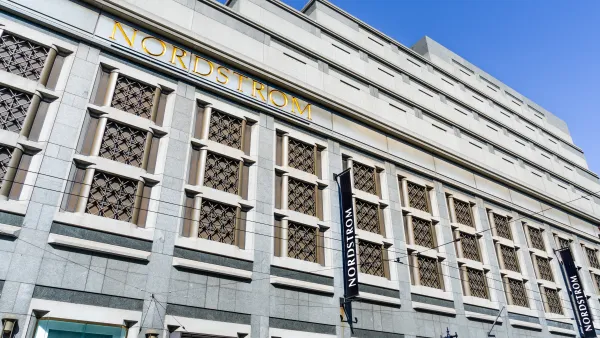
Recent Retail Closures in U.S. Cities Follow Trends Established Before the Pandemic
While some cling to debatable claims about higher crime rates as the cause for recent high-profile store closures in U.S. downtowns, the real reasons are more realistically extensions of the causes of the “retail apocalypse” from the before times.
Looking to Vacant Retail Spaces for Needed Housing Supply
The Phoenix City Council has taken the first steps toward zoning reforms that can balance out the oversupply of retail spaces at one end of the market and the lack of housing units at the other.

Planetizen Federal Action Tracker
A weekly monitor of how Trump’s orders and actions are impacting planners and planning in America.

Amtrak, CN end decades-long dispute with eight-year agreement
The new operating agreement establishes an updated framework for the companies to work together, including processes to resolve disputes.

Judges permit Denver to divert 77,000 acre feet from the Colorado River for reservoir expansion
Overuse and climate change have caused the Colorado River’s water levels to plummet.

NYC DOT wants faster, more permanent street upgrades
The city is examining ways to build more concrete infrastructure without getting entangled in 'decades-long' projects.

'Something we’ve never seen before:' rising utility rates could strain city finances nationwide
Data centers, climate change and other factors have caused utility rates in the United States to increase by 38% since 2020.

Trump to overrule local leaders, lease millions of acres of America’s Pacific Island territories’ seafloors to mining companies
International law says that the Indigenous people of America’s territories have a right to prior and informed consent regarding projects that impact their countries.

FREE Course: Walkable City 1: Why Walkability?
After describing his path towards focusing on walkability as the essence of good planning, Jeff Speck marches through his five principal reasons for making more walkable places.
Reinventing Malls: Planning Alchemy—Turning Gray Fields Into Gold
The course focuses on the opportunities and imperatives that shape reinvention of mall sites.

Harvard University Graduate School of Design
KFH Group Inc.
Greater Baltimore Committee
The Architects Foundation
University of Cincinnati Online
The Pocatello Development Authority
The Urban Renewal Agency of the City of Pocatello

