Plenty, according to Tanya Snyder, Streetsblog USA editor, who finds Obama's Grow America plan far superior. Outside of not including a gas tax to fill the Trust Fund gap, she finds the proposal "underfunded and highway centric." She is not alone.


Snyder condemns the plan drafted by the Senate Environment and Public Work's Committee (EPW) under Chairman Barbara Boxer (D-Calif.) for rejecting "pretty much everything the Obama administration put forth in its bill, including permanent funding for TIGER and the elimination of red tape that prevents states from tolling interstates. The administration called for spending $302 billion over four years, while the EPW bill envisions a $265 billion budget over six years — although that figure does not include transit or rail."
Snyder explains the complex mechanics of the path the bill must take which accounts for some of its shortcomings, particularly as it affects transit and rail.
EPW only writes the highway component of the bill, then hands it over to the Banking Committee for the transit piece and the Commerce Committee for the rail and safety piece. And of course, nothing at all will happen unless the Senate Finance Committee can find a way to pay for it.
Joshua Schank of the Eno Center for Transportation also criticized the MAP-21 Reauthorization Act (S. 2322).
“It’s disappointing that the Senate is still operating under complete modal siloes [sic] and not thinking of this as a comprehensive system in any way, shape, or form,” he said.
Snyder writes that "the EPW bill maintains the status quo right down to the level of funding, which is only adjusted for inflation" of the current MAP-21 Act and makes some minor policy changes, including:
- "(N)otable new line item is money for a national freight program."
- Increasing the federal-aid highway program while maintaining TIFIA at current levels.
- No mention of TIGER while funding the highway-centric Projects of National or Regional Significance, previously funded from General Funds.
- "(S)mall but positive changes to bike/ped funding."
However, she indicates that the policy adjustments, as bad as some of them may be, pale in comparison to finding the revenue to fill Highway Trust Fund shortfall.
And really, securing a new funding source is what the Senate has set out to achieve with this bill, more than policy reforms. (Senators) mainly just want to find new revenue for the ailing Highway Trust Fund. And with a gas tax increase [see Baltimore Sun editorial, May 13] apparently off the table and a bipartisan plan for corporate tax reform not going anywhere, the options are pretty limited."
Snyder includes an optimistic note on funding by stating that the Reauthorization Act "does try to set the table for a solution by funding studies of revenue alternatives. Vehicle-miles-traveled fees would almost certainly be on the list. So would Boxer’s preferred option of a per-barrel fee on oil."
Of course, there have been plenty funding studies and commissions, many (if not most) pointing to increasing the gas tax in the short term and converting to a mileage-based user fee in the long term. What's needed is the political will to enact them.
Read the full story: Barbara Boxer’s Transportation Bill: Same As It Ever Was

Transportation Reauthorization Bill Breezes Past First Committee
Receiving a resounding vote of confidence from the Environment and Public Works Committee, the $265 billion, six-year MAP-21 reauthorization bill advanced on its path to keep federal transportation payments going to states through the summer.
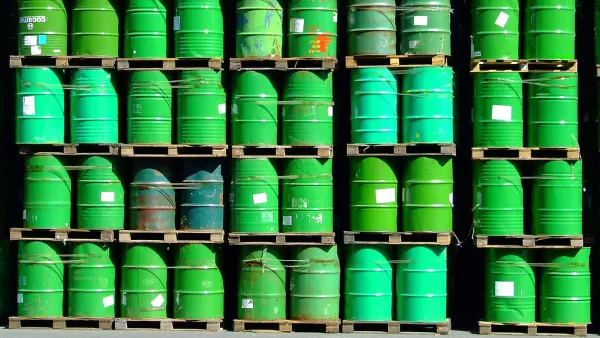
Boxer Proposes Wholesale Oil Tax to Replace Fed. Gas Tax
Taking a cue from states that have introduced new wholesale taxes on fuel that would presumably be passed to the consumer, Sen. Barbara Boxer has proposed replacing the 18.4-cent federal gas tax with an oil sales fee to be paid by oil refineries.
Transportation Think Tank Recommends Ending Highway Trust Fund
The non-partisan Eno Center for Transportation has had it with futile attempts to raise the federal gas tax and the never-ending transfers (bailouts?) from the federal general fund to keep roads and transit funded. "Pay as you go" no longer works.

Planetizen Federal Action Tracker
A weekly monitor of how Trump’s orders and actions are impacting planners and planning in America.

Amtrak, CN end decades-long dispute with eight-year agreement
The new operating agreement establishes an updated framework for the companies to work together, including processes to resolve disputes.

Judges permit Denver to divert 77,000 acre feet from the Colorado River for reservoir expansion
Overuse and climate change have caused the Colorado River’s water levels to plummet.

NYC DOT wants faster, more permanent street upgrades
The city is examining ways to build more concrete infrastructure without getting entangled in 'decades-long' projects.

'Something we’ve never seen before:' rising utility rates could strain city finances nationwide
Data centers, climate change and other factors have caused utility rates in the United States to increase by 38% since 2020.

Trump to overrule local leaders, lease millions of acres of America’s Pacific Island territories’ seafloors to mining companies
International law says that the Indigenous people of America’s territories have a right to prior and informed consent regarding projects that impact their countries.

FREE Course: Walkable City 1: Why Walkability?
After describing his path towards focusing on walkability as the essence of good planning, Jeff Speck marches through his five principal reasons for making more walkable places.
Reinventing Malls: Planning Alchemy—Turning Gray Fields Into Gold
The course focuses on the opportunities and imperatives that shape reinvention of mall sites.

Harvard University Graduate School of Design
KFH Group Inc.
Greater Baltimore Committee
The Architects Foundation
University of Cincinnati Online
The Pocatello Development Authority
The Urban Renewal Agency of the City of Pocatello