Technology
Feds Clear the Road for Self-Driving Cars
This week, the NHTSA issued the federal government's first directive on the benefits and hurdles related to the introduction of self-driving cars. The guidelines should make it easier for companies to develop autonomous technologies.
Civic Tech Leader Joins Obama Administration
Jennifer Pahlka, the founder and executive director of civic tech leader Code for America, has announced she's taking a year-long sabbatical to join the staff of the Office of Science and Technology Policy at the White House.
Is the U.S. Ready for Fuel Cell Vehicles?
Toyota is set to introduce its first fuel cell vehicles in the U.S. in 2015, which are expected to cost between $50,000 and $100,000. But will the U.S. be ready for it, i.e. will there be hydrogen fueling stations? Yes, say public officials.
Will Google Maps Destroy Public Space?
With the latest redesign of Maps, Google is personalizing the mapping experience to reflect the places we, and our friends, frequent. In doing so, will the technology giant eliminate serendipitous "entanglements" from the urban experience?
Lighting Designers Project a Bright Future for Our Cities
Utilizing new approaches and new technologies for illuminating the built environment, lighting designers are helping to create safer, more dynamic, and more accessible cities.
Atlanta Embraces Big Data
An app for locating discarded tires and a program to map the condition of the city's sidewalks are two examples of local initiatives aimed at improving Atlanta's environment. With the Mayor's embrace, the city is trying to catch up to tech trends.
Data Centers: The Next Trend in Adaptive Reuse?
Sears is planning to convert a number of its shuttered buildings into data centers. Could this become a trend for the reuse of vacant buildings nationwide?
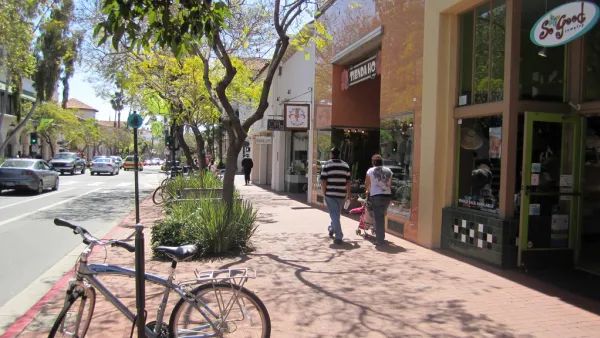
Taking the Guesswork out of Designing for Walkability
The lack of adequate pedestrian behavior models means that designing for walkability has largely remained a matter of intuition. However, agent-based simulation can provide insight into the keys for creating pedestrian-friendly places.
Cities Gain a Brain; But Will They Lose Their Souls?
In the quest to improve efficiency and effectiveness, "smart" technologies are helping cities become more intelligent machines. But a growing chorus fears the side effects of increased privatization, surveillance, and technological sophistication.
The Emancipation of Planning Education
Massive Open Online Courses (MOOCs) are an emerging trend in higher education. And for the first time a course dedicated to urban planning made its debut this month. Could this trend transform planning education?
With Major Redesign, Google Heats Up Online Map Wars
In recent months, new players like Apple and MapBox have taken aim at the increasingly important arena of digital mapping. With the boldest redesign of Google Maps in 8 years launched this week, "the leader in online mapping" isn't standing pat.
Bike Sharing Prepares to Get its World Rocked
The evolution of today's infrastructure-intensive bike sharing systems has been a hard-fought learning process; alas, the current paradigm is about to get turned on its head, and it's happening – surprise - this week in Hoboken, New Jersey.
10 Ways Civic Hacking Can Benefit Your Community
Code for America is planning a National Day of Civic Hacking next month to "promote transparency, participation and collaboration between governments and citizens." In advance of the event, they've explained how cities can benefit from civic hacking.
Electric Vehicles Are Money Losers, But That's Expected
All-electric vehicles - those without tailpipes or gas tanks, are entering the marketplace, particularly in California, but unlike other models from the same manufacturers, they are not expected to sell well. So why are they even being manufactured?
L.A. Surprising History of Transit Innovation
In recent years, Los Angeles has embraced mass transit as a solution to the city's legendary traffic woes. This embrace has historical precedent, however, says Sam Lubell, who examines six of L.A.'s unbuilt proposals for transit systems.
Stumbling Blocks on the Road to the Urban Data Revolution
Data collection and analysis promise to make our cities better, and more efficient, places to live. Though many cities are expanding their digital integration, several obstacles remain to realizing the full potential of the urban data revolution.
A Handy Tool for Making Scale Comparisons
One of the most valuable graphics in the planner's toolbox is the scale comparison. However, producing such graphics can be a tedious process. A web-based tool utilizing Google Maps seeks to make cartographic “mixtures” much easier to produce.
Consummating the Marriage Between Bikes and Geeks
There may be something to the premise that bike amenities attract young technology professionals. Jayme Moye looks at one Boulder software company that's building on the natural affinity between the two subcultures with a bike-themed hackfest.
Earth Engine: Google's Global Time-Lapse
With Earth Engine, Google has compiled decades of images taken by Earth-observing satellites. The tool is meant for "scientists, independent researchers, and nations...to detect changes, map trends and quantify differences on the Earth's surface."
Oil's Voodoo Economics: Reserves Grow As They're Depleted
Contrary to what would seem logical, estimates of oil and natural gas reserves may increase as they are depleted, as the new USGS assessment of recoverable oil reserves in the greater Bakken Basin shows. How does this square with peak oil theory?

FREE Course: Walkable City 1: Why Walkability?
After describing his path towards focusing on walkability as the essence of good planning, Jeff Speck marches through his five principal reasons for making more walkable places.
Reinventing Malls: Planning Alchemy—Turning Gray Fields Into Gold
The course focuses on the opportunities and imperatives that shape reinvention of mall sites.

City of Rosemead
Rutgers University, Edward J. Bloustein School of Planning and Public Policy
One Hundred Miles
University of Michigan School for Environment and Sustainability (SEAS)
Hunter College, City University of New York (CUNY)
The Architects Foundation
City of Cambridge
Montrose County
The Pocatello Development Authority









