Parking Requirements

Mapping the End of Parking Minimums
The high cost of free parking is almost, but not quite, common knowledge. Many, but not all, people realize the pernicious effects of parking requirements. A map can help illustrate this spreading awareness.
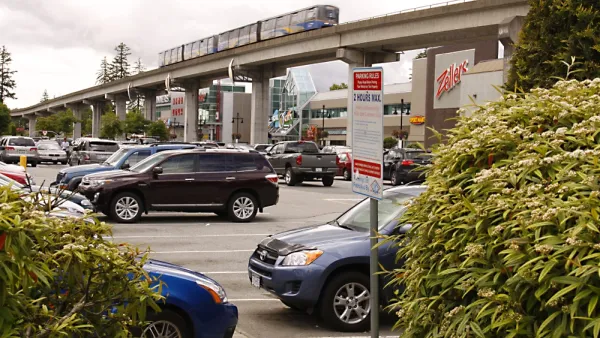
Parking Requirements at TOD Projects Remain Stubbornly Out of Sync
Transit Oriented Development projects around the country are still facing suburban-style parking requirements.
Fayetteville Ends Minimum Parking Requirements for Commercial Uses
Fayetteville, Arkansas, home to the University of Arkansas and neighbor to Bentonville, home of Walmart, has taken a national leadership role in parking policy by ending minimum parking requirements for non-residential uses.
Chicago Approves Big Expansion of TOD Ordinance
Ten times more land in Chicago is now designated for transit oriented development—affording new development reduced parking requirements, density bonuses for affordable housing, and new strength for the city's Pedestrian Street design regulations.

Can Reduced Parking Requirements Generate Too Much Development Competition?
A new argument has appeared in the ongoing debate about parking requirements. A university in a college town objected to reduced parking requirements on the grounds that it would make the city too attractive to developers.
Congestion as an Economic—Not an Engineering—Problem
Thinking about congestion as an economic problem generates new solutions for the problem as well as a response to accusations of social engineering.
Three Parking Solutions for Three Growing Cities
As a new wave of people flood cities to live, work, and play, many arrive on four wheels: cars, which are creating massive headaches for city planners and drivers.
Parking Requirements Among Changes in a Big Week for Planning in New York
Streetsblog NYC reviews new zoning and development rules proposed by the de Blasio Administration and finds incremental progress, not a major breakthrough, for parking policy.
Proposed Chicago TOD Ordinance: Increase Density, Eliminate Parking Requirements
Mayor Rahm Emanuel announced an update of the city's 2013 transit oriented development ordinance. The new version of the ordinance would have a sweeping effect on the land uses around transit stations in Chicago.
Parking, Density, and Affordable Housing in California
A bill to reduce parking minimums for residential or mixed-use developments that include affordable units passed a key Senate committee. AB 744 amends the state's density bonus law, itself controversial, that incentivizes building affordable housing.
Detaching the Family Car from Single-Family Housing
As parking reform takes to multi-family housing, the detached single family home has largely escaped discussion. Should it? Seattle (of course) is taking the lead. Also, is all of Minneapolis ready to eliminate parking minimums along transit lines?

Minneapolis Ends Parking Requirements for Transit-Adjacent Developments
Minneapolis took a large leap forward last week by approving a plan that would reduce parking requirements for transit-adjacent developments in a huge swath of the city—not just downtown.
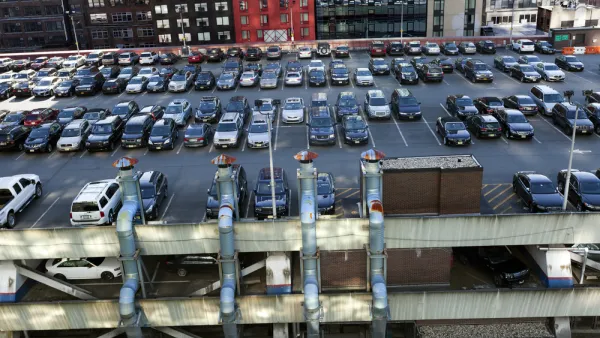
New York City Proposes Parking Requirement Overhaul
The New York Department of City Planning is working on an overhaul of its parking requirements with the potential to impact hundreds of developments.
1954 Report Explains a lot About Parking Requirements, Shopping Centers
Historic planning documents, like those found in the APA's Planning Advisory Service, are full of lessons about how past planning doctrines failed their intentions, and it's always a good time for planners to re-evaluate their antecedents.
Bike Parking Minimums Updated in Washington D.C.
Washington D.C. recently revised bike parking requirements for new or rehabilitated residential buildings, building on precedents first set in 2007.
Database Reveals Bay Area's Parking Waste
A new tool from TransForm shows where parking is underutilized in the Bay Area, even finding wasted space in a city as notorious for parking difficulties as San Francisco.

How '9x18' Parking Spaces Could Solve Affordable Housing
The "9x18" proposal by the Institute for Public Architecture provides a lesson in the relationship between parking requirements and the cost of housing.
Architects Design Fix For New York's Retro Parking Requirements
The "9x18" design team (named after the dimensions of a standard parking space) has evaluated and reimagined New York's parking regulations so they reflect actual parking demand and support affordable housing goals.
Vancouver Could Remove Parking Minimums for Condo Developments
Vancouver’s Transportation 2040 plan allowed for the easing of parking minimums for residential developments in parts of the city, and now city planners are beginning to explore where and how condos can be built without parking.
Boston Mayoral Candidates Talk Livable Streets, But Can They Walk the Walk?
At a forum held this week, Boston mayoral candidates demonstrated their fluency in the language of transportation alternatives and livable communities. But ideas for meaningful policy changes were largely missing, says Boston Streets.

FREE Course: Walkable City 1: Why Walkability?
After describing his path towards focusing on walkability as the essence of good planning, Jeff Speck marches through his five principal reasons for making more walkable places.
Reinventing Malls: Planning Alchemy—Turning Gray Fields Into Gold
The course focuses on the opportunities and imperatives that shape reinvention of mall sites.

City of Rosemead
Rutgers University, Edward J. Bloustein School of Planning and Public Policy
One Hundred Miles
University of Michigan School for Environment and Sustainability (SEAS)
Hunter College, City University of New York (CUNY)
The Architects Foundation
City of Cambridge
Montrose County
The Pocatello Development Authority









