One finding from a new statewide survey, "Californians and the Environment," suggests that the environment is becoming a more bipartisan issue, but that finding is still subject to interpretation. What isn't is the top environmental issue: water.


San Francisco Chronicle on July 25.
On a variety of California environmental issues, a solid percentage of Republicans show they’re willing to break with President Trump and his environmental policies on subjects like water policy and global warming, said Mark Baldassare, the institute’s CEO and president as well as director of the poll [and former professor of urban and regional planning at the University of California, Irvine.]
“The environment is a very personal thing in California,” Baldassare said. “Air pollution, drought, water quality and wildfires are not Republican versus Democrat issues.”
"Likely voters see drought and water supply as the top environmental issue facing the state, followed by air pollution," notes the survey summary.
As evidence of increasing support by Republicans for environmental issues, Wildermuth cites the poll's findings on Proposition 3, an $8.9 billion bond on the November ballot for a range of water projects, that has "support from 58 percent of California’s likely voters, with 25 percent opposed and 17 percent undecided. But while 72 percent of Democrats surveyed back the bond measure, what’s striking is that Republicans, despite a well-documented aversion to new spending, also support the spending, 43 percent to 38 percent."
Prop. 3 may deal with watershed conservation, but is it really an environmental measure from a political perspective? After all, the Sierra Club opposes [pdf] the measure, calling it "a fiscally irresponsible approach to California's water problems.
A large portion of the bond measure would assist farmers in the San Joaquin Valley, whose abundant use of groundwater is causing a major subsidence problem. Repairing the Friant-Kern Canal that largely delivers irrigation water to 15 water and irrigation districts would receive $350 million, with the Friant area receiving another $400 million in watershed projects.
Notwithstanding the political considerations in the water bond initiative, the PPIC "survey shows just how deeply environmental concerns are ingrained in Californians, regardless of party or ethnicity, Baldassare said.
“Many Republicans want stronger environmental protection and believe in climate change,” he said. “They’re concerned about air pollution and auto emissions.”
Up to a point, adds Wildermuth. "That doesn’t mean California Republicans are lining up to join the Sierra Club. While 82 percent of Democrats and 66 percent of independents surveyed were opposed to allowing more oil drilling off the California coast, 54 percent of GOP adults were in favor of it."
It should be noted that opposition to offshore drilling is bipartisan in states such as New Jersey and Florida.
The survey also found that black and Latino voters placed greater priority on climate change and air pollution than the state's white voters.
Dan Morain also writes on the PPIC survey and Prop. 3 for CALmatters.
FULL STORY: Poll shows surprising GOP tilt toward environmental issues in California

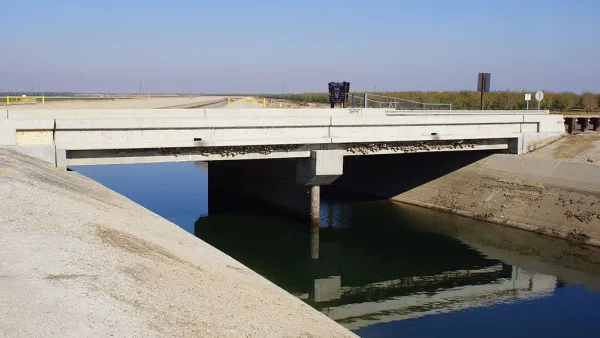
Voters to Decide on Repair of Vital Aqueduct for San Joaquin Valley
California voters in November will have the opportunity to help repair the Friant-Kern Canal, damaged by subsidence, as well as invest in watershed conservation programs, by passing a citizen-initiated $8.9 billion general obligation bond measure.
California Gas Tax Supporters Get Good News from Latest Voter Survey
In a turnaround from prior voter surveys, a poll released Wednesday on November propositions found a slim majority of voters opposed to repealing the state's first legislative gas tax increase since 1989. Rent control opponents received good news too
Calls for Environmental Action Increasing as Coronavirus Lingers
We can't go back to the way of life that makes pollution and climate change acceptable, according to multiple articles published on and around Earth Day. It's time for change.

The state-sanctioned urbicide of Austin
People don’t kill cities. Freeways do.

US to reduce Colorado River water deliveries to Mexico
A new Colorado Treaty amendment reduces Mexico’s Colorado River water allocation by 250,000 acre feet.

New Jersey’s second-largest city bans standalone data centers
Jersey City will continue to allow co-location facilities, such as those meant for research institutions that store their own data.

Amtrak not solely to blame for New Jersey commuter rail's unreliability, report finds
A new study from the Garden State Initiative found that NJ Transit’s budget grew 20% across a 4 year period, but reliability declined significantly over the same period.

EPA erases limits on planet-warming pollution from power plants
Under Monday’s plan, power plants would still have some limits on how much mercury, arsenic and other contaminants they can emit.

Phoenix announces new on-demand transit service, more frequent RAPID buses
Both new services will launch in October, and are part of Phoenix's Project Effective Access Solutions for Easing Congestion.

FREE Course: Walkable City 1: Why Walkability?
After describing his path towards focusing on walkability as the essence of good planning, Jeff Speck marches through his five principal reasons for making more walkable places.
Reinventing Malls: Planning Alchemy—Turning Gray Fields Into Gold
The course focuses on the opportunities and imperatives that shape reinvention of mall sites.

Eagle County Government
Harvard University Graduate School of Design
Nashville Planning Department
The Architects Foundation
University of Cincinnati Online
The Pocatello Development Authority
The Urban Renewal Agency of the City of Pocatello
Journal of the American Planning Association