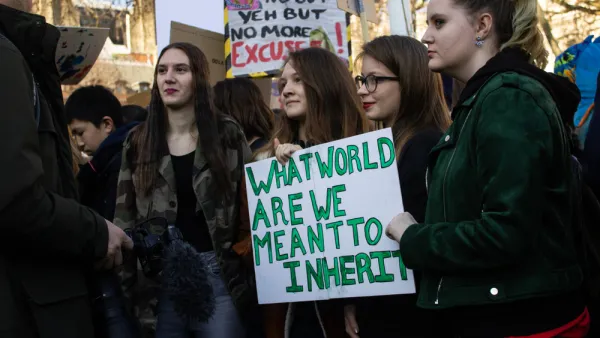
Strike three for the federal government in trying to dismiss a lawsuit launched by 21 children in Oregon who sued the Obama administration in 2015, claiming the government was endangering their future because of its failure to reduce climate change.



The Trump administration is not faring as well as major fossil fuel companies who successfully dismissed climate change lawsuits directed against them in federal courts in San Francisco last month and in New York City on July 19. The plaintiffs the administration faces are aged 10 to 21, almost three years older when they originally filed suit.
On July 20, the Ninth U.S. Circuit Court of Appeals in San Francisco rejected the Trump administration’s second attempt to dismiss Juliana v. United States [pdf], a court case filed August 12, 2015, in U.S. District Court for Oregon by Eugene-based Our Children's Trust and Boulder, Colo-based Earth Guardians on behalf of 21 youths.
"Their complaint asserts that, through the government's affirmative actions that cause climate change, it has violated the youngest generation’s constitutional rights to life, liberty, and property, as well as failed to protect essential public trust resources," according to Our Children's Trust.'
"The suit relies on the 'public trust' doctrine, which holds the government responsible for managing natural resources, such as air, land and water, for the benefit of the people," reports Bob Egelko, court reporter for the San Francisco Chronicle, on July 20. "If they prove constitutional violations, the youths want the courts to order the government to establish a carbon-free energy system by midcentury."
It was the Obama administration that first attempted to dismiss the case. CNN reported on Nov. 10, 2016, that Judge Ann Aiken of the U.S. District Court of Oregon denied [pdf] their motion.
In February 2017, "the young people asked their lawyers to go to court and substitute Trump for Obama," reported The Chronicle.
Egelko reported the following month on the Trump's first failed attempt to dismiss Juliana v the U.S.
The Ninth U.S. Circuit Court of Appeals in San Francisco did not delve into the merits of the lawsuit, saying those could be addressed, along with the government’s legal challenges, by the presiding judge as the case proceeds. But by denying the Trump administration’s request to dismiss the suit, the appellate panel moved the suit one step closer to trial in federal court in Oregon.
“There will now be a full trial on climate science and what our federal government did to create this dangerous situation," said Julia Ann Olson of Wild Earth Advocates, lead attorney for the youths.
Olson is now executive director and chief legal counsel for Our Children's Trust.
Fast forward to July 20: The Trump "administration has already asked the U.S. Supreme Court to intervene," adds Egelko.
The administration’s filing this week argued that youths’ “alleged injuries” stem from “emissions from every source in the world over decades,” and that Americans have no constitutional right to “certain climate conditions.”
Asked for comment, the Justice Department referred a reporter to its pending Supreme Court appeal [pdf]. The appeal said the suit was “an attempt to redirect federal environmental and energy policies through the courts rather than through the political process, by asserting a new and unsupported fundamental due process right to certain climate conditions.”
They may find the nation's highest court more receptive than the Ninth Circuit. In his ruling to dismiss New York City's climate change lawsuit against five of the world's largest oil companies, Southern District Court of New York Judge John F. Keenan asserted that "global warming should be solved by Congress and the president—not by the courts."
Then again, Keenan also stated that climate change was not contested by the fossil fuel companies named in the suit, unlike members of the Trump administration as well as the president himself.
Unless the Supreme Court rules otherwise, a trial is set to begin Oct. 29 at the U.S. District Court of Oregon in Eugene.
Correspondent's note: Our Children's Trust lists links to extensive media coverage of Juliana v. United States and other environmental litigation they filed on behalf of children dating back to 2011.
FULL STORY: Court rejects Trump administration’s request to block climate change trial

The Climate Change Lawsuit That Won't Go Away
The now-famous children's lawsuit, featured on 60 Minutes last Sunday, was not filed against President Trump—he just inherited it from his predecessor. Both administrations have tried to have the case dismissed.

Federal Appeals Court Orders EPA to Ban Harmful Pesticide
The ruling puts another stain on former EPA Administrator Scott Pruitt's legacy as it rebukes his denial of a petition to ban a pesticide that causes neurodevelopmental damage in children. Pruitt had rejected his own scientists' recommendation.

Another Major Climate Win for Big Oil in Federal Court
A New York federal district court rules on a climate change lawsuit like its West Coast counterpart did last month: Don't hold oil companies accountable for climate change and sea level rise. Baltimore and Rhode Island file climate change lawsuits.

Planetizen Federal Action Tracker
A weekly monitor of how Trump’s orders and actions are impacting planners and planning in America.

The state-sanctioned urbicide of Austin
People don’t kill cities. Freeways do.

US to reduce Colorado River water deliveries to Mexico
A new Colorado Treaty amendment reduces Mexico’s Colorado River water allocation by 250,000 acre feet.

5 New England states march closer to 800 megawatt wind energy project
Securing federal approval for the project may be complicated under the Trump administration, which has historically been hostile towards domestic wind power.

Baltimore to break ground on $50 million Transit Priority Project
The project will bring faster bus trips, safer streets and better bike connections to Baltimore.

Airbnb launches $250 million 'last-dollar financing' housing accelerator, makes first investment in Austin
The company will put $6.4 million towards affordable housing development in Texas’ capital.

FREE Course: Walkable City 1: Why Walkability?
After describing his path towards focusing on walkability as the essence of good planning, Jeff Speck marches through his five principal reasons for making more walkable places.
Reinventing Malls: Planning Alchemy—Turning Gray Fields Into Gold
The course focuses on the opportunities and imperatives that shape reinvention of mall sites.

Eagle County Government
Harvard University Graduate School of Design
Nashville Planning Department
The Architects Foundation
University of Cincinnati Online
The Pocatello Development Authority
The Urban Renewal Agency of the City of Pocatello
Journal of the American Planning Association