A new report from the Human Rights Council of the United Nations chastises the United States for allowing so many Americans to live in poverty.


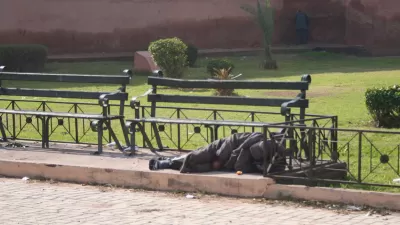
"A new United Nations report is getting plenty of national media attention for predicting President Trump will exacerbate hardships for America's poor by weakening the nation's safety net," reports Jeff Stein.
Here are the headlining stats about the conditions of poverty in the United States:
- 40 million Americans living in poverty.
- 18.5 million Americans living in "extreme poverty."
- 5 million Americans living in "Third World conditions of absolute poverty."
- 13.3 million American children living in poverty.
The report, titled "Report of the Special Rapporteur on extreme poverty and human rights on his mission to the United States of America" [pdf], is notable for also describing worsening conditions for impoverished Americans even before the Trump Administration came into power. "These statistics largely 'could not reflect the policies of the Trump administration,' since the best existing poverty data predates his inauguration, said the author of the report, Philip Alston, U.N. special rapporteur on extreme poverty and human rights, in an interview," writes Stein. Still, the report says the poverty and human rights failings of the United States is the fault of the political class, and experts are already following up the findings of the report with predictions that Trump Administration will exacerbate the problems of poverty, despite the improving economy.
Read the full story: An explosive U.N. report shows America’s safety net was failing before Trump’s election

European Union Takes Initial Step to Ban Russian Energy Imports
After a second day of talks in Brussels, ambassadors to the European Union agreed to ban coal imports from Russia as evidence of widescale atrocities committed by Russian troops in Ukraine surfaced after their withdrawal from the outskirts of Kyiv.
Is Housing a Human Right?
Advocates around the country, and around the world, think so, and they're making their case from Southern California to Scotland and South Africa.
Human Rights Violations in NY's Affordable Housing?
The United Nations has appointed a special envoy to evaluate whether lack of access to affordable housing in New York is so bad it violates basic human rights.

Planetizen Federal Action Tracker
A weekly monitor of how Trump’s orders and actions are impacting planners and planning in America.

California plans to bury El Niño’s downpour
If the state plays its cards right, it may be able to store a billion acre-feet of El Niño’s water in aquifers.

Desperate measures: Advocates weigh draining Lake Powell to fill Colorado River
Draining the reservoir could reduce evaporation losses by a couple hundred thousand acre-feet.

Mamdani’s pied-à-terre tax survives legal challenge
A panel of judges found that the plaintiffs failed to demonstrate injury as a result of New York City's implementation of the tax.

Eastern Nebraska is running out of electricity
Data centers and electrification are straining eastern Nebraska’s grid, throttling economic development.

Seattle passes record-breaking transit services expansion
Proposition 1 will double the city’s transit tax to add 95,000 more bus trips and preserve 180,000 bus trips annually.

FREE Course: Walkable City 1: Why Walkability?
After describing his path towards focusing on walkability as the essence of good planning, Jeff Speck marches through his five principal reasons for making more walkable places.
Reinventing Malls: Planning Alchemy—Turning Gray Fields Into Gold
The course focuses on the opportunities and imperatives that shape reinvention of mall sites.

City of Rosemead
Rutgers University, Edward J. Bloustein School of Planning and Public Policy
One Hundred Miles
University of Michigan School for Environment and Sustainability (SEAS)
Hunter College, City University of New York (CUNY)
The Architects Foundation
City of Cambridge
Montrose County
The Pocatello Development Authority