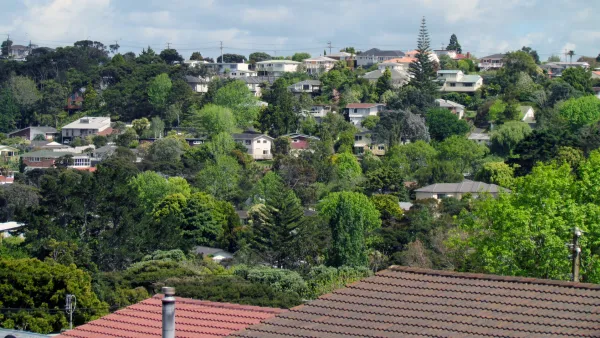
In Seattle, most (88 percent) of the city's new housing is being developed in a few small, already dense areas around the city. Most of the city is reserved for single-family housing.



Mike Rosenberg takes a deep dive into zoning in the city of Seattle to examine how it has contributed to the city's skyrocketing residential real estate market. The questioned examined in the article is, "how much of Seattle’s housing is traditional, suburban-style single-family homes, and how that has affected our growth and housing prices."
Rosenberg's analysis finds that with 69 percent o fits residential lots devoted to single-family housing, Seattle's use of residential land is akin to much smaller cities, "[b]ut compared to other peer cities with expensive housing, Seattle generally devotes a lot more of its housing to single-family homes…"
After explaining the residential make-up of the city in other terms, Rosenberg digs into the concept of zoning, which is described as the "whole game" when it comes to housing. According to Rosenberg, because most of the city is limited to single-family zoning, and new buildings have only been added in already dense area, most of the city is not growing in the sense of the size and total of its buildings. That reality has implications for both the homeownership and rental markets, which Rosenberg examines in more detail in the article.
For more on potential changes to the land use scheme currently controlling the market in Seatte, see analysis from March of a proposal to expand the more dense "urban villages" where most of Seattle's growth is located as part of the city's Housing Affordability and Livability Agenda.
FULL STORY: Rapidly growing Seattle constrains new housing through widespread single-family zoning

Upzoning of Seattle's Single-Family Zoning Called a 'Disappointing Half-Measure'
A critical analysis of a proposal that would incrementally increase density in parts of Seattle.

Lesson from Seattle: Zoning Is a Political Debate, Not a Policy Debate
The swift rejection of a proposal to upzone residential neighborhoods in Seattle inspired The Urbanist to evaluate the lessons of the episode. One takeaway: don't demonize single-family homeowners.
Can Seattle Solve the Affordable Housing Crisis With Zoning?
Seattle returns to zoning as a tool to promote the construction of affordable housing.

Planetizen Federal Action Tracker
A weekly monitor of how Trump’s orders and actions are impacting planners and planning in America.

The state-sanctioned urbicide of Austin
People don’t kill cities. Freeways do.

US to reduce Colorado River water deliveries to Mexico
A new Colorado Treaty amendment reduces Mexico’s Colorado River water allocation by 250,000 acre feet.

5 New England states march closer to 800 megawatt wind energy project
Securing federal approval for the project may be complicated under the Trump administration, which has historically been hostile towards domestic wind power.

Baltimore to break ground on $50 million Transit Priority Project
The project will bring faster bus trips, safer streets and better bike connections to Baltimore.

Airbnb launches $250 million 'last-dollar financing' housing accelerator, makes first investment in Austin
The company will put $6.4 million towards affordable housing development in Texas’ capital.

FREE Course: Walkable City 1: Why Walkability?
After describing his path towards focusing on walkability as the essence of good planning, Jeff Speck marches through his five principal reasons for making more walkable places.
Reinventing Malls: Planning Alchemy—Turning Gray Fields Into Gold
The course focuses on the opportunities and imperatives that shape reinvention of mall sites.

Eagle County Government
Harvard University Graduate School of Design
Nashville Planning Department
The Architects Foundation
University of Cincinnati Online
The Pocatello Development Authority
The Urban Renewal Agency of the City of Pocatello
Journal of the American Planning Association