Unlike banning sales of new internal combustion vehicles at a future date, the German court ruling applies to the operation of older, diesel-powered cars in the country's most polluted cities. It's up to the cities, though, to enact the bans.


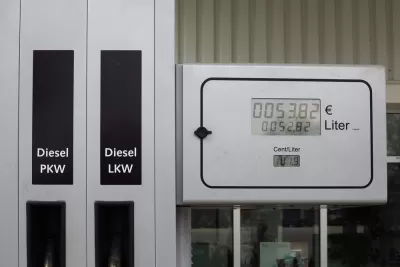
"The days of flooding the inner cities with poisonous diesel emissions are over,” said Jürgen Resch, managing director of Deutsche Umwelthilfe. “These vehicles have no place in our cities anymore.”
The environmental and consumer rights organization had initiated the lawsuit, reports Melissa Eddy for The New York Times on the Feb. 27 ruling. The court case pitted environmentalists against auto manufacturers, as the photo taken outside the courthouse in Leipzig, Germany on Feb. 22 shows.
Frustrated with the lack of progress in improving air quality in about 70 of the country’s most polluted cities, the group brought lawsuits against several local governments, demanding that they uphold the air quality standards set by the European Union. In some instances, cities found that the only way to ensure those standards were met involved banning certain vehicles — mostly older diesel models — from city streets.
“Limited bans for certain diesel cars are within the law,” the court said in its ruling, as one way to allow cities to meet the limits on the emissions of nitrogen oxide established by the European Union in 2010.
Age of the vehicle is critical to emissions output
The court further found that when emissions exceeded the allowed limits, banning all vehicles with diesel motors older than those approved in 2014 and gasoline-burning engines older than those approved in 2001 was the only way for the municipal authorities to ensure air quality.
The ruling called for “proportionality,” stipulating that only older models with the highest emissions could be subject to such bans...
Resch of Deutsche Umwelthilfe stated that he expected the ruling to take effect this fall in two of the nation's most polluted cities, Düsseldorf and Stuttgart.
Eddy also writes about Volkswagen's "dieselgate" scandal, as it was called in the U.S., exposed in September 2015 that has led to multi-billion dollar settlements.
Katrin Bennhold, also of the Times, reports on the court ruling as well, with a focus on how it affects German's auto industry and Stuttgart, home of Daimler AG, in particular. ”Industry leaders were stunned," she writes.
“It is the latest wake-up call for the German auto industry and German politicians,” said Christoph Bals, policy director of Germanwatch, an advocacy and research group for clean energy. “And this time it might actually force them to change their ways.
Chancellor Angela Merkel has sided with industry. “We will use all our power to prevent such bans,” she told Parliament ahead of elections last September.
Welcome to the club
German cities now can join others that have enacted partial diesel car bans, including Milan and Delhi. Also on Feb. 27, Mayor Virginia Raggi of Rome announced "plans to ban diesel cars from the [city] centre by 2024," according to Reuters. Unlike the German court ruling, the ban will apply to all diesel cars regardless of age.
Hat tip to MTC-ABAG Library.
Read the full story: German Court Rules Cities Can Ban Vehicles to Tackle Air Pollution


More Diesel Driving Bans Coming to German Cities
Germany's automotive industry and Chancellor Angela Merkel are increasingly worried about the economic effects of court-sanctioned diesel driving bans to improve air quality, as enacted in Hamburg last May. Four more cities are likely to enact bans.
Inadequate Diesel Vehicle Testing Results in 38,000 Global Fatalities Annually
While the study stems from research that found Volkswagen diesel cars had used 'defeat devices' to pass emissions tests, the new study points to inadequacies in the tests themselves, resulting in 50 percent higher pollution than testing permits.

Hooked on Russian Gas
The EU relies on Russia for 45% of its natural gas imports and 27% of its crude oil imports. Germany's dependency is a major reason why it won't ban these imports despite Russia's war in Ukraine. Two natural gas pipelines explain part of the problem.

Planetizen Federal Action Tracker
A weekly monitor of how Trump’s orders and actions are impacting planners and planning in America.

California plans to bury El Niño’s downpour
If the state plays its cards right, it may be able to store a billion acre-feet of El Niño’s water in aquifers.

Chicago breaks ground on $3 billion megadevelopment
The new neighborhood, titled Foundry Park, will one day host 3,700 residences.

California High-Speed Rail Authority CEO resigns after $600,000 scandal
Under Ian Choudri, the authority used taxpayer dollars to fund first class flights and trips to nightclubs.

Want to study the Missouri River? Soon, you may need unanimous approval from 10 states
Legislation would require 10 governors’ permission to study or build projects moving water outside the basin.

Desperate measures: Advocates weigh draining Lake Powell to fill Colorado River
Draining the reservoir could reduce evaporation losses by a couple hundred thousand acre-feet.

FREE Course: Walkable City 1: Why Walkability?
After describing his path towards focusing on walkability as the essence of good planning, Jeff Speck marches through his five principal reasons for making more walkable places.
Reinventing Malls: Planning Alchemy—Turning Gray Fields Into Gold
The course focuses on the opportunities and imperatives that shape reinvention of mall sites.

City of Rosemead
Rutgers University, Edward J. Bloustein School of Planning and Public Policy
One Hundred Miles
Hunter College, City University of New York (CUNY)
The Architects Foundation
University of Cincinnati Online
City of Cambridge
Montrose County
The Pocatello Development Authority