A study from the USGS using five decades of data shows salinity and alkalinity are up in waterways across the United States.



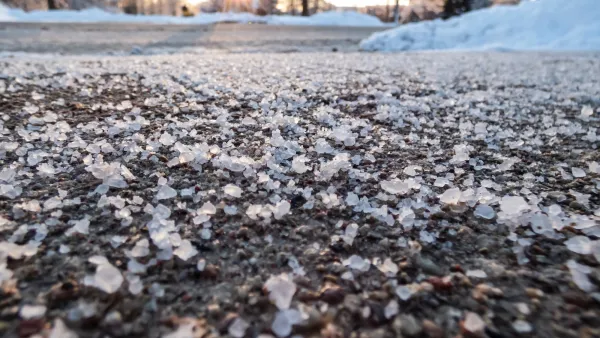
According to a study published in Proceedings of the National Academy of Sciences, as reported by Don Hopey, “sodium chloride’s use to melt snow and ice also has a big, long-term and wide-ranging ecological downside.”
The unintended consequences of road salt are not breaking news (In Canada, it’s a regulated toxin), and this is the second study on the topic published in PNAS in the last year. But this is the first to "assess the extended changes in freshwater salinity and alkalinity across the continent."
The study also touches on the effects of fertilizer and runoff from mining operations, both of which are contribute significantly to the study’s findings in the agricultural areas of the Midwest.
In the cities, however, salt remains the primary culprit. Hopey writes:
“Waterway contamination from road salt is particularly bad in urban areas, and because it’s transported more easily than sodium, chloride is the greater concern, according to the USGS. An estimated 40 percent of the nation’s urban streams have chloride levels that endanger their aquatic life, largely because of road salt.”
Strategies to mitigate the effects of road salt include pre-salting and beet juice (but likely not sand) as well as technological advances Hopey details after speaking with an official from the Pennsylvania Department of Transportation.
But regardless of what happens in the future, planners will have to grapple with the fact that "many of the nation’s major rivers and river systems, including the Hudson, Potomac, Canadian, Chattahoochee and Mississippi" have endured "significant changes" to their ecology over the last five decades.
Read the full story: Road salt has long-term effect on rivers, study finds

Inside the Initiative to Protect Lake George by Reducing Road Salt
Ten years after launching a plan to cut salt pollution, Lake George is seeing results, and the model is spreading across the country and beyond.
New Non-Salt Strategies for Snowy Cities
Winter brings snowy conditions to roads in many cities, and many react with snow-melting salt solutions. But the physical and environmental damage of salt is leading some to look for other means of fighting the freeze.
Rain gardens keep up to 99% of pollutants out of San Francisco Bay
The city's roadside rain gardens soak up stormwater and filter out dozens of harmful micropollutants.

Planetizen Federal Action Tracker
A weekly monitor of how Trump’s orders and actions are impacting planners and planning in America.

The state-sanctioned urbicide of Austin
People don’t kill cities. Freeways do.

US to reduce Colorado River water deliveries to Mexico
A new Colorado Treaty amendment reduces Mexico’s Colorado River water allocation by 250,000 acre feet.

Nation's most wind-powered state turns to coal as data centers increase energy demand
For the first time in decades, Iowa has increased its generation of coal power.

NYC cools commuters with city's first rain garden above a bus stop
New York City officials say the plants in the rain garden can absorb 16 gallons of rainwater during heavy storms.

Brightline West’s future may rely on $6 billion federal loan
The company has until Nov. 2 to make a $400 million equity investment into its proposed high-speed rail line.

FREE Course: Walkable City 1: Why Walkability?
After describing his path towards focusing on walkability as the essence of good planning, Jeff Speck marches through his five principal reasons for making more walkable places.
Reinventing Malls: Planning Alchemy—Turning Gray Fields Into Gold
The course focuses on the opportunities and imperatives that shape reinvention of mall sites.

Greater Baltimore Committee
Eagle County Government
Harvard University Graduate School of Design
The Architects Foundation
University of Cincinnati Online
The Pocatello Development Authority
The Urban Renewal Agency of the City of Pocatello
Journal of the American Planning Association