Crude oil from Kern County's Belridge field will soon have a much lower life cycle carbon intensity thanks to new solar technology used to extract hard-to-get oil. The renewal of California's carbon cap-and-trade market made it possible.


"The Belridge oil field near Bakersfield [Kern County] is one of the largest in the country," reports writes about energy and the environment at The Washington Post,
become the industry's equivalent to "clean coal" due to the use of renewable solar power. But first, a little history to understand the extraction process.
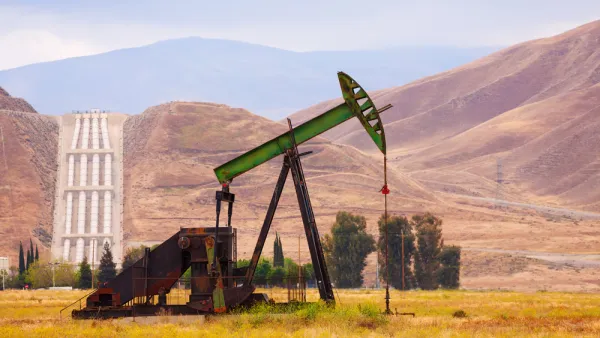
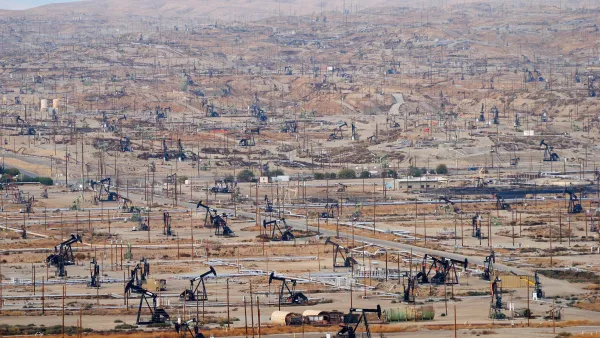
The Belridge field was discovered in 1911. Oil from the field flowed out of the ground because of natural pressure in the geologic reservoirs. Later, as the pressure declined, many companies said the field was exhausted. But in the 1960s, a process known as enhanced oil recovery gave the field new life. But squeezing more crude oil from the Belridge requires large amounts of steam to help loosen up the heavy crude, which in turn requires energy.
Enhanced oil recovery (EOR) is not fracking. The process extends the life of existing wells, but it is energy intensive, and that's where solar power comes into play. Aera has partnered with Fremont, Calif.-based GlassPoint Solar to replace the natural gas used to produce steam needed for the extraction process with a large, 850-megawatt solar thermal array.
The solar thermal array will capture the sun’s energy using curving mirrors that are enclosed in a greenhouse and then use that energy to heat water. In addition, there will be a smaller, 26.5-megawatt solar photovoltaic installation to help power oil field operations. The project should start operations by 2020, the participating companies said.
The critical role played by cap-and-trade
"The project was made possible by the recent extension of California’s cap-and-trade system for carbon-dioxide emissions until 2030, said Christina Sistrunk, chief executive of Aera Energy," adds Mooney. Hard-fought legislation, with the support of the business community, to renew cap-and-trade beyond 2020 was signed by Gov. Jerry Brown in July.
“We need some level of what I would call regulatory and legislative stability to be able to fund projects that really need a couple of decades worth of certainty to be economic,” said Sistrunk. “The extension of that program really underpinned our ability to make this long-term commitment.”
Solar power will eliminate the emission of 376,000 tons of carbon in the EOR process, which Aera can capitalize in the cap-and-trade market.
Caifornia's carbon-intensive oil
Some critics of cyclic-steam injection wells in Santa Barbara and San Joaquin counties compare the energy-intensive, high-emissions process to extraction of bitumen in the Alberta tar sands, a form of which is used there. It is true, though, that the oil "is some of the heaviest and most carbon intensive in the world, primarily because of this need for intense heating,” said Timothy O’Connor, director of the California oil and gas program at the Environmental Defense Fund.
“So while we are producing that oil, I think there’s going to be a drive to find solutions that reduce the embedded emissions.”
Other solar thermal EOR operations
A 2011 Planetizen post reported on a pilot project set to launch in Coalinga (Fresno County), Calif. The 29 megawatt, Chevron/BrightSource Solar-to-Steam Demonstration Facility operated successfully from 2011 to 2014. At the time, it was the world's largest solar thermal EOR operation. The Belridge facility will be 29 times greater, but it won't be the biggest. That title goes to GlassPoint's 1-gigawatt (1,021MW) Maraah project in Oman on the Arabian Peninsula, now under construction.
FULL STORY: One of the country’s biggest oil fields just turned to an unexpected power source: Solar

New Oil and Gas Drilling in California May Be Subject to Moratorium
Gov. Gavin Newsom pleased environmentalists by doing what his predecessor, Gov. Jerry Brown, refused – halting all new oil and gas fracking and placing a moratorium on another extraction method linked to a massive oil spill in Kern County.
The ‘Necessity of Oil and Gas Drilling’
The California Supreme Court on Aug. 3 unanimously overturned a successful 2016 Monterey County ballot measure that banned new oil and gas drilling. According to plaintiff Chevron USA, the justices recognized the ‘necessity of oil and gas drilling.’

California Legislature Approves Continuation of Cap-and-Trade Program
The nation's only state-run, market-based program to reduce greenhouse gas emissions will continue until 2031 without fear of litigation, as it passed with the required two-thirds supermajority needed for tax increases, along with two related bills.

Planetizen Federal Action Tracker
A weekly monitor of how Trump’s orders and actions are impacting planners and planning in America.

The state-sanctioned urbicide of Austin
People don’t kill cities. Freeways do.

US to reduce Colorado River water deliveries to Mexico
A new Colorado Treaty amendment reduces Mexico’s Colorado River water allocation by 250,000 acre feet.

5 New England states march closer to 800 megawatt wind energy project
Securing federal approval for the project may be complicated under the Trump administration, which has historically been hostile towards domestic wind power.

Baltimore to break ground on $50 million Transit Priority Project
The project will bring faster bus trips, safer streets and better bike connections to Baltimore.

Airbnb launches $250 million 'last-dollar financing' housing accelerator, makes first investment in Austin
The company will put $6.4 million towards affordable housing development in Texas’ capital.

FREE Course: Walkable City 1: Why Walkability?
After describing his path towards focusing on walkability as the essence of good planning, Jeff Speck marches through his five principal reasons for making more walkable places.
Reinventing Malls: Planning Alchemy—Turning Gray Fields Into Gold
The course focuses on the opportunities and imperatives that shape reinvention of mall sites.

Eagle County Government
Harvard University Graduate School of Design
Nashville Planning Department
The Architects Foundation
University of Cincinnati Online
The Pocatello Development Authority
The Urban Renewal Agency of the City of Pocatello
Journal of the American Planning Association